


Iran Renews Threats and Says it Turned Back Ships After US Sinks Tanker
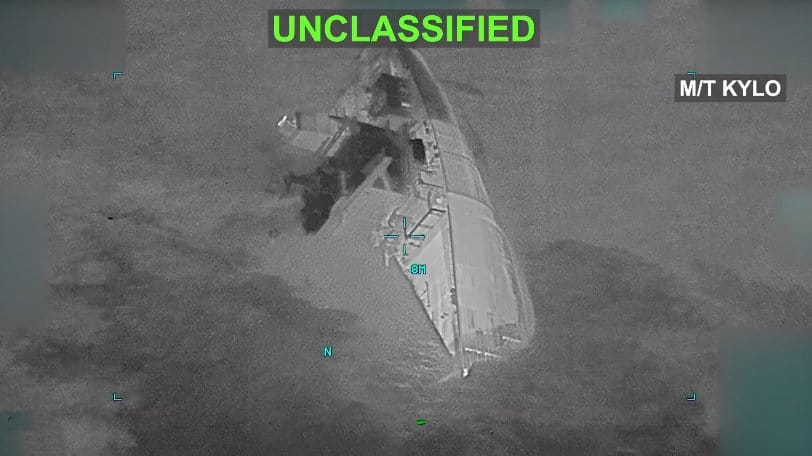
The Islamic Revolutionary Guard Corps Navy unleashed a series of threats at commercial shipping and claimed to have attacked U.S. Navy assets in response to the U.S. accounts of attacking three tankers. U.S. Central Command later released a video showing one of the tankers sinking as the level of tit-for-tat attacks increased.
The IRGC Navy asserted in a statement on Sunday that it had targeted three tankers in response to the U.S. attack on three tankers. It claimed the vessels were attempting an unauthorized passage of the Strait of Hormuz and were “affiliated” with the United States. It also “issued a firm warning to all vessels in the Persian Gulf and near the Strait of Hormuz.” It demanded the vessel “refrain from any suspicious movements aimed at crossing unauthorized waterways,” saying those vessels would be targeted.
Iran later expanded the claims to say it had also attacked a U.S. naval drone and an American military unmanned surface vessel. It claimed the vessel was attempting to enter the Strait of Hormuz.
A deputy political commander of the IRGC Navy, Ali Mohammadi, asserted that recently, between two and five non-compliant vessels have been targeted daily. He repeated the claim that Iran has full control of the Strait of Hormuz, which was later reiterated in social media postings from Iran’s embassies.
When we say the Strait of Hormuz is closed, we mean it.
— Iran Embassy SA (@IraninSA) September 6, 2026
Do not listen to the great lier. pic.twitter.com/qpaT5dakcl
The later reports evolved Iran’s targeting to having turned back at least three tankers from attempting transits on the southern route through the Strait of Hormuz. Route tracking data appeared to confirm the product tankers Velos (74,900 dwt) and Bravo (10,000 dwt) had turned back and are anchored in the Persian Gulf. The Qatari LNG gas carrier Al Sheehaniya (122,000 dwt) also approached from the Gulf of Oman but reversed course.
Velos is a Greek-owned product tanker registered in the Marshall Islands. Bravo is a small, Liberian-flagged chemical tanker, while Al Sheehaniya is registered in the Marshall Islands and managed by Qatar’s Nakilat Shipping.
CENTCOM denied the reports of new attacks on American assets, after it said on Saturday it struck three tankers in retaliation for Iran firing anti-ship ballistic missiles at an aircraft carrier and a guided-missile destroyer.
Thanks to the precision and professionalism of American service members, the M/T Kylo sank in the Gulf of Oman today and joined Iran’s navy at the bottom of the sea. pic.twitter.com/OwSDMl8SSQ
— U.S. Central Command (@CENTCOM) September 6, 2026
CENTCOM’s initial report said the tanker Kylo (IMO: 9189146), which also used the name Noxen, was “inoperable” and “completely destroyed.” The 160,573-dwt tanker was reported to have been empty, and the crew was directed to abandon ship. The 2001-built tanker was sanctioned previously by the U.S. and was falsely sailing under the flag of Comoros after being acquired by unknown interests in 2024.

that matters most
Get the latest maritime news delivered to your inbox daily.
In a later video posted on social media, CENTCOM said, “Thanks to the precision and professionalism of American service members, the M/T Kylo sank in the Gulf of Oman today and joined Iran’s navy at the bottom of the sea.”
Iranian media also provided additional details on the U.S. strike on the tanker Downy (296,977 dwt), which was hit off Kharg Island. The 2004-built tanker, registered in Iran and under U.S. sanctions, reportedly was struck by four projectiles fired by U.S. forces. CENTCOM said the tanker was “permanently disabled,” while Iranian media confirmed that the crew was being evacuated.
