


Houthis Consolidate Gains and Pause Before the Next Push
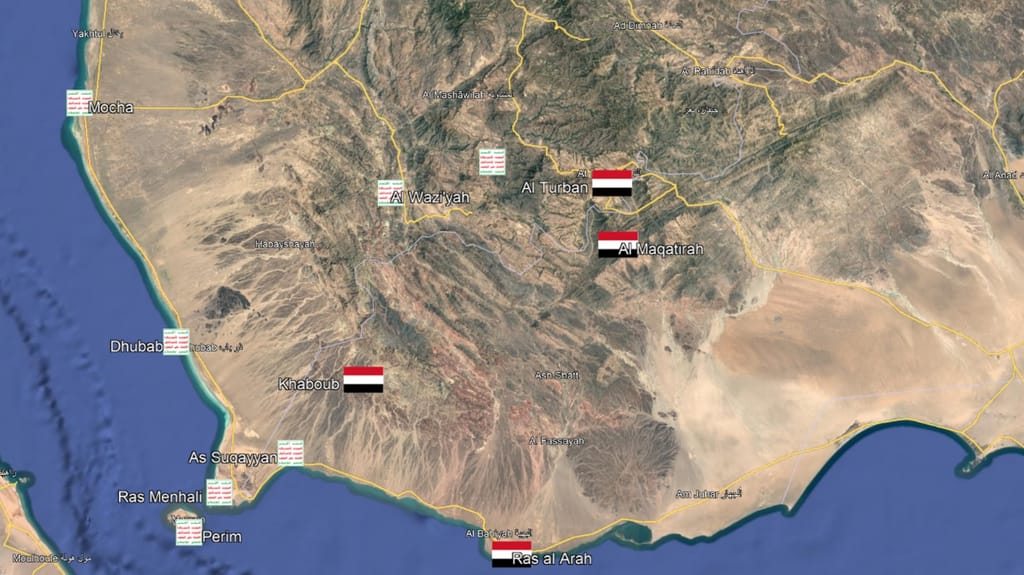
A week after Yemen's Houthi rebels broke through the forces of the Internationally Recognized Government (IRG), the situation in South West Yemen appears to have settled. Having taken Perim Island and captured the Ras Menhali peninsula overlooking the Red Sea at its narrowest point, the Bab el Mandeb, and having faced some limited push-back, the Houthi forces are now consolidating their positions.
The Houthi hold on the Ras Menhali peninsula is for the moment still tenuous, as will be their grip on Perim Island, because these locations need resupply over exposed lines of communication, and IRG forces still control overlooking high ground in the hills immediately to the east.
Houthi front-line positions are being reinforced with tunneling and defensive positions, which will make the Houthis harder to dislodge as time goes by. In the rear, in newly-captured areas, the Houthis are consolidating their position both socially and politically, setting up municipal administrations, arresting political opponents, imposing taxes and establishing local policing, all hallmarks of a take-over which had been well-planned in advance and for which the Houthis had a plan. The Tihama coast is tribally connected to areas further north up the coast which have been in Houthi hands for some time, and the Houthis are exploiting these tribal connections to consolidate their political control.
The Houthi military success in this move south can be attributed firstly to Houthi strengths, based on clear ideology, the elimination of internal opposition and unity of purpose. In contrast, the forces of the IRG in the area were split between three factions, operating under the loose umbrella of the National Resistance Forces led by Tareq Saleh. General Tareq Saleh proved to be a more active commander than many of the others within the IRG military structure, but as a nephew of the late President Ali Saleh, he remained a divisive figure all too enmeshed with the long history of treachery within Yemeni politics.
Whereas Tareq Saleh’s previous sponsors, the Emiratis, were skilled in keeping a fractious coalition of fighters together, their Saudi successors had not yet had time enough to have been able to weld the three factions into a coherent force, a process which the Houthi were well-positioned to subvert. After initial successful resistance, the IRG forces then collapsed rapidly, and left behind intact in their rapid withdrawal large quantities of ammunition and sophisticated weapons systems, all ready for the Houthis to use against their previous owners.
Outside observers might consider that little has changed. Maritime traffic through the Bab el Mandeb is continuing, and appears to have increased slightly in a snapshot on September 24 when compared with AIS returns visible on September 14 (per VesselFinder), albeit without Saudi-flagged vessels. But this should be considered a temporary illusion, a calculated move on the Houthis’ part not to antagonize the United States and others before they have been able to consolidate their position.
When the Houthis decide they want to do so, their ability to control traffic in the southern Red Sea is much enhanced. For the moment, the Houthis seek to switch their focus to isolating Taiz and capturing more of the Marib with its oil fields, and do not want to be diverted from doing so by fighting off attacks by the IRG’s allies in the southwest. The Houthis have ambition – but their ideology also gives them patience. If unchecked, their grip on the southern Red Sea will eventually be manifested.

that matters most
Get the latest maritime news delivered to your inbox daily.
Controlling 70% of Yemen’s population, but only 30% of its land and none of its oil, the Houthis will first target the rest of Yemen which it does not control – a difficult task and what can only be a long-term project given their political unpopularity. Thereafter but possibly beforehand, they will seek to expand their influence not only over the southern Red Sea but probably its western coast as well, and will continue to do so whatever the fate of Iran – who they take lessons, money and technology from, but not necessarily orders. The Houthis will flourish in this enterprise so long as those they seek to dominate within the region are disunited and unwilling to take action.
Until the Houthis are countered, the maritime community can expect to see navigation in the southern Red Sea become increasingly problematical. The more far-sighted of the integrated shipping and logistic companies will seek to develop alternative routes and channels which avoid what is likely to be an increasingly contested area as well as the Strait of Hormuz.
The opinions expressed herein are the author's and not necessarily those of The Maritime Executive.
