
Corridor Sovereignty: Cooperation Without Surrendering Control

Consider a vessel arriving late at a port. Its revised arrival time is useful to the cargo owner only if the terminal, inland carrier and receiver can act on it. Who may share that information, who must respond, and who settles a disagreement about what happened?
These are the questions behind what we call corridor sovereignty: the capacity to coordinate trade across borders without surrendering control over how sensitive information is used. We argue for federation: participants remain independent and retain control of their data, while agreeing what they need to achieve together, how information is exchanged and how decisions are coordinated. The test is not who owns the platform, but whether the arrangements work for the parties at both ends.
A corridor has two ends, and a lane has many hands
A trade corridor crosses borders. Within it, cargo owners and their transport partners use recurring lanes whose performance depends on contributions from multiple independent actors. A lane connects nodes and infrastructure shared by many shipments, while each shipment has its own end-to-end itinerary, including the first and last mile.
Follow one such shipment. It starts at an origin specific to one cargo owner and ends at its particular destination, but along the way it may pass through nodes, transport services and infrastructure shared with shipments from many other cargo owners. It may travel by road, rail, air or sea, and pass through intermediate nodes and jurisdictions before reaching its receiver. Components moving from a supplier in Asia to a receiver in northern Europe may be collected by road, loaded at an origin port onto a vessel carrying cargo for many other owners, transferred at an intermediate node, then moved inland by rail and delivered by truck: three jurisdictions, seven or more independent organizations, one end-to-end movement. The shipment is end-to-end; much of the infrastructure and many of the services it relies on are shared.
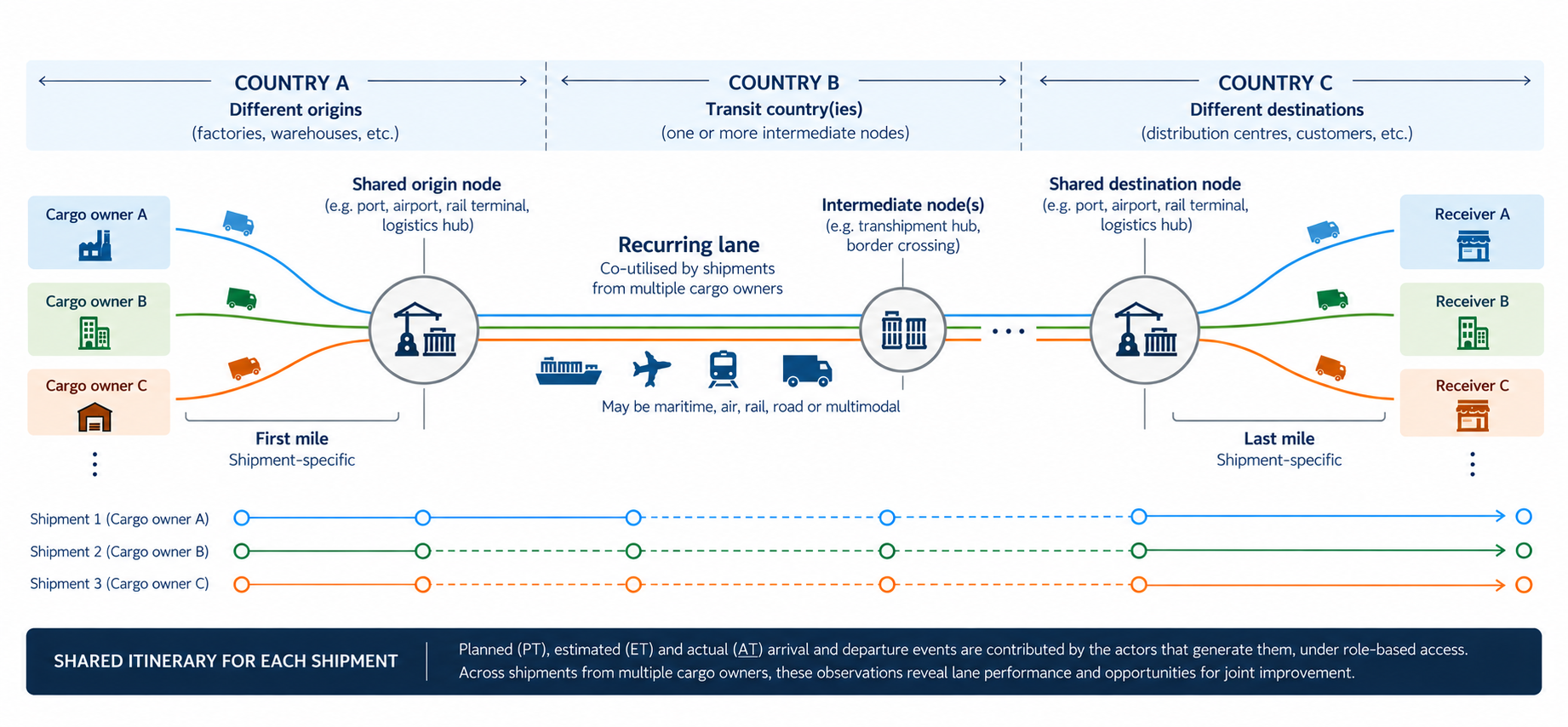
Figure 1. End-to-end shipments from multiple cargo owners co-utilize recurring lanes, shared nodes and infrastructure across jurisdictions.
Along that journey, different actors generate events the others may need: arrival and departure at nodes, loading and unloading, border or customs clearance, transfer between transport services and final delivery. The difficulty is not that these data are missing. It is where they sit.
- Terminals generate many of the decisive events, yet usually sit outside the cargo owner's contracts. Their relationship to the shipment runs through the carrier.
- Carriers control much of the data flow, and decide what is shared, with whom and when.
- Cargo owners and receivers often work from estimates derived from secondary sources rather than from what actually happened.
When that shipment misses its onward connection at the intermediate node, the event may already be known to the node operator and transport provider. It can reach the receiver days later. That is the coordination problem a lane has to solve, and it is why the revised arrival time in our opening example so often changes nothing.
A national digital twin may represent an entire corridor. That does not, by itself, give its operator the right to obtain another party's data or direct its decisions. Geographic coverage, access to information and authority to act are different things.
Our case for federation rests on that distinction. Participants should agree what they share, for what purpose and under whose authority, while retaining control over other uses. Federation need not replace national systems or commercial platforms. Nor does it remove the need for enforceable rules. It is a way to organize cooperation between independent actors around an outcome none of them can achieve alone.
The model is only part of the problem
Technical design and governance should be tested together. Before asking parties to share shipment information, a corridor initiative should answer practical questions: who can see it, what may they do with it, who pays, and what happens when the information is wrong?
The agreement should address commercially sensitive information and undergo competition-law review before implementation. A resilience objective should not be treated as a substitute for that review.
The Virtual Watch Tower (VWT), with which we are involved, should be judged against the same tests. Readers should look for clear access rules, accountable decisions and documented operational results. Our involvement is a reason to make those tests explicit, not to ask readers to take the benefits on trust.
Give participants a reason to coordinate
A requirement to use a particular transport mode does not, by itself, specify how the parties should coordinate a shipment. Compulsion can move behavior once; coordination is what sustains it. We propose making that coordination explicit in procurement: which events must be reported, who receives them and who is responsible for responding.
It is the cargo owner, rather than the vessel operator, who is in a position to set that expectation across a chain of independent suppliers — the case for cargo-led digitalization. Start with a willing cargo owner and its transport partners using a recurring lane. Agree what improved lane performance means to them, then work backwards to identify the information, decisions and individual contributions required from each participant.
The parties do not need identical interests. A cargo owner may seek predictability, a terminal better use of capacity, a carrier more reliable connections and a receiver greater certainty about arrival. What brings these interests together is a common object of interest: the sustainable and efficient movement of goods from origin to destination — economically viable, environmentally sound and socially responsible. The shipment makes that end-to-end movement tangible: its itinerary connects the contributions of otherwise independent actors across first mile, shared lanes and last mile, while its events show how the movement is progressing. Across repeated shipments from multiple cargo owners, performance becomes visible at lane level. Federation provides a means of organizing those contributions while allowing each participant to retain control of its own operations, data and commercial relationships.
In practice the first step can be light. The cargo owner selects a small number of shipments and defines their itineraries. It invites the forwarder, carrier and terminals already involved. Each contributes the planned, estimated and actual events it generates anyway, with access governed by role, so that a shared view of those shipments can be established without first requiring a large-scale integration project. Those first shipments give the parties a shared operational picture; an understanding of lane performance develops as the number of observations grows. Three points decide whether it holds:
- A shared signal rather than a single demand. When several cargo owners ask together, the request reads as a direction of travel rather than one customer's requirement — a demand-side signal that is now audible across the sector.
- Terminals need their own route in. Because they sit outside the buyer's contracts, early direct engagement has to be followed by integration through terminal systems as volume builds.
- Value spills over. Better information about the progress of a shared transport service can benefit multiple cargo owners whose shipments depend on it, including those not yet participating.
Test whether the arrangement improves performance in practice. Public support should depend on a credible test and independently assessed results, not on an assumption that either compulsion or data sharing will be sufficient.
Design around evidence requirements
Where regulation requires evidence about goods or their movement, corridor designers should identify the specific obligation before choosing the system. Which party must provide the information? In what form, to whom and by when?
Designers should then test whether information collected for operations can also support compliance. Do not assume that a shared shipment record satisfies every requirement, or that an obligation to provide evidence requires federation. The proposal is narrower: reuse information where appropriate, preserve its provenance and check each use against the applicable rules.
Measure outcomes independently
A record does not become accurate simply because several parties share it. If public funding is tied to performance, the funding agreement should define the baseline, measurement method and evidence required before the work begins.
It should also identify who validates inputs, how errors are corrected, how disputes are resolved and who independently assesses the results. Federation is one possible arrangement for sharing that evidence, not a substitute for verification. The same tests should apply to public, commercial and member-governed systems.
We may be wrong, and three questions should show it within a couple of years: whether terminals take part without a contractual lever once enough cargo owners ask, whether competition authorities accept governed sharing of operational data among competitors, and whether participants see enough value early enough to stay.
A corridor strategy that holds up
A practical starting point is to assign responsibilities before selecting technology:
1. Cargo owners and transport partners should identify the recurring lane they share and the performance they seek to improve together, then identify the decisions and contributions that require coordination.
2. Participants should agree on access, permitted use, correction procedures and responsibility for acting.
3. Those responsible for compliance should establish which evidence can be reused and where separate records remain necessary.
4. Funders should specify measurable outcomes and arrange independent assessment.
Begin with a limited scope. Expand only when the results justify doing so.
Cooperation without surrendering control
A country need not own every system along a corridor to help make that corridor dependable. We argue that its contribution should be judged by the quality of the arrangements it helps establish: clear responsibilities, controlled information sharing, coordinated action and verifiable improvements in performance.
That is the case for federation. Not sovereignty surrendered to a common platform, but cooperation under rules that participants can inspect, enforce and hold one another to.
Shad Blidberg Hallam is Founder & Executive Lead of Nomon AB, Stockholm, and a member of the VWT Steering Committee.

that matters most
Get the latest maritime news delivered to your inbox daily.
Wolfgang Lehmacher is a global supply chain and logistics expert, former World Economic Forum director and president and CEO emeritus of GeoPost Intercontinental. He is a member of the Virtual Watch Tower (VWT) leadership team and an advisor to RISE.
Mikael Lind is Senior Strategic Research Advisor at Research Institutes of Sweden (RISE) and Secretary General of the Virtual Watch Tower (VWT). He was appointed the world's first Adjunct Professor of Maritime Informatics at Chalmers University of Technology and is a co-initiator of community-driven initiatives including collaborative decision making (CDM), Sustainable Port and VWT.
The opinions expressed herein are the author's and not necessarily those of The Maritime Executive.
