


Japanese Naval Strengthening Steals Limelight at U.S.-China Talks
Chinese criticism of Japan’s growing defense budget appears to have been one of the most consequential developments coming out of the days President Xi Jinping spent in Washington for his state visit, which otherwise seems to have done little to move forward Sino-US relations. In advance of the meeting, Chinese Ambassador to Washington Xie Feng had warned that President Xi should not be challenged over Taiwan, democracy and human rights, nor restrictions to China’s growing development influence in the world, so the agenda between the two presidents was limited.
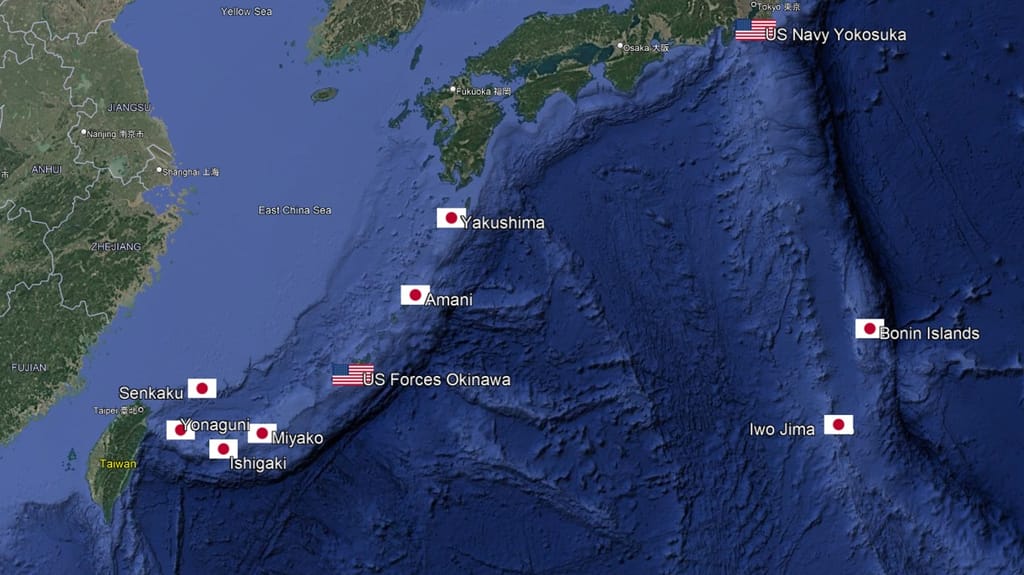
Japan’s Sanae Takaichi was in New York at the same time to make her first appearance as Prime Minister at the UN General Assembly, and held bilateral meetings with President Trump in New York. Chinese state media chose the moment of the Sino-US summit to launch a stinging attack on Prime Minister Takaichi’s radical plans to increase Japanese defense spending, and in particular to strengthen naval and air defense forces defending Japan’s isolated southern islands, specifically the Nansei Chain islands of Miyako, Ishigaki and Yonaguni.
Japan’s possession of these islands, and others to the east and north-east of Taiwan, would prove an obstacle to any Chinese plan to invade Taiwan. If long-range anti-aircraft and anti-shipping missiles are stationed on these islands, they would be able to disrupt the deployment of the PLA Navy to encircle Taiwan and cut it off from external reinforcement.
Prime Minister Takaichi has already made it clear that a Chinese invasion of Taiwan would be a causus belli for Japan, and a strategic threat to Japan’s national security. Her approach has been endorsed in this year’s general election in Japan, which gave her an unprecedented supermajority in the Japanese Diet, sufficient to change the constitution and to support a doubling of the percentage of GDP devoted to defense.
Besides a significant expansion of the Japan Maritime Self Defense Force, in particular enhancements to its Mogami Class frigates and submarine fleet, the Japanese Defense Minister Shinjiro Minister Koizumi has already announced that infrastructure to support a permanent presence of Chu-SAM (Type-03) medium-range air defense missiles on the Japanese island of Yonaguni will be in place by 2030. Field-deployed Chu-SAM systems are probably there already, with sufficient range to cover the eastern approaches to Taiwan.

that matters most
Get the latest maritime news delivered to your inbox daily.
These systems will thicken up air defense cover for the Okinawa-based 12th Marine Littoral Regiment, which is tasked alongside the JGSDF with defending Japan’s outlying islands, and which has recently been re-equipped with the Navy-Marine Expeditionary Ship Interdiction Systems (NMESIS) and Marine Air Defense Integrated Systems (MADIS). Mobile Japanese Type 88 coastal defense anti-ship missile systems can also be expected to be deployed to the islands, and all these systems have ranges which cover Taiwan’s eastern flank and coastal areas.
The Chinese diplomatic assault on Japan was headlined in the Chinese Military Bugle newspaper, which told its readers that China had rights over Japan, because Japan is still defined by the United Nations - as it has been since 1945 - as an ‘enemy country’, entitling China to take unilateral action if it feels threatened. The same paper criticized Japan for its Free and Open Indo-Pacific project, which looks very similar to the Chinese Belt and Road outreach program combining security and economic development objectives. The Chinese defense spokesperson upbraided Japan for supporting Filipino protests over aggressive Chinese coastguard actions off the Spratly Islands, over which the Japanese Embassy in the Philippines had said it was "gravely concerned". The Xi-Trump talks attracted one story in the Chinese Military Bugle, whilst China’s criticism of Japan was covered in four stories.
The opinions expressed herein are the author's and not necessarily those of The Maritime Executive.
