

Russia Fields a Floating Pillbox to Defend Against Ukraine's Drones
The invasion of Ukraine has crystallized the rapid changes in warfare brought about primarily by advances in electronic applications. Ukraine, kept short of the technology transfers it needs to defend itself from Russian aggression, has had no choice but to develop and innovate its own systems, and to be fair, the Russians - while behind - have not been far behind in the contest between newly fielded offensive capabilities and the means to defend against them. Any nation wishing to prepare for the next war needs therefore to keep a careful eye on both the Ukrainians and Russians for what naval technical developments may impact future warfare at sea.
HI Sutton, the naval analyst at the forefront of detecting new developments in the maritime space, has been among the first to notice a new Russian capability designed to defend Russian ports from the increasingly damaging impact of Ukrainian attacks at sea, both on naval targets and on Russia’s dark fleet of tankers (as well as on others deriving benefit from exporting Russian oil and gas). The need to defend ports in particular has been demonstrated frequently in recent weeks, most notably in Novorossiysk, which was attacked by hundreds of drones on August 11 and 12.
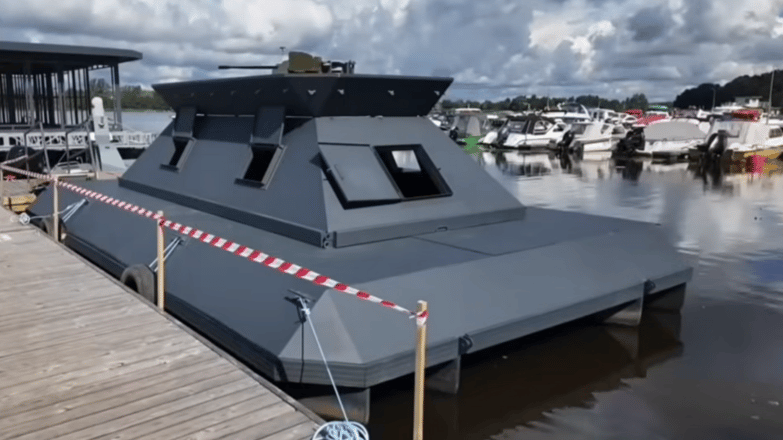
The new Russian PLOT-40 (or PLOT-47) appears to be a naval sentry box, designed to be stationed at sea to protect the approaches to Russian ports and anchorages. Best described as a pontoon rather than a boat, the 4.5m x 2.5m rectangular structure sits on top of four cylindrical floats; PLOT (or ????) means ‘raft’ in Russian. Atop the sloping-walled pillbox shape is what appears to be a 12.7 or 20mm automatic cannon with guidance system.

that matters most
Get the latest maritime news delivered to your inbox daily.
With two opening hatch windows on either side, and one each fore and aft, it is not clear if the sentry box is supposed to be manned by sailors keeping watch and servicing the weapon, but benches can be seen inside. The interior must also house an electrical system to power the automatic cannon and its sensors. The craft appears to be unarmored, but would in any case be vulnerable to the kinetic effect of any impacting strikes.
For a young Russian naval officer looking for a career at sea it would be a disappointing first command, as the PLOT-40 does not appear to have an engine. As a target, it appears vulnerable - but given the success of recent Ukrainian attacks, a wide range of desperate countermeasures are being trialed by the Russians.