


U.S. Navy Takes First Big Unmanned Step, Buying 30 Production MUSV Hulls
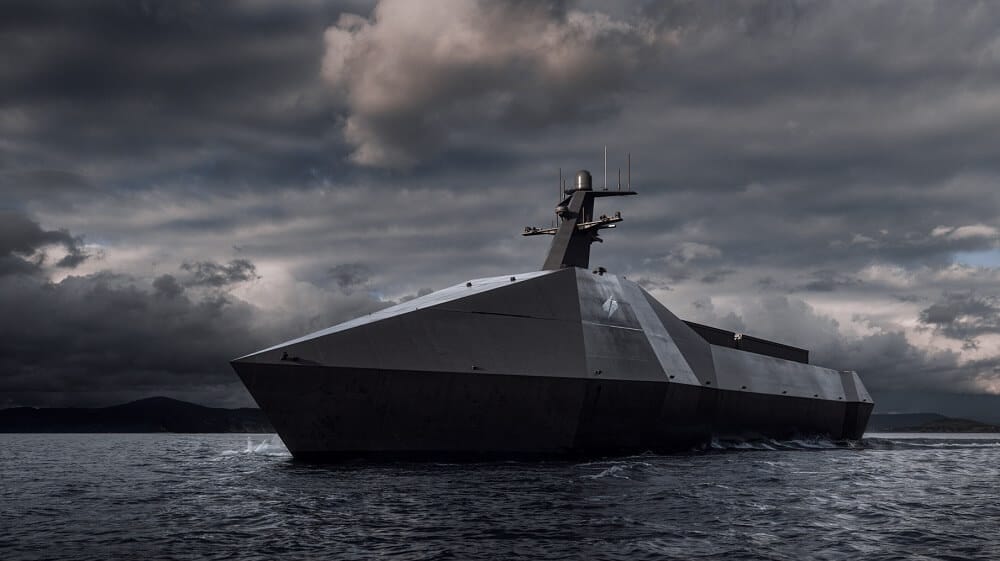
Huntington Ingalls Industries (HII), Galliano Marine Services and Saronic have each secured a contract to build 10 small autonomous warships for the Navy's Medium Unmanned Surface Vessel (MUSV) competition, giving the Navy a pipeline for 30 of the long-awaited vessels - a meaningful mass for operational implementation.
The average cost came in at about $40 million per hull.
Other competitors - Leidos, PAC MAR, and Sea Machines - received $15 million completion awards for their work and will be listed on the Drones.mil "Maritime Marketplace" for future authorized orders.
HII celebrated the contract award in a statement. “HII has made deliberate, early investments in the development of autonomous systems, advancing capabilities essential to the Navy’s hedge strategy,” said Chris Kastner, HII president and CEO.
HII's Romulus MUSV entrant is a midsize unmanned vessel with a speed of 25 knots and a range of 2,500 miles. It has a familiar crewboat layout with a long aft deck, suitable for modular payloads. HII envisions a wide variety of roles for Romulus, including ISR, counter-drone, mine countermeasures, strike, and the launch and recovery of unmanned platforms - likely to include HII's own Remus submersible survey drone, a standard tool that exists in quantity in the Navy inventory.
To build the first Romulus prototype, HII turned to Breaux Brothers, a commercial yard on the Gulf Coast with a long and successful history of building commercial aluminum working vessels. HII builds it subs, carriers, surface combatants and amphibs out of steel; Breaux has decades of knowledge in building with aluminum and had input on the design to ensure its manufacturability in a commercial setting.
Saronic breaks ground on a new factory
Competing startup Saronic is pursuing the same program but plans to keep production in-house through the construction of a mega-shipyard in Brownsville, Texas - a $3 billion plant that could become the largest in the U.S. if fully built out. It broke ground at its "Port Alpha" facility on Wednesday in a ceremony attended by Vice President JD Vance, Texas Gov. Greg Abbott and other dignitaries.
Saronic hopes to create as many as 10,000 direct jobs with the yard, making it among Texas' biggest new economic development projects. It does intend to be able to build ship-sized vessels: Its initial capacity will be about 150,000 GT per year, with potential to scale to two million GT per year - equivalent to 15% of China State Shipbuilding Corporation's output. It will be initially limited to an 850-foot (sub-Panamax) maximum hull length, growing to 1,200 feet (Neopanamax) at full buildout.

that matters most
Get the latest maritime news delivered to your inbox daily.
“American shipbuilding needs to be rebuilt for what comes next,” said Dino Mavrookas, Co-Founder and CEO of Saronic, speaking at the ceremony. "Port Alpha is designed from the ground up to produce both autonomous and manned vessels at scale."
Its first contract at Port Alpha will be the Navy's Landing Craft Utility (LCU), a workhorse ship-shore connector for beach logistics. Like HII, it now holds a contract for 10 of its MUSV hulls as well, giving it a pipeline for both manned and unmanned work.
