


Panama Canal Begins Reducing Daily Transits Due to Declining Water Levels
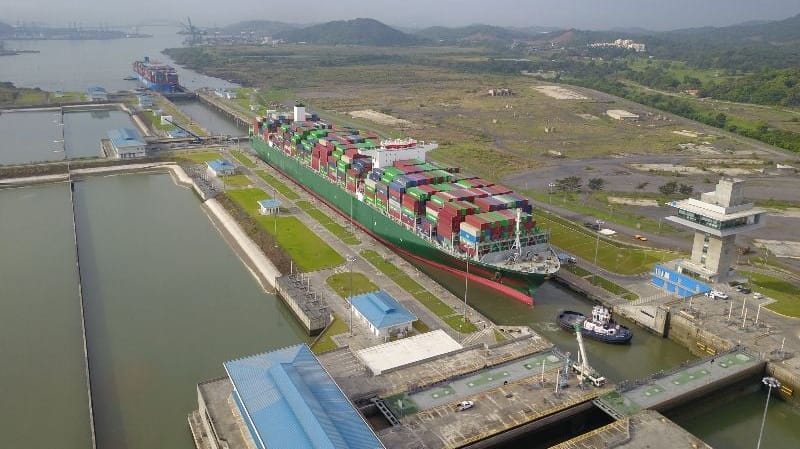
The Panama Canal Authority is expanding what it is calling “temporary modifications to the lock’s transit capacity” as the forecasts for a worsening drought continue to grow. While water levels in Gatun Lake have been largely stable for the past nine days, the isthmus is experiencing significant declines in rainfall, with forecasts for the Super El Niño effect to further intensify for the remainder of 2026.
Despite the arrival of the rainy season in Panama, and the water-saving measures implemented by the Panama Canal to mitigate the adverse effects of the El Niño event, the Authority warns that current watershed conditions, including below-expected precipitation in the canal watershed, require additional action to support the long-term sustainability of transit operations.
Earlier restrictions focused on the maximum draft for the vessels, but now it is shifting to the number of daily transits. In the first wave due to go into effect on September 3, the Panama Canal will go from the current 34 daily transits to 32, and a second adjustment at mid-month will shave off two more daily transits in the Panamax locks. As of September 3, the Neopanamax locks for the largest ships will be adjusted to nine daily slots and 25 at the Panamax Locks and then to 23 as of September 15 for the Panamax Locks.
The Authority is warning customers that a reduction in the number of daily transits may increase waiting times for vessels without a secured reservation. The waiting time is already elevated, but has come down in the past few days. Non-booked vessels, on average, are waiting 8.5 days northbound and 7.7 days southbound. As of August 20, 36 non-booked vessels were waiting.
Ships have already been taking steps to address the growing concerns about delays. A Seaspan containership reported to be on charter to Ocean Network Express (ONE) won an auction slot at just under $4 million in early August, nearing the records set early in 2026. The number was shattered days later, according to a report by Bloomberg, when an LPG carrier owned by SK Shipping, G. Arete (54,842 dwt), paid a record $4.6 million in the auction to jump line.
The Panama Canal Authority has become acutely aware of the challenges and said it is taking steps to “promote a more equitable allocation process.” In part is says it looks to reflect the market composition and segments and will adjust the daily auction slots accordingly.
It is introducing segmentation into the auctions for Neopanamax, Super and Regular vessels by type of ship. There will be groupings for LNG/LPG; Dry Bulk/Other Cargo; Container vessels/RoRos/Vehicle Carriers/Refrigerated; and all categories of tankers. It is also limiting customers, saying if they have a slot, they will not be eligible for another that same day unless there are no other competitors. Also, it plans to give priority at the Neopanamax Locks to full container vessels with the highest TEU capacity.
By reducing the number of daily transits, the Authority is delaying the next round of draft reductions. The move to 48 feet (14.63 meters) in the Neopanamax Locks is delayed a week to September 2. The next adjustment to 47.5 feet (14.48 meters) is also delayed until October 1.
It warns that further restrictions could be necessary. It notes that it has the authority to temporarily suspend all or part of the Transit Reservation System.
Water levels in Gatun Lake have been steady the past week at just over 84 feet, which is a foot below the five-year average for August. Over the 5-year period, the lowest the lake has averaged is just under 84 feet, but in 2003 it briefly fell to just under 80 feet for a few months. Typically, water levels begin to rise at this time of the year as the rainy season begins and peaks at the five-year average for December, just over 87 feet.

that matters most
Get the latest maritime news delivered to your inbox daily.
The Panama Canal Authority reports it is taking the current steps in response to a 34 percent reduction in accumulated rainfall and a 44 percent reduction in water inflows to the watershed during the current hydrological year.
NOAA continues to project that the current phenomenon will strengthen rapidly to become a Super El Niño no later than October. It says forecasts a nearly 70 percent that it will become the strongest El Niño on record by the end of 2026. While it typically begins to decline as the winter progresses, forecasters are warning large parts of the United States are expected to see significant changes both in higher than normal temperatures and rainfall levels.
