


India's Big Boost for Maritime Oil & Gas Exploration
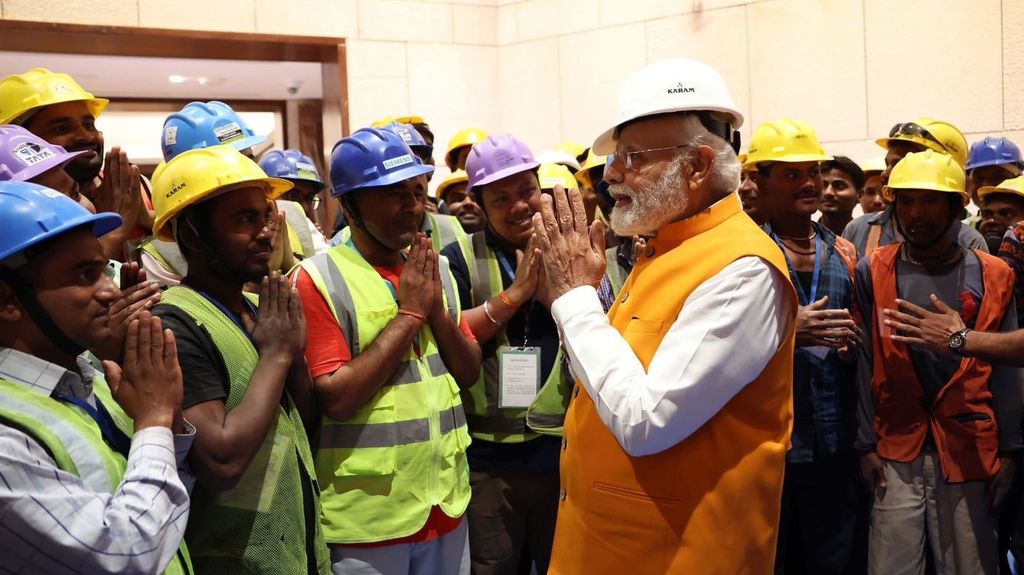
Prime Minister Modi in a hard hat mixes in with Indian construction workers (KARAM)
The Indian government is looking to reduce its 90% reliance on imported crude by providing an $8.8 billion boost to private sector maritime oil and gas exploration. India also imports 50% of its gas, and its heavy dependency on imported hydrocarbons has been highlighted by the continuing closure of the Strait of Hormuz.
Much of India’s currently imported oil and gas comes from the Middle East. Although government announcement on Samudra Manthan did not dwell on this aspect of the plan, if domestic oil and gas production can be increased it will also lessen dependency on Russian exports, which have increasingly become too hot for Indian refiners to handle because of US sanctions.
Under Prime Minister Narendra Modi’s Samudra Manthan plan, the National Offshore Exploration Scheme will subsidize 50% of the costs of every deep sea well drilled (capped at $70 million per well). As part of the plan, sea areas which were previously banned to explorers on national security grounds will now be opened up. The exploration activity will look for prospects across India's Exclusive Economic Zone, from the Arabian Sea in the west to the Bay of Bengal in the east, and around the Andaman Islands off the coast of Myanmar. Increased oilfield support work is likely to be spread between multiple Indian ports.
The plan is intended to expand India’s hydrocarbon reserves and provide an engine for growth among suppliers and sub-contractors, as well as reducing India’s dependence on global supply chains. There may be spare capacity which Indian firms can leverage from the North Sea, where the United Kingdom’s response to the Hormuz crisis is diametrically different, with the UK government seeking to close down any further exploration for oil and gas.
India at the moment has an estimated 1.6 billion tons of hydrocarbon resources in the ground, and Prime Minister Modi aims to expand this through the Samudra Manthan scheme to 2.2 billion metric tons.

that matters most
Get the latest maritime news delivered to your inbox daily.
The scheme is targeted at foreign oil majors, particularly from the United States, Europe and Japan, who have not been tempted to engage in the past because of the legal and regulatory barriers to foreign direct investment, barriers which are still prevalent in India.
There are also some legacy and reputational barriers to overcome. Edinburgh-based Cairn Energy (now Capricorn Energy) found the huge Mangala oil field in Rajasthan in 2004, but subsequently had to fight a long battle with the Indian government to avoid having to pay a retroactively-applied capital gains tax bill. The Permanent Court of Arbitration in The Hague eventually awarded Cairn $1.7 billion in costs and damages.
