


Houthis Fighting on All Fronts and Aiming for the Red Sea Coast
Fighting has now broken out on most fronts on the internal frontier within Yemen.
The Houthis are seeking to portray the fighting as being between themselves and the Saudis. But the Saudis are in general only acting in a back-up and support for the forces of the Internationally Recognized Government (IRG), primarily using air power, and are not directly engaged - except on the northern border and on the receiving end of drone and missile attacks within Saudi Arabia, to which they have been restrained in response.
Neither side appears to have made any substantial breakthrough as yet. For several months, the Houthi have been preparing the population of the areas they control in north Yemen for renewed conflict with Saudi Arabia, and signaling their intentions. IRG forces have accordingly had plenty of time to prepare, and while not having taken the initiative, have kept a careful eye on the Houthi build-up and been ready with pre-emptive strikes and counter-attack plans.
It is still not completely clear what the Houthis are trying to achieve tactically, their primary objective being to get the Saudis to return to negotiations with a better offer. The Houthis are unhappy with how the Omani-sponsored negotiations to bring about a final settlement to end the civil war in Yemen are proceeding. The civil war started in 2014, but has effectively been paused since a de facto ceasefire came into force in 2022.
In line with getting a better offer out of the Saudis, the Houthi threat to shipping is supposedly directed only at what the Houthis have identified as Saudi vessels – but as usual with the Houthis, there have been targeting errors. There does not appear to have been any attempt to take on what can loosely be described as Western or Asian vessels. The United States has said that as far as it is concerned, its ceasefire with regard to shipping in the Red Sea remains in force, and has threatened that if the Houthis break this status quo it will prompt a repeat of Operation Rough Rider, which last time round the Houthis found a bitter experience. The EU Operation Aspides to protect merchant vessels in the Bab el Mandeb has not yet reported any attack on vessels which they are escorting, and in general merchant traffic levels through the southern Red Sea are being maintained.
 cha,
cha,
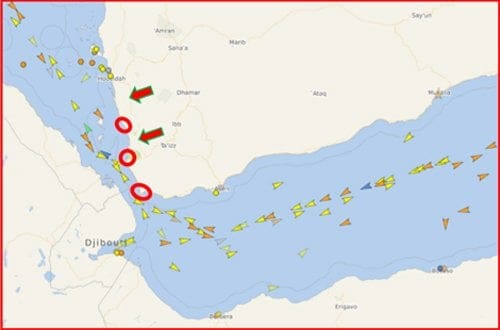
Traffic proceeding as normal on the Maritime Security Transit Corridor (MSTC), August 17, with Houthi attacks in red (VesselFinder)
There is one target, however, where the Houthis are trying to make tactical gains. From attacks on the landward side, along the front-line south of Hodeida where the IRG-held coastal plain transitions into the jebel held by the Houthis, the Houthis appear to be trying to break through and reach the sea.
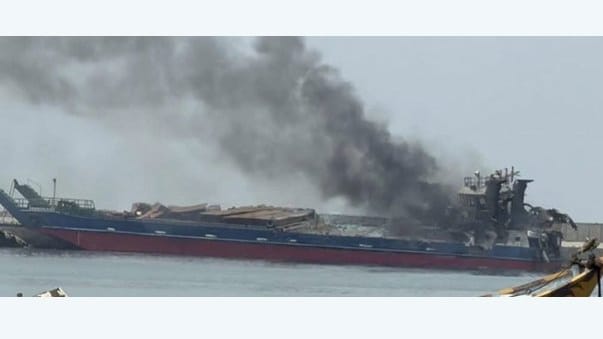
They have also heavily attacked port facilities and coastal shipping operating along the IRG-held coastline, in particular in Mocha and the small port of Khawkhah. The Tanzanian-flagged coastal ferry Tihama (IMO 1031329), operating in the Bab el Mandeb, suffered several missile hits, killing four Pakistanis, an Indonesian and two Yemeni Coastguard rescuers, before being brought into the port of Ras Menhali, at Murad opposite Perim Island. The formerly Indonesian-flagged landing craft Amir Khan 1468 (IMO 1088504), which was laid up in Ras Menhali, was also damaged, but not being crewed, suffered no casualties. Both vessels have well-established civilian roles, but the Houthis falsely claimed that both were Saudi vessels transferring military supplies. This was likely a deliberate Houthi operation to close down civilian coastal traffic serving IRG-controlled areas in conjunction with their landward offensive.

that matters most
Get the latest maritime news delivered to your inbox daily.
By seizing more control of the coastline south of Hodeida, the Houthi grip over the southern Red Sea would be enhanced, giving them the sort of bargaining power which the IRGC now has by dint of their over-watch of the Strait of Hormuz. In this endeavor, the Houthis have as yet made little progress, appear to have suffered heavy casualties, and IRG forces for their part have held their positions.
At present, the limited resumption of hostilities appears to have achieved nothing for the Houthis. It has served as a rallying call for IRG forces, whose military performance has been resilient and much improved. A forthcoming televised speech by the Houthi leader AbdulMalik al Houthi on Thursday, August 20, may provide an opportunity for a restatement of Houthi war aims and possibly for an adjustment in direction.
