

Oil Prices Jump at News of Pause in Saudi Loadings at Red Sea Terminal
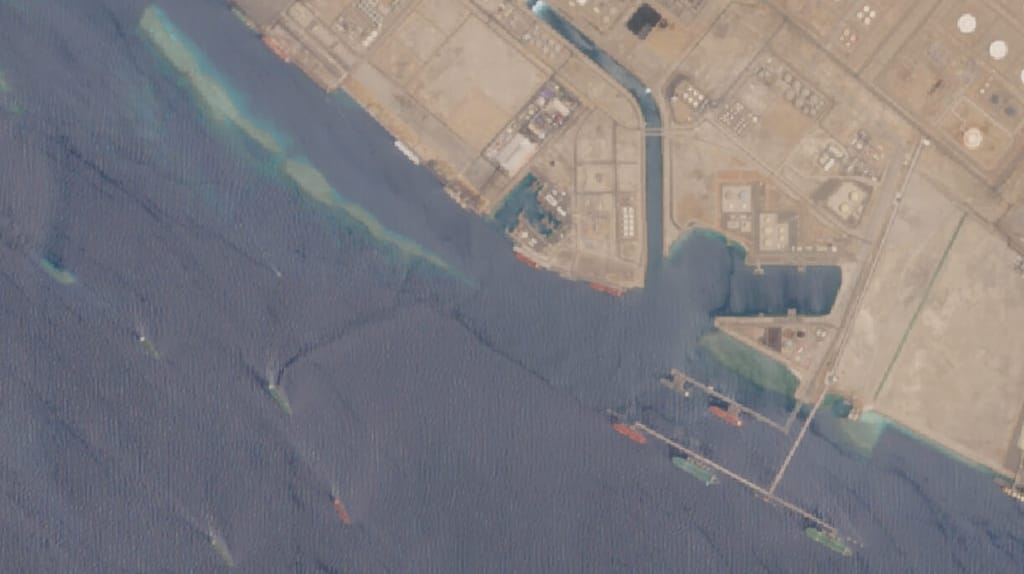
Benchmark Brent crude price resumed its upward climb on Tuesday after news of a pause in the loading program at Yanbu, Saudi Arabia's main Red Sea loading terminal.
The terminal's ability to keep exporting crude was already expected to come to a close: recent attacks on the Saudi Aramco East-West Pipeline have brought cross-country oil movement to a halt until repairs can be completed, and full flow may not be restored for three to five weeks, oil industry sources told AP. Satellite imaging intelligence firm Soar Atlas has released imagery that appears to show significant damage to three different pumping stations on the pipeline route, new evidence that extensive repairs may be required.
???? This is starting to look MUCH bigger than a single strike on Saudi Arabia’s East-West oil pipeline.
Satellite imagery has now showed significant damage at Pump Station 9, while possible damage is also visible at Pump Station 8, both along the same critical pipeline system.… pic.twitter.com/GjvNXYJ6i1— Soar (@SoarAtlas) September 15, 2026In peacetime, Yanbu sees less use and has less strategic importance. Saudi oil production is centered on supergiant fields along its eastern coastline, and most of its cargoes have historically exited through the Strait of Hormuz to reach market. The pipeline to the western Red Sea coast is ordinarily used for cargo deliveries to Europe and points west, and has more recently been used to circumvent Hormuz and offset the impact of the Iranian blockade on GCC tankers.
The Yanbu terminal was loading about four million barrels per day on average before the shutdown, equivalent to roughly four percent of world oil supply. Markets will be watching closely to see if Aramco can now increase its (normally higher) Gulf exports enough to offset the temporary loss of its backup pipeline. Recent satellite evidence suggests that this may be possible, or already in progress. Open-source imaging shows heightened tanker transit activity through contested Omani waters; an elevated rate of ship-to-ship transfer activity off Fujairah; and even two-way tanker traffic in daylight hours through Hormuz. All point to a rapidly improving energy shipping environment for GCC export interests in the Gulf - except for tanker transport costs, which have soared to levels previously unimaginable, especially for movements through Hormuz. If Saudi shipments overcome the cost and security barriers as well - as seen by analysts TankerTrackers.com - the temporary shutdown at Yanbu would be less impactful for global energy markets.
EXCLUSIVE: Based on our satellite imagery analysis conducted on 2026-09-14, we can see that the Strait of Hormuz now hosts bi-directional daytime traffic of VLCC supertankers. Furthermore, greater volumes of crude oil, LNG and LPG are being exchanged via STS transfer in the Gulf… pic.twitter.com/DOmhxOtIzI
— TankerTrackers.com, Inc. (@TankerTrackers) September 15, 2026 Stay on Top of the Daily Maritime News The maritime news
that matters mostGet the latest maritime news delivered to your inbox daily.
In all events, the Yanbu suspension is difficult news for refiners in Europe, who have traditionally sourced Arabian grades from the geographically-closer loading location. It grew in importance after 2022, when Northern Europe took steps to find non-Russian alternatives for its oil supply. In an ultra-tight market, EU buyers now have to compete for cargoes further afield, and pay for record-high shipping rates for the extra ton-miles, too.
New disruption in Libya could add to upward pressure on oil prices. As is common in Libya after years of civil war, a dispute involving security forces has shut down a key pipeline, interfering with loading and reportedly affecting production as well. The country's Petroleum Facilities Guard - tasked with protecting pipelines and wells - has shut off a valve on the pipeline until its demands are met. The security force insists that it must be re-housed within the administrative and financial structure of the National Oil Corporation, or it will keep the National Oil Corporation's pipeline shut down.