


First Three-Tank LNG Carriers Will Improve Operating Efficiency
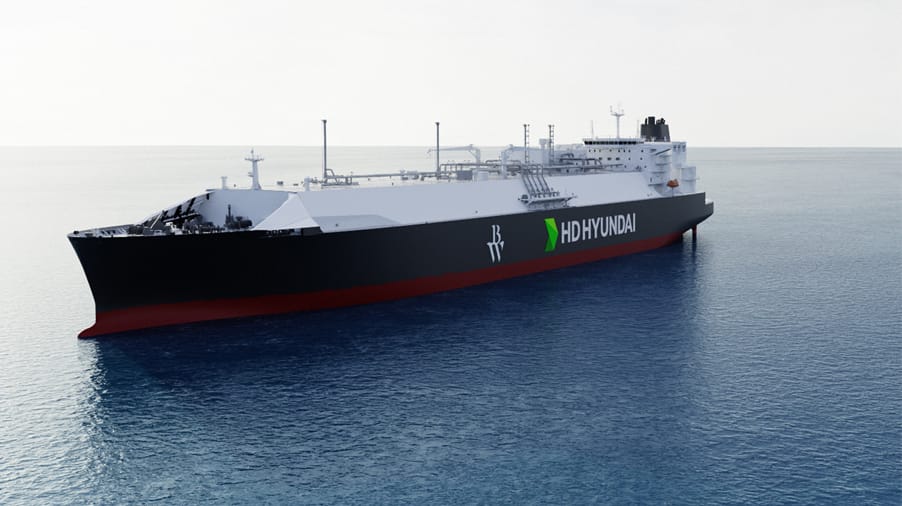
South Korean shipbuilder HD Hyundai and Singapore-based BW LNG highlight that they are moving forward with building the world’s first three-tank LNG carriers. The design permits an increased carrying capacity of up to 2,800 cbm (1.6 percent) while avoiding terminal berthing restrictions that could be caused by larger vessels.
Designs for the new vessels were developed by HD Hyundai, working in conjunction with French cargo tank technology company GTT, BW as the shipowner, and DNV as a class society. Designs were approved for the 176,800 cbm carriers, and in June BW proceeded with the first order for four of the new design vessels.
According to HD Hyundai, it was able to secure an additional 2,800 cubic meters of space by removing one insulated bulkhead from a 174,000 cbm LNG carrier. This allows for the transport of more cargo, lowering the unit freight cost and enabling shipowners to achieve better profits. The conventional design for LNG carriers is a four-tank system.
By applying a three-tank system, the space between cargo holds can be reduced while maintaining the vessel's size, thereby increasing loading capacity. The LNG loading capacity of vessels ordered by BW expands from approximately 174,000 cubic meters to approximately 176,800 cubic meters. BW highlights that the design also maintains flexibility, permitting partial loading conditions.
The design has other advantages, including a lower boil-off rate. HD Hyundai explains that as the total surface area of the cargo tank decreases, the amount of heat flowing from the outside to the inside is reduced, and thus the daily boil-off rate. The daily boil-off rate of the three tanks was improved by about six percent.
One of the key concerns, however, was cargo sloshing. It notes that as the size of the cargo tank increases, the impact load can also increase. It was able to address this concern through precise strength analysis and structural and thermal reinforcement. The vessels will continue to employ the proven Mark III membrane technology.

that matters most
Get the latest maritime news delivered to your inbox daily.
BW highlights that the vessels will feature the industry’s lowest emission profiles, especially when compared with previous generations of LNG carriers. They will employ the WinGD X-DF 2.2 is a low-pressure, two-stroke dual-fuel marine engine. They will also incorporate shaft generators.
The four ships will be built by HD Hyundai Samho in South Korea. The deliveries are scheduled from the fourth quarter of 2028 to the third quarter of 2029.
