


China is Remaking the South China Sea With a Return to Island-Building
A new Chinese outpost at Antelope Reef won’t create legal rights but will shape control over disputed waters
[By Lowell Bautista]
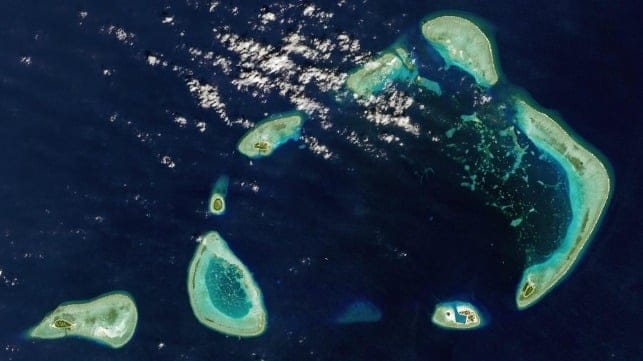
After nearly a decade of relative pause, China has resumed large-scale island-building in the South China Sea. Satellite images of Antelope Reef show a once-submerged feature rapidly transformed into what could become one of Beijing’s largest outposts in the region. It signals a renewed willingness to reshape maritime geography as a means of consolidating control.
During the mid-2010s, China’s island-building campaign drew global attention for its scale and speed. Reefs were dredged and turned into artificial islands, some equipped with runways, ports, and military facilities. That phase appeared to slow in the years that followed. Recent analysis now indicates that construction at Antelope Reef could rival the size of China’s largest bases. What is unfolding is not just about building land, but about building infrastructure that can sustain operations over time – more closely integrated with China’s broader maritime approach. Early development at Antelope Reef appears focused on logistics: berthing facilities, access for construction vessels, and the gradual creation of a stable platform rather than overtly military installations. Before there are airstrips or missile systems, there are docks, dredgers, and engineering works.
From this foundation, more recognisable capabilities of a functioning outpost may follow. The scale of reclamation suggests the potential for a runway capable of supporting military aircraft, alongside radar systems and hardened infrastructure. If realised, such developments would extend China’s operational reach, enabling persistent surveillance and more flexible deployment across a wide maritime area.
Yet the significance of Antelope Reef lies not in any single capability, but in how it strengthens a wider system. China already maintains a network of outposts across the Paracel and Spratly Islands. Antelope Reef adds capacity, redundancy, and dispersal. It is another node in a distributed architecture designed to sustain presence. In maritime disputes, endurance matters as much as firepower. The ability to remain on station, resupply, and rotate assets over time can translate into a decisive advantage.
This dynamic is particularly evident in the operations of China’s coast guard and maritime militia. These forces operate in the grey zone between civilian and military activity, asserting presence without crossing into open conflict. Infrastructure of this kind enables more persistent and coordinated deployments. With improved berthing and logistical support, vessels can remain in contested waters for longer periods and in greater numbers. Over time, this sustained presence can shape patterns of use and control.
The timing of this renewed activity is telling. Recent reporting highlights that China is consolidating its position while external attention is divided at a moment of heightened geopolitical complexity, when the United States and its allies are managing multiple global challenges. Beijing may judge that the costs of creating new “facts on the water” remain manageable, particularly in the absence of consistent external pushback. Whether or not this is the primary driver, it underscores how developments in the South China Sea are closely tied to wider challenges.
International law remains central to how these disputes are understood. Under the United Nations Convention on the Law of the Sea, artificial islands do not generate maritime entitlements. The legal status of a feature is determined by its natural condition, not by subsequent human modification. In that sense, the transformation of Antelope Reef does not create new legal rights. This position was affirmed in the 2016 South China Sea Arbitration.
But law does not operate in a vacuum. What developments such as Antelope Reef demonstrate is the growing gap between legal rules and material reality. Other claimants – notably Vietnam – have also undertaken efforts to reinforce and expand features under their control. This points to a gradual shift from a contest centred on legal claims to one increasingly shaped by infrastructure and presence. The competition remains asymmetric, but it is nonetheless interactive, contributing to a steady hardening of positions.
Physical presence, supported by infrastructure and sustained operations, can shape outcomes in ways that law alone cannot easily address. This is less a collapse of international law than a demonstration of its limits when not backed by enforcement and sustained presence.
For policymakers, the implications are clear. Responses that focus solely on legal argument or diplomatic protest are unlikely to be effective on their own. If control is increasingly shaped by sustained presence, then strategies that enhance maritime domain awareness, strengthen regional partnerships, and support the capacity of coastal states to maintain their own presence at sea carry growing weight.
International law continues to define what states are entitled to claim in the South China Sea. Increasingly, however, it is engineered geography that determines what they can actually control.

that matters most
Get the latest maritime news delivered to your inbox daily.
Lowell Bautista is Associate Professor of Law at Western Sydney University and an expert in public international law and the law of the sea, with a focus on maritime disputes in the Asia-Pacific.
This article appears courtesy of The Lowy Interpreter and may be found in its original form here.
The opinions expressed herein are the author's and not necessarily those of The Maritime Executive.
