
Will Chinese Oil Imports Rebound After the Iran War?
For several decades, there has been one reliable growth engine for oil demand in the world: China. China’s massive growth in oil demand in the early 2000s was the primary driver of the tanker super cycle that lasted from roughly 2001 to 2009. It established China as the key driver of global oil and tanker demand.
China has only limited domestic production and most of the oil needs to be imported, which is why tanker owners keep a close eye on developments in the Middle Kingdom. When the Iran war broke out, the Strait of Hormuz closed, which caused the largest oil supply shock in history. In response, China drastically reduced its crude oil imports. This decision, in addition to global SPR releases and efforts by Middle Eastern producers to bypass Hormuz, prevented oil prices from reaching record highs.
How was China able to do this and what will happen if/when the oil markets go back to “normal”?
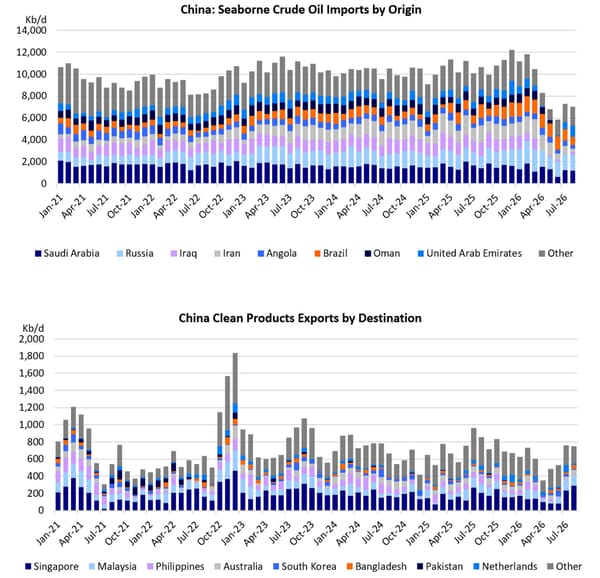
China’s seaborne crude oil imports reached 11.8 Mb/d in February 2026, just before the war broke out (chart 1, below). China’s highest imports on record were in December 2025, at 12.2 Mb/d. About 50% of China’s imports were sourced from the Middle East. As the war continued, China resisted the urge to compete for replacement barrels from the Atlantic Basin. Instead, China reduced its imports. Seaborne imports dropped 50% from 11.8 Mb/d in February to 5.8 Mb/d in June, before recovering slightly to 7.3 Mb/d in July and 7.0 Mb/d so far in August.
Courtesy Poten & Partners / Vortexa
There are a number of ways in which China was able to achieve this drastic reduction. First of all, China had been building its petroleum reserves over the years. China doesn’t publish official numbers on their reserves, but analysts estimate that the country’s onshore crude oil inventories reached approximately 1.2 Billion barrels in early 2026. China started to tap into these reserves in April, when imports dropped significantly. Vortexa estimates that China drew down about 1.5 Mb/d from onshore and floating storage combined in May-July 2026. It also stopped importing the “extra” barrels (around 1.0 Mb/d more than was needed to meet demand) that were used in 2025 and early 2026 to boost these inventories.
A reduction in clean product exports (chart 2) is another lever that China used to balance imports with demand. China’s product exports are quite variable. In 2025 they averaged 722,000 b/d, with a high of 964,000 b/d in July and a low of 533,000 b/d in February. However, in April 2026, they dropped to 350,000 b/d. Lastly, the Chinese government managed to reduce domestic demand. Fuel prices were allowed to rise, which discouraged the use of gasoline powered cars and motivated commuters to take public transport or to use bicycles. Travelers switched from airplanes to trains where possible, which also helped. Overall, China has managed to reduce oil imports and consumption significantly without a big hit to the economy.

that matters most
Get the latest maritime news delivered to your inbox daily.
Despite the reduction in Chinese seaborne crude oil imports, the tanker market is having one of its best years in history. This is a result of the inefficiencies in the market caused by delays and disruption as well as a significant increase in ton-mile demand due to longer sailing distances. When the conflict in the Middle East ends and/or traffic through the Strait of Hormuz and in the Red Sea normalizes, the tanker fleet will resume its most efficient routing, and rates may come under pressure, especially with the large orderbook looming.
Shipowners have pinned their hopes on restocking of inventories globally and in particular a return of Chinese imports to pre-war levels. That may be optimistic. China is a price sensitive buyer, and oil prices will be a more important driver for imports that the need to replenish reserves, which, because of all the others measure China took to curb demand, are still at very comfortable levels. Also, China has invested a lot in renewables and other energy sources to reduce its dependence on imported fossil fuels. So, Chinese imports will come back, but the new normal may be lower than elevated levels of 2025 and early 2026 and future growth will be subdued as China will continue to diversify away from imported oil. China will remain very important for the crude tanker market but cannot be relied upon to drive ton-mile demand growth. The next 25 years will be very different from the last 25.
The opinions expressed herein are the author's and not necessarily those of The Maritime Executive.
