

US Says IMO Must Move Beyond NZF While Seeking Common Sense Approach
The United States continues to “firmly oppose” the International Maritime Organization’s Net Zero Framework (NZF), calling it a “tax on shipping.” Speaking at the IBIA (International Bunker Industry Association) Annual Conference in New York this week, Laura DiBella, Chairman of the U.S.’s Federal Maritime Commission, ahead of the upcoming critical meetings at the IMO, said the United States will work with all for a common sense approach to the challenges of decarbonization of shipping.
“The NZF cannot be adopted, will never be enforced, and has to be off the table,” asserted DiBella, speaking to the annual gathering of executives from the bunker industry. She reaffirmed the U.S. position, saying the approach needs to be “rethought” and further developed, asserting that the rush to resolve the issue “undermines compromise.”
The Trump administration has repeatedly asserted its opposition to the NZF. The United States was one of the nations that organized opposition to the adoption of the NZF in 2025, along with others such as Saudi Arabia. The IMO meeting devolved into a political fight, defused only by tabling the proposal for further discussion.
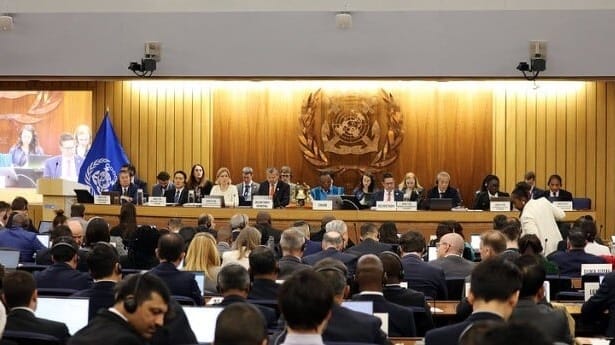
The issues are back at the forefront as the maritime industry gears up for the critical Marine Environment Protection Committee (MEPC) session scheduled for the end of November. The following week, the IMO has planned an Extraordinary Session for members to consider the NZF.
DiBella highlighted four principles that the U.S. is seeking as it builds a coalition. The solution must be “commercially realistic and technology neutral,” and “compliance must be voluntary, flexible, and market-based.” The United States demands a single target for emission intensity based on availability and affordability, and it must be reviewed within the decade, by 2035 at the latest.
DiBella spoke of the importance of the maritime industry while recognizing it has been a volatile fuel environment. “Maritime has to be part of economic development,” declared the chairman who previously led economic development programs in Florida. “If you do not have maritime at the center of economic development, you are doing it all wrong,” said DiBella.
Addressing the IMO’s efforts, DiBella said it must “move beyond” the NZF, which it views as anticompetitive in its approach. She called for a solution that provides fuel flexibility, affordability, and availability. The U.S. position is that the NZF limits some fuel options. Specifically, DiBella cited the need to recognize LNG, bio-LNG, ethanol, and biodiesel as viable pathways.
One of the U.S.’s strongest objections centers around the proposed carbon fund, which U.S. officials have repeatedly called a “tax on shipping.” DiBella told the audience that the FMC’s analysis showed the fund component could cost the shipping industry $53 billion to $265 billion annually. The FMC’s prior chairman, Louis Sola, in 2025, predicted the fund component would create a cost of $100 per shipment for containers and $50 per passenger on a cruise.
“The United States will not accept the IMO fund,” said DiBella, stating the U.S. position that any financial mechanism must be under the authority of the member states, not funds distributed by the IMO. In April 2026, DiBella, in a statement outlining her beliefs on the NZF, asserted the strict fuel standards proposed in the drafts “would have impacted 97 percent of the global fleet, which would be liable to pay the tax, and these charges would then be passed along to consumers.”
Among attendees at the IBIA Conference, the sentiment is that a resolution is vital to the future of the industry. They highlighted the uncertainty overhanging the industry while noting that companies will need to make large capital investments. The view is that regulation brings stability and direction.

that matters most
Get the latest maritime news delivered to your inbox daily.
Attendees voiced the belief that a stable direction would drive investment while noting that fragmentation is not good for the industry. Attendees said it needs to be a realistic solution, that is global in nature, while some said the industry cannot wait for perfection.
It remains to be seen if the MPEC session, followed by the extraordinary meeting, can achieve this consensus. All eyes will be on London as the meetings begin on November 30.