
How High-Speed Ferries Can Reclaim Their Environmental Credentials
[By Tore Stensvold]
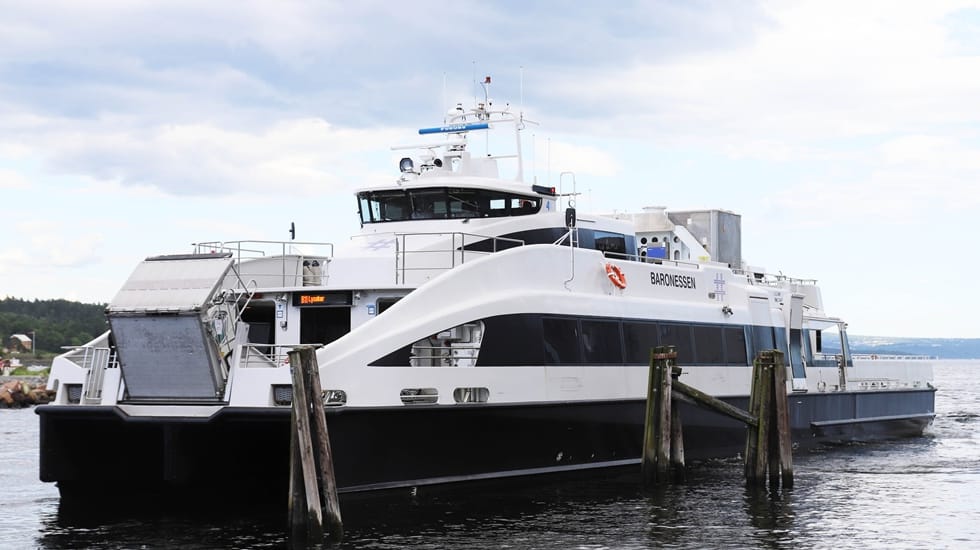
Public transport can benefit the environment, but catamarans are among the worst offenders when it comes to emissions. Batteries and underwater wings could make them considerably greener.
Norway has the technology and expertise needed to develop high-speed catamarans capable of operating even the longest routes. But something is missing.
“In less than five years, we could have a zero-emission high-speed passenger catamaran, capable of travelling at 20–35 knots and carrying 150–250 passengers. But that will require political will and decisive action,” says Professor Sverre Steen from the Department of Marine Technology at NTNU.
Steen is confident that Norway has a broad range of expertise and companies capable of commercialising hydrofoil passenger catamarans within a few years. This could help address some of the challenges associated with emissions from passenger transport, including over longer distances.
Norway aims to reduce emissions from domestic shipping by 50% by 2030 and achieve zero emissions by 2050. This means high-speed ferries must switch from diesel engines to battery-electric propulsion or hydrogen and fuel cells.
Norway has everything it needs
“We have highly skilled shipyards, expertise in hydrofoil technology, a strong battery-electric industry and several companies specialising in control systems. The authorities need to establish clear zero-emission requirements in public tenders and stick to them. That would give ferry operators the confidence to invest,” says Steen.
The export opportunities could be substantial if Norwegian industry succeeds in developing zero-emission passenger vessels.
All countries that rely on high-speed ferries face the same challenge – they consume enormous amounts of energy per kilometre and consequently generate very high emissions.
Norway could reclaim its leading position
So far, few companies or countries have developed solutions that are ready for widespread use. Sweden’s Candela has succeeded with smaller hydrofoil passenger catamarans, while the British company Artemis is working on similar technology.
As early as the 1990s, Norway was producing hydrofoil catamarans capable of reaching speeds of up to 50 knots. However, the focus was entirely on speed, and the solutions proved too expensive.
Today, the technology has improved. The sensors and computing power needed for hydrofoil control systems are available, along with new propeller technologies.
There is also no need to reach 50 knots. Scheduled passenger services typically require speeds of 20–35 knots.
“Norway and Australia were the world leaders in developing passenger catamarans, but Norway was the only one with hydrofoil solutions. We can reclaim that leading position. We have the necessary conditions, the industrial expertise, the technology and the knowledge,” says Steen.
According to a new study conducted as part of the Zero Emission Passenger Vessel Services (ZEVS) project, several technical solutions could reduce emissions from high-speed ferries.
However, the study, Zero-Emission Fast Ferries: A High-Level Assessment of the Technical Feasibility of Catamarans and Hydrofoil Vessels, shows that there is no simple route to achieving this goal.
Testing alternatives to reduce emissions
Researchers from NTNU, the Institute of Transport Economics and the Institute for Energy Technology have developed several models and methods to investigate different ways of reducing emissions from high-speed ferries.
The most suitable solution depends on factors such as route length, vessel size and speed, operating conditions and timetables. The researchers used real-world sailing data collected from 85 high-speed ferries operating 95 routes in 2019.
To identify the best solutions, they combined the following data sources and methods:
- Automatic Identification System (AIS) data from Norwegian high-speed ferries
- Models of vessel resistance and energy consumption
- Models of vessel mass
- Simulations of actual routes and speed profiles
The study’s lead author is John Martin Kleven Godø. As part of his doctoral research in hydrodynamics, he developed tools that demonstrate the relationship between speed, weight and resistance in high-speed ferries.
These tools are used to optimise hull dimensions according to the energy requirements of individual routes. The aim is to ensure that the hull can support the additional weight of zero-emission propulsion systems without reducing passenger capacity, speed or other important operating parameters.
Combining these tools with the other models, the researchers investigated four different energy solutions:
- Battery-electric propulsion
- Battery-electric propulsion with one battery swap
- Battery-electric propulsion with two battery swaps
- Hydrogen propulsion using fuel cells, without refuelling during the journey
‘Flying’ ferries dramatically reduce energy consumption
The study concludes that replacing diesel with zero-emission solutions, primarily batteries, is technically feasible. However, batteries are heavy relative to the amount of energy they store. This increases the vessel’s weight and, consequently, its resistance in the water.
The problem can be addressed by lengthening the hull and introducing one or two battery swaps during the journey. Battery-swapping technology is currently being tested in the Oslofjord, where the vessels’ hulls had to be lengthened to accommodate the additional weight.
Research shows that a much better way to address the weight and energy challenges is to install hydrofoils – essentially wings beneath the water. Hydrofoils lift the hull out of the water, eliminating much of the resistance. Regardless of the propulsion system, reducing water resistance delivers significant benefits.
“Hydrofoils reduce energy consumption by approximately 38 per cent,” says Godø.
He also points to an additional benefit: hydrofoils make it possible to build smaller, lighter vessels, which further reduces energy requirements.
“When we calculate the average combined energy savings across Norway’s high-speed ferry fleet, the reduction is approximately 46 per cent,” says Godø.
Hydrofoil ferries require some additional power to accelerate to the speed at which the hull rises out of the water. However, according to Godø, this has very little impact on overall energy consumption.
“The batteries need to provide sufficient power for lift-off, but that additional power accounts for only a few per cent of the vessel’s total energy requirements. That’s not the main challenge for electric hydrofoil ferries,” says Godø.
Electrifying long-distance routes
Based on route distances and operating patterns, the study shows that 78 per cent of Norway’s high-speed ferry fleet could be electrified without additional measures such as battery swapping or hydrofoils.
However, these vessels operate the shortest routes and therefore consume the least diesel. Consequently, electrifying them would eliminate only around 31 per cent of the fleet’s emissions.
The worst offenders are a small number of long routes with numerous stops along the way. One example is the Nordland Express route between Bodø and Sandnessjøen. It is one of Norway’s longest and most demanding high-speed ferry routes and was used as a case study to investigate potential zero-emission solutions. The study suggests that if the Nordland Express can operate without emissions, any Norwegian high-speed ferry route can.
The route is currently served by two catamarans. One of them, MS Elsa Laula Renberg, is built from carbon fibre and can accommodate 220 passengers. Four diesel engines provide a cruising speed of 33 knots on the 220-kilometre journey.
There is no time to recharge batteries during the crossing. However, the development of lighter batteries with higher energy density, such as solid-state batteries, combined with hydrofoils, means the route could probably operate entirely without emissions within a few years.
Even with today’s technology, the route could be electrified if the vessel swapped battery packs twice during the journey.
So far, battery swapping is only being tested in the Oslofjord. If the Nordland Express vessels were equipped with hydrofoils, they could complete the route with just one battery swap.
Energy mix and increased emissions from hydrogen
Hydrogen and fuel cells are another potential zero-emission solution for the route.
However, when the total energy requirements are considered, from hydrogen production through to operating the ferry, fuel cells perform very poorly.
In the worst-case scenario, hydrogen produces 111 per cent more emissions than diesel. Producing hydrogen through electrolysis requires enormous amounts of energy. Compared with using electricity directly, as much as 70 per cent of the energy is lost.
Hydrogen performs particularly poorly compared with battery-electric ferries charged using 100 per cent renewable electricity, especially when calculations are based on the European energy mix, which still includes a substantial proportion of fossil fuels.
Norway ‘lost its nerve’
Sverre Steen has a clear message for politicians:
“Forget hydrogen as an energy carrier for high-speed ferries. Introduce zero-emission requirements when counties and municipalities issue new tenders for high-speed ferry services. Norway’s collaborative approach will stimulate creativity and innovation, resulting in good solutions with considerable export potential,” says Steen.
He points out that Norway had been moving in the right direction but then ‘lost its nerve’.
Encouraged by government plans to introduce stricter emissions requirements for high-speed ferries, several county authorities launched a development project in 2017 called The High-Speed Ferry of the Future.
A wide range of Norwegian companies, from shipyards to equipment and systems suppliers, joined forces.
Incentives for industrialisation
Five solutions were developed, but The High-Speed Ferry of the Future project gradually fell apart when the government failed to follow through on its promised emissions-reduction requirements for high-speed ferry tenders.
The counties never received the regulatory pressure they needed, while shipyards and suppliers lost their financial incentives.
Encouraged by the findings of Zero-Emission Fast Ferries: A High-Level Assessment of the Technical Feasibility of Catamarans and Hydrofoil Vessels, Steen believes the time is right for renewed investment.
He also points to increasingly stringent national and international climate requirements and the rising cost of fossil fuels.
During the parliamentary consideration of the revised national budget in June, NOK 100 million was allocated to developing emission-free high-speed ferries.
The budget agreement also included a request for the government to work towards stricter emissions requirements, with the aim of introducing zero-emission requirements from 2029.
However, neither John Martin Kleven Godø nor Sverre Steen is celebrating.
“Progress is far too slow. This has been on the agenda for many years, but deadlines and requirements keep being postponed,” says Steen.
Godø adds:
“There’s no shortage of effort or willingness. Research funding is welcome, but what we really need are incentives for industrialisation.
“We need tenders that genuinely encourage low- or zero-emission solutions, along with funding to operate these routes.
“Commercial competition without prescribing specific technologies will ensure that we develop the best and most cost-effective solutions.”
that matters most
Get the latest maritime news delivered to your inbox daily.
John Martin Kleven Godø, Rebecca Thorne, Ingrid Sundvor, Sverre Steen, Zero-emission fast ferries: A high-level assessment of the technical feasibility of catamarans and hydrofoil vessels, Ocean Engineering, Volume 362, Part 3, 2026, 126414, ISSN 0029-8018, https://doi.org/10.1016/j.oceaneng.2026.126414
This article appears courtesy of Gemini News and may be found in its original form here.
The opinions expressed herein are the author's and not necessarily those of The Maritime Executive.