

More Than Muscle
Today’s heavy movers are smarter and pack more pull relative to size than ever before. But while the core tasks remain unchanged, it’s less about brute force than reliability and integration into a larger system.
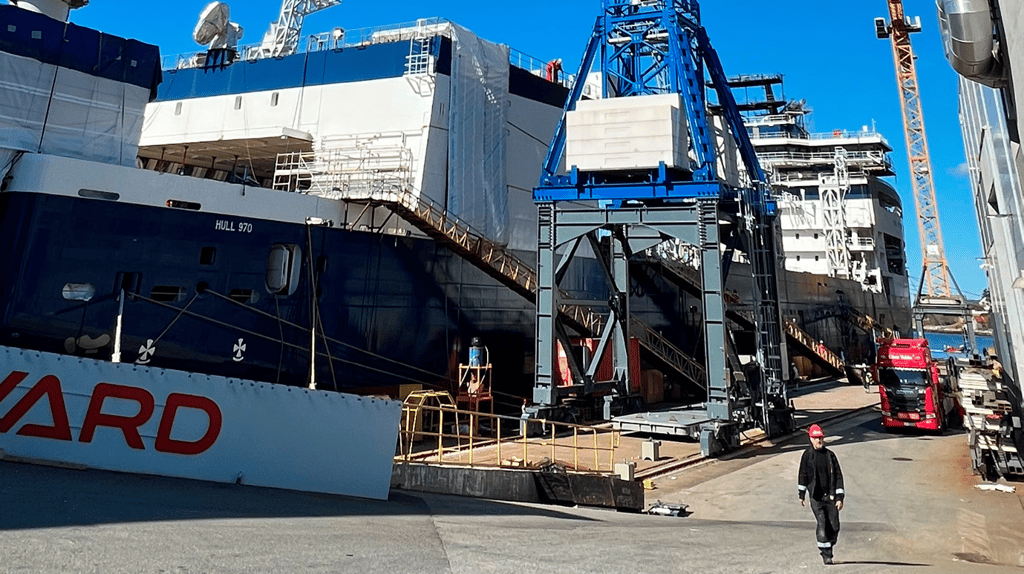
(Article originally published in Sept/Oct 2026 edition.)
Historically, the design and operation of lifting equipment was largely a matter of muscle. Whether lifting machinery onto a ship under construction or controlling a towing hawser under load, every system ultimately performed the same fundamental task – converting power into controlled mechanical work.
The physics haven't changed, but the machines doing the work have evolved dramatically. Electric drives and sophisticated electronics are changing how machinery consumes (or recovers) energy. Sensors and software continuously monitor loads and equipment condition. Automation separates people from hazards, and operating data is an essential tool for managing maintenance and productivity.
These factors make cranes and deck machinery a useful barometer for the maritime industry's broader technological evolution. It also requires looking beyond the gunwales
From Machine to Ecosystem
Equipment manufacturers Comansa and Markey Machine serve the industry from different markets. Comansa's shoreside cranes support shipbuilding, repair, ports and major infrastructure. Markey's towing, escort and mooring machinery provide brute strength aboard some of the industry's hardest-working vessels.
Different machines, different missions, similar challenges.
While tons of lift and pull still matter, they no longer tell the whole story. Modern lifting and handling equipment exemplifies the integration of mechanical might with electric or hydraulic drives, sensors, programmable controls and data systems. Each individual machine is now part of a larger ecosystem.
Comansa's PLC-controlled cranes incorporate sophisticated automation as the standard. Its cranes include anti-collision systems and human-detection scanners that support the operator. The company's Crane Mate platform monitors operating information and faults, recording operational history and trends that can be used to identify problems earlier, reduce unplanned downtime and extract more useful life from the equipment.
"The industry is moving decisively from preventive maintenance toward predictive maintenance," says Jon Ander Mora, Comansa's newly appointed Key Accounts Manager.
Markey approaches the same problem from the deck. "Vessel operators continue to focus on maximizing uptime and minimizing equipment failures," says Scott Kreis, Markey's Vice President of Sales & Engineering. "The cost of having a tug tied up because a key piece of deck equipment is down can add up quickly, so reliability remains the central requirement."
Electrification
Ports and terminals are de facto laboratories for electrification because much of their equipment operates on predictable duty cycles within defined areas. But electrification is spreading far beyond container handling.
Tower cranes have long relied on electric power, giving Comansa an upper hand considering the industry's current fascination with electrification. The company is investigating battery systems teamed with regenerative braking, which can recover energy during deceleration that's lost to friction and heat in conventional braking systems.
Markey faces a different conversion challenge aboard battery-powered tugs. The company's direct-DC hawser winches can draw power directly from a battery-powered tug's DC switchboard, returning regenerated power and eliminating unnecessary DC to AC conversions.
The significance is larger than either application. Electrification is no longer simply about replacing an engine or hydraulic motor with an electric one. Deck equipment is becoming an integral part of the vessel's overall power architecture.
Workforce Reduction?
Perhaps counterintuitively, automation does not necessarily mean workforce reduction. The operation of heavy equipment involves incredible amounts of kinetic and stored energy, creating hazards that cannot simply be wished away through better procedures.
Innovation can increase the separation between hazards and people. For example, Comansa is offering AI-enabled camera systems that can differentiate between an ordinary obstacle and a person within a crane's travel path, allowing different stopping protocols depending on what the system detects.
But Mora cautions against assuming that this trajectory leads immediately to an operator-free crane. "The near-term evolution is likely to focus on intelligent operator assistance, advanced sensors, anti-collision systems, load monitoring and semi-automated functions rather than fully autonomous operation," he says. "The goal should be to combine human experience with increasingly intelligent technology."
Markey provides an equally compelling example. In collaboration with customers, the company analyzed vessel motions and resultant forces between two vessels operating in a seaway. It then developed an active mooring system based on an existing static arrangement using two 200-horsepower winches capable of actively attenuating mooring forces as conditions change.
Customization
These are unique approaches that fit with Markey's century-old reputation as a custom winch manufacturer. But not every "custom" job needs to begin with a blank sheet of paper. Kreis says the company first evaluates whether a proven design already in service can satisfy a customer's requirements before developing a bespoke solution. Reliability, value and support remain the constants.
On the other side of the operation, ships themselves are getting larger. Still, capacity is only part of the equation. Shipyards need machinery that can reliably execute large numbers of lifting cycles of varying capacity with increasingly complex vessels. Comansa says its equipment is evolving to meet the challenge with power and modularity.
"A modular crane design provides greater flexibility, allowing the crane to adapt to changing construction requirements and space constraints," Mora explains. A crane installed today can potentially be reconfigured years later for greater height or a longer jib as the shipyard's requirements change.
Obsolescence
Nonetheless, a tension hides within all this technology: While ships, cranes and winches may remain in service for decades, electronics and software don't always age on the same schedule.
Markey sees that as an issue the industry should be discussing more.
"As the industry adopts more advanced automation and integrated systems," says Kreis, "we need to think beyond initial capability and consider how equipment will be maintained, repaired and upgraded throughout its service life."
Component obsolescence, replacement parts, software and compatibility with newer technologies can become significant problems long before the underlying steel begins to fail. "The next generation needs to be designed not only for performance but also for long-term reliability, maintainability and adaptability," he adds. "Technology should make equipment easier to operate and support, not create additional obstacles for the people who depend on it."
Comansa reaches much the same conclusion. Because shipyard and port cranes can be permanent installations, the company emphasizes corrosion-resistant surface treatments, oversized components where appropriate and standardized components from globally recognized suppliers. The latter lets owners source replacement components from multiple providers rather than getting trapped by an obsolete proprietary part.
That's not futuristic technology; it's smarter engineering.
Convergence
Comansa expects the crane of the future to remain recognizable mechanically. Lighter, stronger components will continue reducing structural loads, but the bigger transformation will happen in software with operators gradually moving from direct manipulation to remote supervision and decision-making with even finer control.
Markey's work in integrating reliable design and engineering with existing platforms and power structures provides another glimpse of where that convergence could lead as individual machines increasingly become elements of larger digitally managed operations.
Taken together, these perspectives suggest that the future of maritime machinery will not be defined by one breakthrough technology. Amid developments in electrification, sensors and software, automation, materials and data, Comansa and Markey provide an important counterweight to the industry's appetite for novelty. The equipment still has to last, be maintainable and work when the shipyard needs the lift or the tug needs the line.
Something heavy still has to move, and the machinery is getting smarter.

that matters most
Get the latest maritime news delivered to your inbox daily.
But the muscle still matters.
Chad Fuhrmann is Vice President at Core Group Consulting.
The opinions expressed herein are the author's and not necessarily those of The Maritime Executive.