


U.S. Hits Five More Iranian Tankers After Second Attack on U.S. Warship
In response to a second attempted Iranian missile strike on U.S. Navy warships on Monday, U.S. forces have hit another five Iran-linked tankers inside of the blockade line, according to U.S. Central Command. Iran subsequently warned mariners to prepare for retaliatory strikes on GCC-linked merchant shipping.
Last weekend, Iran launched ballistic missiles at a U.S. aircraft carrier and a destroyer, striking neither but drawing a U.S. retaliatory attack that sank one Iranian tanker and damaged two more. A second cycle of strike/counterstrike activity began Monday when Iran "tested" a new model of antiship missile against an unspecified U.S. Navy vessel, per top Iranian security official Major General Mohsen Rezaei.
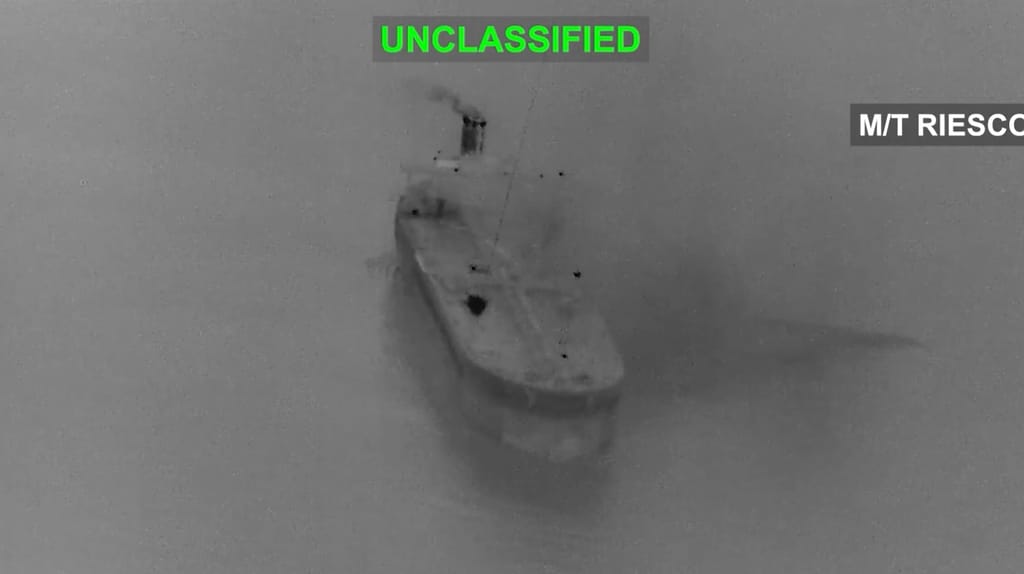
In response, U.S. forces launched additional strikes on Iran-linked tankers on Tuesday, hitting five ships - Derya, Horizon 1, Kaviz, Charminar and Riesco. Imagery released by CENTCOM suggests that several received disabling strikes at the transom; the attack on Riesco was more forceful, and the vessel subsequently sank.
CENTCOM forces destroyed five Iranian crude oil carriers, Sept. 8, after the Islamic Revolutionary Guard Corps (IRGC) targeted a U.S. Navy warship with ballistic missiles twice over the past two days. The U.S. warship successfully evaded the attempted Iranian attacks and… pic.twitter.com/Gi8a2tloN1
— U.S. Central Command (@CENTCOM) September 8, 2026
M/T Riesco sinks in the Gulf of Oman, Sept. 8, after being destroyed by CENTCOM forces in response to attempted IRGC attacks on a U.S. Navy warship. pic.twitter.com/EkmG8uyMT9
— U.S. Central Command (@CENTCOM) September 9, 2026
A closer look at DERYA (9569700) shows that her two lifeboats were not lowered in the water prior to the strike. Instead, Kharg Island port authorities dispatched many tugboats and pilot vessels to her in order to bring the crew to shore. CENTCOM usually provides 3 hours notice. pic.twitter.com/GHyUR16GPK
— TankerTrackers.com, Inc. (@TankerTrackers) September 8, 2026
U.S. officials told the Wall Street Journal that there is increasing concern that the quality of Iran's antiship weaponry and targeting appears to be improving, suggesting foreign assistance from one of its technologically-sophisticated partners. In May, the U.S. sanctioned three Chinese satellite and geospatial data companies for providing militarily-useful satellite imaging to Iran. The Russian government is also widely believed to be providing Tehran with high-end satellite surveillance.
In response to Tuesday's U.S. attack, Iran's Islamic Revolutionary Guard Corps announced an "urgent warning" to all tanker crewmembers off the coasts of Kuwait and Bahrain. "We warn that they must immediately abandon their vessels, whether in the anchorage or at the docks, as they will be targeted," the group said via social media channels.

that matters most
Get the latest maritime news delivered to your inbox daily.
Iran also launched a large-scale ballistic missile attack on U.S. bases in Jordan. Bystander imagery suggests that some of the missiles were armed with cluster munitions and that local air-defense batteries had to expend a substantial volume of increasingly scarce interceptors in order to defeat the attack. The extent of any potential damage to the base infrastructure is unknown; Central Command has previously declined to comment on or confirm the scope of battle damage to its facilities.
Iran launched a barrage of missiles at Jordan, claiming to target U.S. bases. Footage shows several interception attempts over the skies of Jordan. https://t.co/soDNkXXqQr pic.twitter.com/qHah5BSGQn
— Ariel Oseran ????? ??????? (@ariel_oseran) September 8, 2026
