


China Invents the "Land of Nanhai Zhudao" in the South China Sea
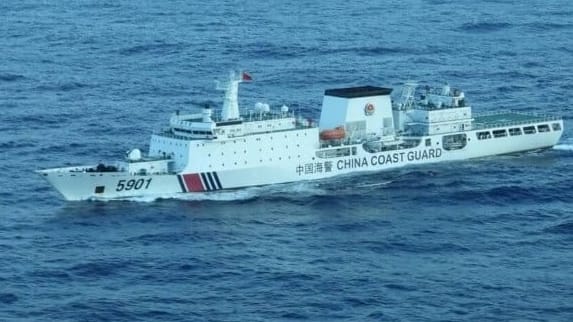
Frustrated by the 2016 ruling by the Permanent Court of Arbitration in The Hague, which found that Beijing’s claims to historic rights within the Nine-Dash Line in the South China Sea had no legal basis under the United Nations Convention on the Law of the Sea (UNCLOS), China has been further annoyed by events in the area in recent weeks, in which other claimants have stood their ground.
There has been a noticeable escalation of tension in the last month involving the Philippines, with clashes reported at sea between Chinese Coast Guard vessels and fishing boats supported by Filipino maritime agencies in the areas of the Scarborough Shoal and the Second Thomas Shoal, where the Philippines has been attempting to resupply its presence aboard the grounded ship BRP Sierra Madre (LT-57). The situation was worsened by the very public rebuff of the Chinese made by the Philippine Defense Secretary Gilberto Teodoro Jnr at the Defense Dialogue conference in Seoul on September 8. These tensions have prompted a Chinese counter-offensive.
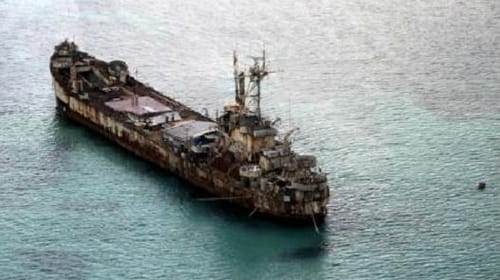
The LST-542 Class landing ship BRP Sierra Madre (LT-57) aground in the 2nd Thomas Shoal (USN file photo)
In the wake of the Hague ruling in 2016, China started – sparingly at first - to use the term Nanhai Zhudao to describe the area of the South China Sea where it claimed four separate groups of islands: Pratas Island, the Paracels, Scarborough Shoal, and the Spratly Islands. Alongside Nanhai Zhudao, it has also used the descriptor Four Sha (or Four Sands). In recent pronouncements, the Chinese have begun referring to these islands as one collective, politically administered as Sansha City, and implying that the four separate island groups are an archipelago, one geographic entity, and part of China’s internal seas and territorial waters.
China will be adopting this single collective identity to try to strengthen its claims. However, The Hague judgment specifically dismissed historical background as irrelevant to adjudications made under UNCLOS, and in any case, Nanhai Zhudao is a recent invention, and the first known mention of the invented term Four Sha is dated etymologically to 2017. Claims that the four island groups form a single archipelago are also geographically incorrect, and again are irrelevant to the case adjudicated under UNCLOS by the Hague Arbitration Tribunal. Nonetheless, the Chinese Military Bugle newspaper somewhat optimistically claimed on September 27 that “Nanhai Zhudao have long been widely recognized by the international community as part of China's territory.”
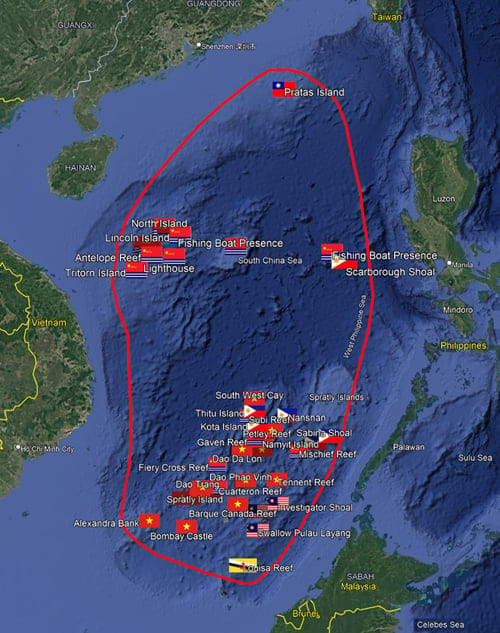
Disputed South China Sea islands occupied by China, Taiwan, Vietnam, and the Philippines (Google Earth/Copernicus/CJRC)

that matters most
Get the latest maritime news delivered to your inbox daily.
The dispute between China, Taiwan, Vietnam, the Philippines, Malaysia, and Brunei over ownership of rocks and reefs in the South China Sea has been going on now for long enough for all parties to recognize that a concession made by any party will be eaten and digested before a demand for more is made, such that negotiation to achieve a consensus settlement would not only be fruitless but also dangerous. It appears therefore that this sea area will remain a long-standing arena for potential conflict, and it is only a matter of time before there is a serious incident at sea with loss of life, with the danger that matters will then escalate further. In the meantime, China is likely to continue and even expand its program of land reclamation, to create islands and military bases out of reefs, a program which has accelerated in recent months as the construction of a 3000m runway on Antelope Reef in the Paracel Islands nears completion.
