

TOTE Wins U.S. Navy's First Vessel Construction Manager Contract
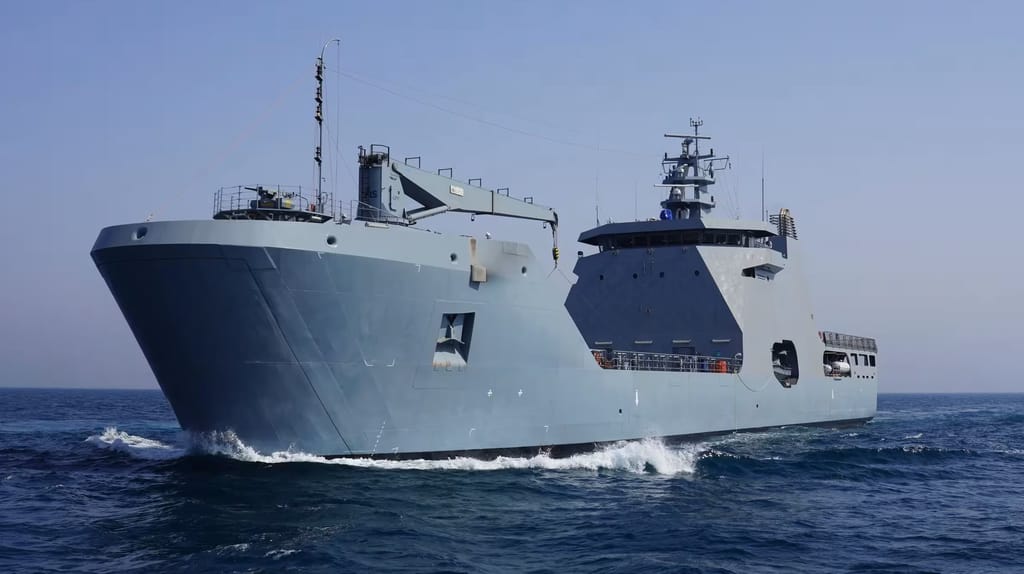
TOTE Services, which pioneered the idea of a third-party construction manager for U.S. government shipbuilding programs, has won the U.S. Navy's first-ever VCM award. TOTE will supervise construction of the future Medium Landing Ship (LSM) program at two Navy-selected yards, Bollinger (for the lead ship) and Fincantieri Marinette Marine (for four follow-on ships). TOTE will have flexibility to award contracts for up to three more vessels in the series.
The contract is worth $2.2 billion. In its contribution to the program, TOTE will standardize the vessel design across multiple yards; buy ships in blocks to get the best possible price; and "accelerate delivery, strengthen cost and schedule discipline, and expand the U.S. shipbuilding industrial base." The contract structure was authorized by Congress: a requirement to hire a VCM for up to eight of the 15 ships in the LSM program was inserted into the appropriations language in the FY2026 NDAA.
LSM is based on a 4,000-tonne tank landing ship designed by Damen, and it is already in service in the Nigerian Navy and on order for the Australian Defence Force. It is a comparatively simple, inexpensive design, lacking the exquisite sensors and defensive systems of a surface combatant - a design decision that was debated for years by the Marine Corps and the Navy. The program is driven by the USMC's need for interisland mobility in the Western Pacific.
"This is a tremendous responsibility and a defining moment for American shipbuilding, the VCM model, and TOTE Services," said Jeff Dixon, President of TOTE Services. "We are grateful to PAE Maritime, the Marine Corps, Congress, and the many government leaders who have championed this important program."

that matters most
Get the latest maritime news delivered to your inbox daily.
According to its proponents, the VCM model reduces the risk of cost overruns and delays, which have affected every Navy newbuild program in recent years. The third-party manager can offer government customers several benefits: it interfaces with the yard using commercial language and procedures, streamlining decisionmaking; it can handle federal paperwork on the yard's behalf, taking off the reporting and compliance burden; and it can maintain design stability by absorbing institutional pressure to make changes and contract modifications. Late-arriving design changes can cause serious difficulty in maintaining schedule, as seen in the Constellation-class frigate program, which was ultimately cut short after design-driven delays.
In TOTE's first VCM contract, for the Maritime Administration, it was selected as the prime contractor at the outset of the program. TOTE then selected the shipbuilder and hired it as a subcontractor. This time, TOTE is stepping in after the start of the program: the Navy has already designated the vessel's designer and to two shipyards. A competing bidder, Crowley Government Services, filed a formal protest over this arrangement during the selection process for the VCM. Crowley asserted that the Navy was putting too much commercial risk on the VCM by pre-selecting the subcontracting shipyards, thereby reducing the VCM's leverage as prime contractor. The protest was not successful.