


Iranian Leadership Changes Signal Regime's War Plan
Within Iran’s political leadership, factions compete for power and influence. Of late, these struggles have been between the IRGC and Paydari Party faction, loosely described as hardliners unwilling to compromise, and ‘reformists’, who take a more pragmatic approach to achieving the same Islamic Republic goals that the hardliners seek. A body of politicians are currently ‘outside the tent’, excluded from political positions by the Expediency Council; these are best described as liberals, but tap into widespread disillusionment with religion and the direction of the government.
Likely the consequence of disputes between these factions coming to a head, on August 10 the WANA News Agency announced that the Commander-in-Chief of the Iranian Armed Forces, Supreme Leader Mojtaba Hosseini Khamenei, had made six senior military appointments. The appointments followed what was claimed to have been an all-day meeting between the Supreme Leader and President Masoud Pezeshkian, who - not having had a face-to-face meeting with the Supreme Leader since his appointment on the death of his father - has now claimed somewhat dubiously that the Supreme Leader was ‘in perfect health’. A picture issued of the Supreme Leader today, to mark the meeting and to provide proof that he is alive, has been shown by Iran International to have been photoshopped.
The appointments made filled war casualty gaps and made adjustments.
Chief of Staff of the Armed Forces was named as Major General Pilot Ali Abdollahi, with Brigadier General Kioumars Heydari appointed as his Deputy.
Brigadier General Ahmad Vahidi, a noted and leading hard-liner, was promoted and appointed Commander-in-Chief of the IRGC, with Major General Mostafa Izadi to serve as his Deputy.
Although announced today, Rear Admiral Ali Ozmayei was appointed to command the IRGC Navy at the beginning of July, to replace the late Rear Admiral Alireza Tangsiri.
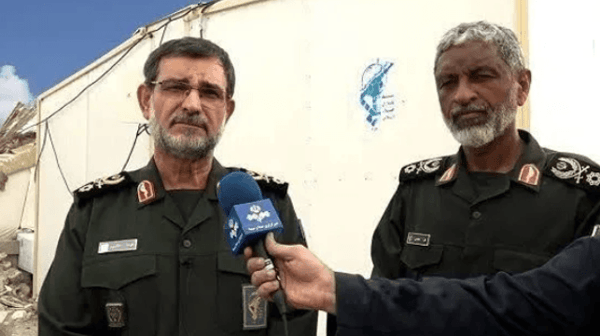
The late Rear Admiral Alireza Tangsiri (left) and his successor Ali Ozmayei (Facebook)
He has now also been appointed to command the Basij Organization, with Hossein Taeb nominated as his Deputy but also with command of the Basij internal security force. Taeb commanded the suppression of widespread protests in 2009, was then moved to head the IRGC internal security intelligence organization, and has now in his new role been tasked to expand what Iran International has translated as a “popular intelligence network”, using technology to detect and suppress popular unrest, presumably drawing on the Chinese social control model. Admiral Ali Ozmayei (sometimes transliterated as ‘Azmaei’) clearly has a critical role, being in charge both of warfare in the Strait of Hormuz and the effort to control popular dissent on the streets. With the distinction of having been sanctioned by the US Treasury in 2019, he previously was a particularly aggressive commander of the IRGC Navy’s 5th Naval Region, headquartered at Bandar Lengeh.
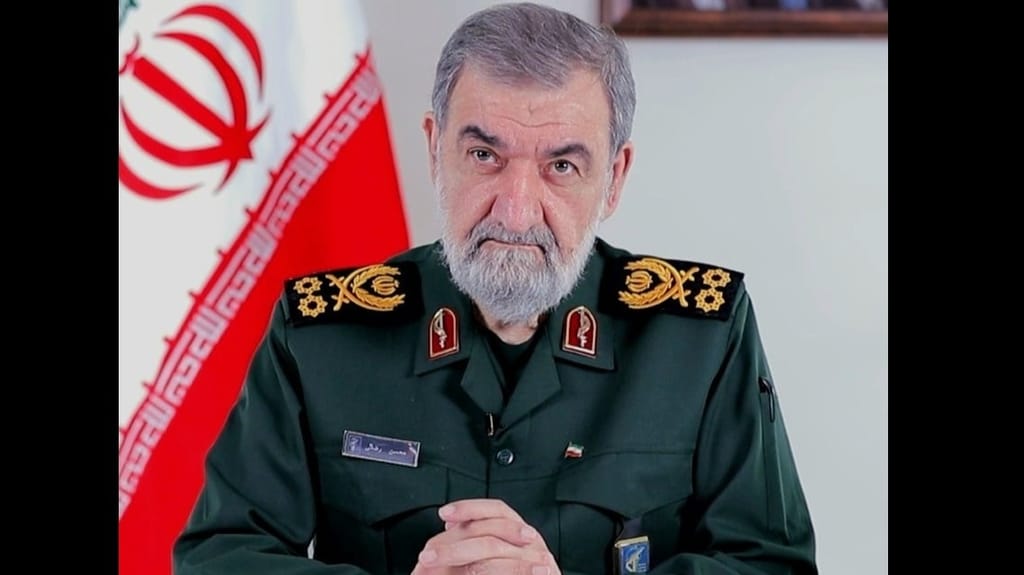
The military appointments were capped by an announcement made earlier that Mohsen Rezaei, a former head of the IRGC, was to be appointed secretary of the Supreme National Security Council - replacing Mohammad Bagher Zolghadr who had been appointed as a stand-in when Ali Larijani was killed in March. Rezaei and Zolghadr are both IRGC hardliners.
While some of the new appointees are relatively unknown, the track record of the others suggests that the IRGC hardliner faction has consolidated its grip on power in the contest between factions within the ruling elite.
Outside observers have great difficulty interpreting leadership struggles and political developments in Iran, tending to accept Iranian statements and confidential off-the-record leaks to the press as being honest and accurate, rather than calculating. The Iranian political elite is highly skilled in manipulative strategic negotiation, employing lies and deceit where necessary under the concepts of taqiyya and tawriya to gain an advantage over a non-believing enemy.
In this context, the leadership appointments suggest that the regime does not feel confident enough of long-term success to be able to make concessions in negotiations, which would be interpreted as weakness. It is also extremely concerned about internal unrest, which is likely to grow in strength as the economic blockade begins to affect ordinary Iranians in every aspect of their lives, who have to deal with the effects of hyper-inflation, shortages of food, and drastic shortages of power and water. As the regime senses popular unrest is rising, so its suppression and terrorization of the populace will increase, as evidenced by the recent reintroduction of public executions. But this in turn will create a backlash.

that matters most
Get the latest maritime news delivered to your inbox daily.
The regime knows that its primary weapons are its grip on the Strait of Hormuz and its threats to critical infrastructure in the Gulf States. It cannot afford to back down from threatening either. Any agreement on technical arrangements with Oman over traffic in the Strait will not be implemented, because Iran will not under current circumstances give up its right to vet what ships pass through the Strait. Not only does Iran want to control merchant traffic from GCC states using the Strait, it will also want to completely deny the Strait to US and allied warships.
As time goes on, GCC states will continue to lose their reliance on passage through the Strait, so the Iranian blockade becomes less and less worrisome day by day. But at the same time, the US naval blockade, aided by the US Treasury, is almost entirely effective, choking Iran both of money and essential imports, and these effects become worse day by day. Moreover, the United States can impose the blockade indefinitely, thanks to the professionalism of the US Navy, without putting the safety of its sailors in danger. Thus the contest becomes a matter of economic endurance, in which Iran has the weaker position. Provided that the U.S. has the staying power to remain on course, the war becomes a contest between the world’s richest nation and Iran - which clocks in at 197th place in global economic rankings.
The opinions expressed herein are the author's and not necessarily those of The Maritime Executive.
