


US Treasury Deals Iranian Sanctions Buster SeaLead an Exemplary Blow
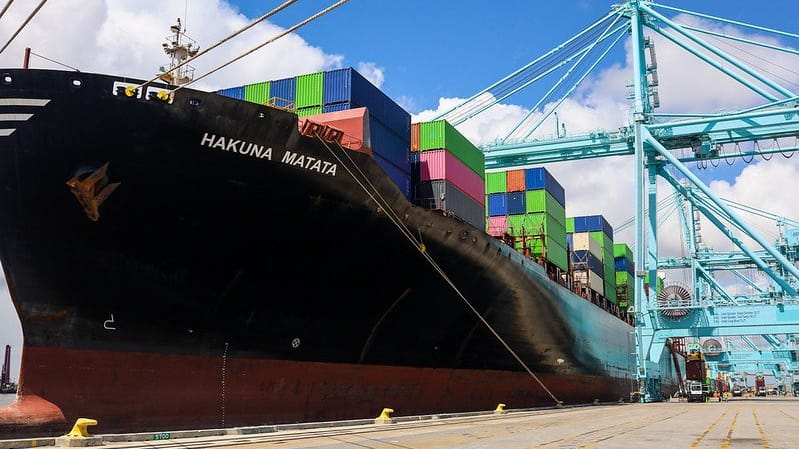
In late July, Singapore and Dubai-based SeaLead Shipping filed for voluntary liquidation. The company had long been a target of the United States for sanction busting, but it is a more involved tale, highlighting the depth of the Iranian schemes.
The U.S. Treasury first sanctioned 20 SeaLead entities and 10 vessels in July 2025, following up with further sanctions in April 2026 and a killer last-tightening on July 14. SeaLead’s container line, which had carried 200,000 TEU on 52 chartered ships pre-sanctions, ended up when liquidated with eight ships carrying 10,000 TEU, two of which SeaLead attempted to ring-fence by switching them to the Iranian flag in recent days.
Services to the U.S. West Coast were among the first to be axed. Ranked by Alphaliner as the fastest growing container line in 2024, ranked 13th globally in 2025, by the time it was on the brink of liquidation, post OFAC sanctioning, SeaLead had collapsed to 24th position.
The U.S. Treasury achieved a notable victory last week in tackling the sanctions evasion that has made the likes of Mohammed Hossein Shamkani and Babak Zanjani extremely rich.
Two figures closely connected to the political and religious elite in Iran typify for most Iranians what is wrong with the Velayat-e Faqih system of religious rule in Iran. Mohammed Hossein Shamkani, son of the late Iranian National Security Advisor Ali Shamkani, and Babak Zanjani, who manages to be intermarried both with the family of the late Supreme Leader Ali Khamenei and also his son Mojtaba, supposedly the current Supreme Leader, have both made billions by heading up commercial networks that sell Iranian oil exports through sanctions evasion schemes. Gholamreza Tajgardoun, the head of the Budget Committee in the Iranian Majlis, told lawmakers that in 2025 the government only received $13 billion from oil sales, worth $21 billion – the missing $8 billion having been purloined by the regime’s “trusted” middlemen such as Shamkani and Zanjani. Iranians may disagree on many things, but are united in their hatred for the corrupt figures that operate within the protected inner circle of the political and religious ruling elite in Iran.
SeaLead had no glaringly obvious Iranian or Shamkani connections until it was sanctioned by the U.S. Treasury, whereupon it denied it was trading on behalf of Iranian interests. However, the evidence was there: containerships it chartered, such as the Liberia-flagged Bigli (IMO 9307047), appeared to have loaded Iranian petrochemicals that were then discharged in China, and Dubai-based ship manager Marvise SMC DMCC undertook sub-charters from SeaLead apparently under Hossein Shamkani’s direction from a company office in Tehran.
A profitable business in which a great deal of Shamkani money is likely to have been tied up has, in effect, been closed down, depriving the Iranian regime of capital and a source of foreign earnings at a time when the U.S. naval blockade has closed down most Iranian oil and gas exports.
Financial sanctions are a particularly effective pressure point to apply to the Iranian regime, because it needs money in order to keep the Iranian population onside at this difficult time.

that matters most
Get the latest maritime news delivered to your inbox daily.
While the regime has shown a brutal determination to suppress political dissent, and has done so effectively, economic dissent, prompted by a shortage among ordinary Iranians, of food, money, and essential services, is harder to keep under control. As regime survival is the key determinant of political decision-making within the IRGC leadership in Iran, preventing an outbreak of economically-based dissent is probably the main engine within the regime persuading decision-makers to come to a settlement with the United States. The IRGC appears to be cognizant of the wisdom of the late General Gadhafi, who remarked that it is better to keep the people’s bellies full and their heads empty. The longer the conflict continues, the greater these economic pressures become, which is why in negotiations the Iranian team always appears to seek as a priority the resumption of oil exports and presses to have sanctions lifted.
When complaining of the shortfall in oil revenues last year, Gholamreza Tajgardoun perceptively recognized that the revenue shortfall would be far more acute this year, and in this regard, the U.S. Treasury shares some credit with the US Navy’s 5th Fleet.
The opinions expressed herein are the author's and not necessarily those of The Maritime Executive.
