


Geopolitical Turmoil Drives Improved Results and Higher Costs for Boxships
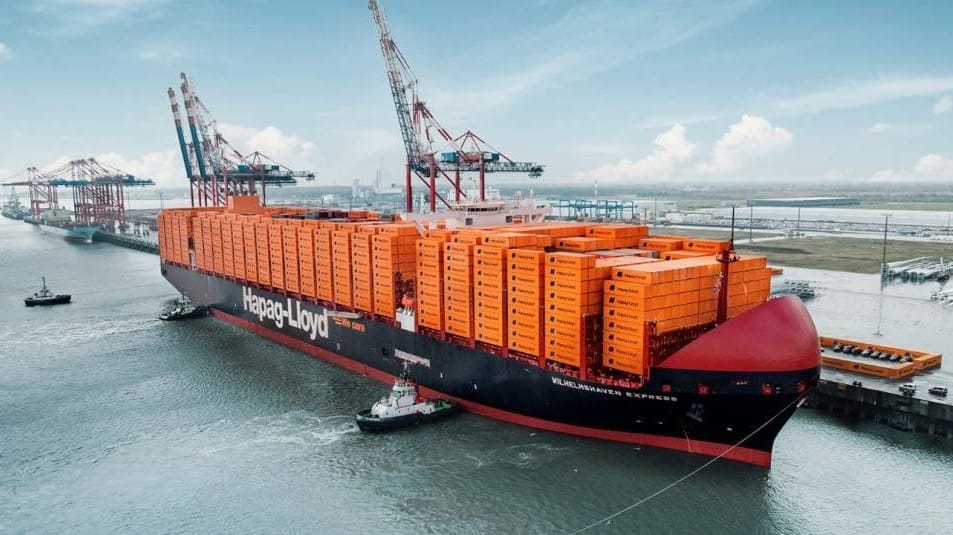
Maersk and Hapag-Lloyd both reported quarterly earnings on Thursday, August 13, and while they highlighted the turmoil in global markets, they also reported improved results driven in part by those same issues. While the two carriers are partnered in the Gemini Cooperation, they, however, experienced different impacts from the problems in the Middle East.
Both carriers cited significantly higher spot rates and robust demand in the second quarter, as Hapag-Lloyd termed it. Maersk said the markets had “remained resilient,” pointing to a better than four percent increase in volumes and a 22 percent increase in rates.
Hapag-Lloyd said its results were, however, impacted by a headwind of around $600 million in the second quarter “arising from the conflict in the Middle East.” The carrier had previously said it had six ships caught in the Persian Gulf, but today described additional costs for bunker, insurance, storage, service rerouting, and inland transport, all linked to the blockage of the Strait of Hormuz. The increased costs saw Hapag-Lloyd report slightly higher group EBITDA, but declines for EBIT and group profit.
“The second quarter was yet another proof point of the new era of heightened volatility we have entered,” said Vincent Clerc, Chief Executive Officer at Maersk. “Our global team's ability to capture opportunities in these difficult markets has enabled us to deliver significant volume and earnings growth across our businesses, leading to the substantial upgrade to our full-year guidance.”
Maersk cited growth that was “particularly strong for imports from Africa, North America, and Latin America, supported by continued momentum in exports from the Far East, especially China.” It said it had been able to reroute cargo bound for the Persian Gulf region to alternate ports and through inland transport routes.
Similarly, Hapag-Lloyd pointed to improvements in the second quarter versus the first. It cited strong exports out of Asia and improved U.S. demand. Both companies also pointed to positive results in their non-shipping segments, including terminals and logistics.
Maersk, as a result of the strong second quarter and “improved visibility for the remainder of the year,” raised its full-year financial guidance. After having started the year with a negative outlook for growth and even possibly a financial loss in operations, it is now expecting four percent market volume growth for the full year 2026. It increased its guidance by adding approximately $2 billion to both EBIDTA and EBIT forecasts, pointing to a strong profit for the year.
While sounding more cautious on the market, Hapag-Lloyd did raise its full-year 2026 earnings outlook in July. While saying the outlook remains subject to “considerable uncertainty due to the highly volatile development of freight rates and the conflict in the Middle East.”
Maersk, however, voiced potential longer-term concerns emerging in the markets: “Strong, broad-based demand from the Far East since 2024 has resulted in significantly more unbalanced trade flows, with volume levels that are challenging landside infrastructure capacity,” said Clerc. “From ports to inland transportation, we are seeing increased congestion and disruption across multiple geographies.”

that matters most
Get the latest maritime news delivered to your inbox daily.
In the past, both carriers have spoken about the potential for overcapacity. Maersk confirmed that it expects more volumes will return to the Red Sea but predicted it would have little impact on the market.
Speaking with the Financial Times, Vincent Clerc called for increases in investments in infrastructure. He pointed to the need to expand ports and add to trucking and rail capabilities. He predicted it will take time to make up for 15 years of under-investment. He pointed to emerging congestion in markets around the world, saying that it would result in more volatility.
