


Suspicious Subsea Cable Breaks Prompt Calls for Investigation in Australia
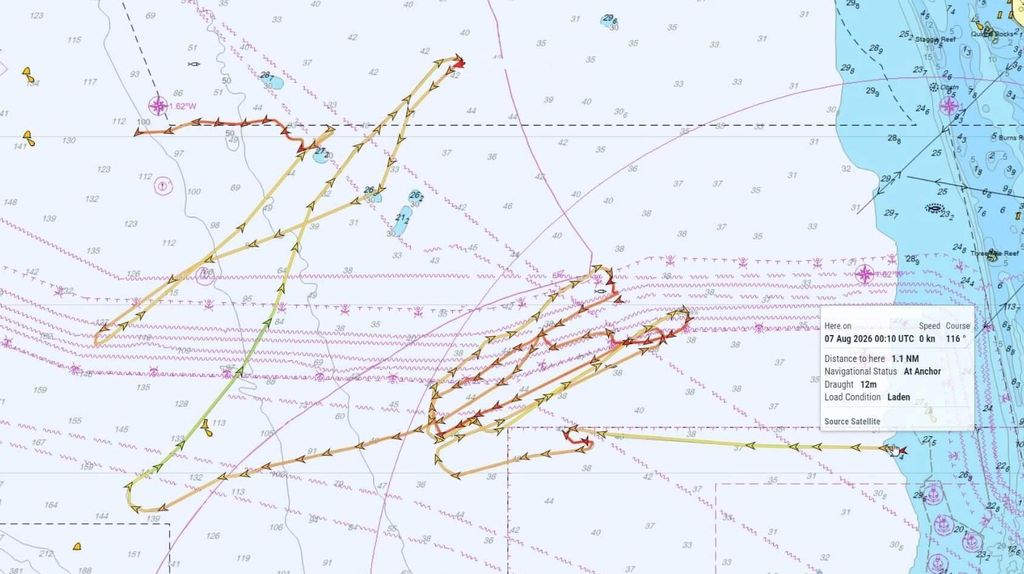
A new awareness of the vulnerability of subsea infrastructure is leading to enhanced scrutiny with every break, particularly when there might be a ship involved. Over the weekend, a UAE-managed product tanker opted to navigate in an unusual racetrack pattern over a charted subsea cable zone off Perth, Australia; at about the same time, a fiber optic cable operator reported an outage in two cables in the same area - and raised the possibility of a security incident.d
The cables breaks happened back-to-back within a government-designated cable protection zone, and the ship was moving back and forth in the same area. Security consultancy Windward independently validated the vessel's presence and identity.
The CEO of the operator, Subco, noted that the activity of the vessel could be a coincidence - but encouraged the authorities to investigate.
"This is a concerning development. Partially because submarine cables are the digital lifeblood of our nation, but also because this this could very well turn out to be the second such incidence in a Federally declared cable protection zone," said Bevan Slattery, founder and CEO of Subco.
The cables did not have automatic diagnostic systems installed, so Subco will not know the root cause of the casualty (and whether it was an anchor-drag incident) until it arranges a physical inspection. Anchor-dragging accounts for about one third of all cable breaks globally, according to the International Cable Protection Committee. Surface conditions at the time were benign, and the vessel made multiple crossings of the same cable area.
"This maybe a coincidence, but it’s important for the Australian Federal Police to investigate the issue urgently," said Slattery.
Australia has a keen awareness of its reliance on subsea cables. Just 16 of them connect the Australian market to the rest of the world, and losing two is a substantial security event. Both Russia and China are suspected of experimenting with cable-cutting as a way to cause disruption while maintaining deniability.
"We've seen numerous incidents in Europe and around Taiwan over the last, say, three or four years of cables being cut," said ASPI researcher David Brewster, speaking to ABC. "It's difficult to be absolutely certain of the reasons in some of these cases, but in a great number of cases, it's fairly obvious that they were done by state actors, Russia and China."

that matters most
Get the latest maritime news delivered to your inbox daily.
A newly-prepared review from the National Security College at the Australian National University (ANU) - released just this week - warns that these subsea capabilities are being actively tested and developed.
"The more recent incidents in the Baltic Sea and around Taiwan suggest that state actors are now actively probing and testing cable infrastructure in peacetime as part of broader hybrid warfare strategies, with the intention of being able to rapidly degrade connectivity at the outset of a conflict," the authors of the report concludd.
