


Video: AUKUS Partners Test-Fire Torpedo From Drone Submarine off Scotland
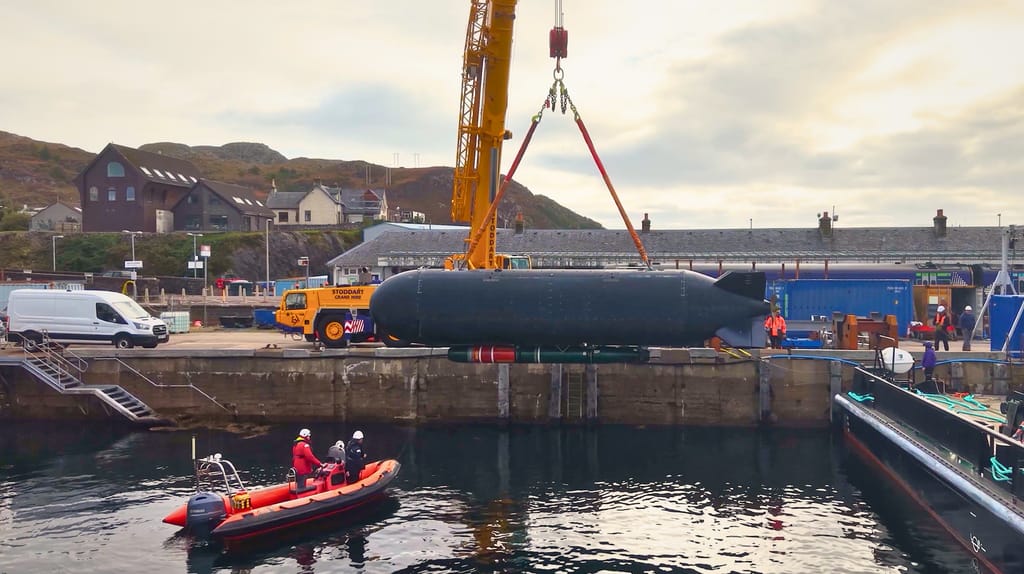
In a combined exercise of operational capability mounted jointly by Australia, the United Kingdom and the United States, a heavy-weight torpedo has been fired remotely from an unmanned submarine drone cruising in Scottish waters.
The weapon used in the trial was jointly developed by Australia and the United States, and has been identified as a Mk 48 Mod 7 Common Broadband Advanced Sonar System (CBASS) heavyweight torpedo, the latest version of a capable weapon with decades of service history.
The prime contractor for the Mk 48 Mod 7 is Lockheed Martin. The torpedo is the primary antiship and antisubmarine armament of U.S. Navy attack subs, and can use acoustic homing or wire guidance. In its antiship role, it is designed to detonate under the target's keel, with devastating effects.
The launch vehicle was an XV Excalibur, a 12-meter undersea 19-tonne drone, officially described as an Extra-Large Uncrewed Underwater Vehicle, built in Britain by MSubs Ltd. XV Excalibur was formally handed over to the Royal Navy in May 2025, and is mid-way through a two year trials program with the UK’s Submarine Development Agency.
???? U.S. NAVY UPDATE: U.S. Navy and Royal Navy Successfully Test Fire Torpedo from Unmanned Undersea Vehicle
— Office of the Chief of Naval Operations (@USNavyCNO) September 22, 2026
????WASHINGTON – On September 13, 2026, the U.S. Navy and the Royal Navy successfully conducted the proof-of-concept launch of an exercise U.S. Mk 48 Heavyweight Torpedo… pic.twitter.com/lVB4wYSwC0
An XV Excalibur was seen on the dockside at Kyle of Lochalsh in NW Scotland on September 16, so the trial is likely to have taken place at the UK Ministry of Defence torpedo range run by QinetiQ on Loch Alsh.
XV Excalibur’s ability to operate at extreme range was demonstrated in August last year, when it was controlled while cruising in British waters from an operations center in Australia. It is not clear what technology was used to achieve this, or how situational awareness is exchanged between a deployed drone and its control center.

that matters most
Get the latest maritime news delivered to your inbox daily.
In business since 1986, Msubs Ltd has a background in the development of crewed submersibles for manned, scientific and commercial uses, some of which can also be operated autonomously. A particular feature of the XV Excalibur is its quantum optical atomic “Tiqker” clock, which allows for highly accurate inertial navigation over much longer periods of time than previously possible, thus giving the system the means to undertake long-range covert missions.
The recent trial was conducted under AUKUS Pillar 2, the advanced capability component of the AUKUS trilateral partnership. The trial – and development of an operational capability to be deployed from 2026 onwards - forms part of the Atlantic Bastion program, which is designed using manned and unmanned systems to counter a growing threat to North Atlantic undersea cables and pipelines. As such, it demonstrates that AUKUS is not focused solely on the Asia-Pacific theater of operations.
