


Russia Opens Massive Vostok Oil Project and Sever Bay Arctic Port
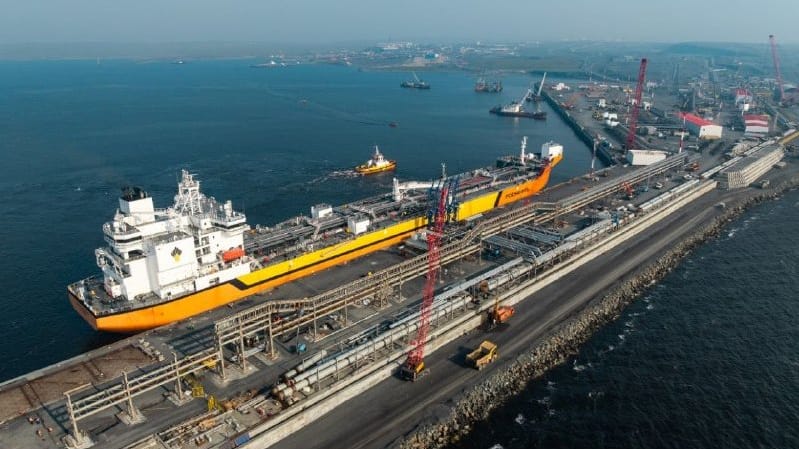
Russia’s massive new oil field in the Arctic, Rosneft’s flagship Vostok Oil, officially began operations on September 5. Underlining the significance of the project, President Vladimir Putin participated in the ceremony via teleconference and gave the order to begin loading the first tanker.
Vostok, which encompasses 52 license areas with 13 oil and gas fields, is estimated to have a total reserve of 7 billion tons of oil, making it one of the largest in the world. Rosneft proposed consolidating its Arctic interests in 2019 and began drilling in 2020 on the Taimyr Peninsula, the largest peninsula in Russia and the northernmost continental landmass of the Eurasian continent.
Putin referred to it as one of the largest Arctic projects and a key part of his plan to develop Siberia, the Arctic territories, and Russia’s Far East. He pointed to the key role the Northern Sea Route and their plans for the creation of the Trans-Arctic Transport Corridor played in the project and Russia’s goals to create a single route linking the Baltic region, the Arctic, and the Far East.
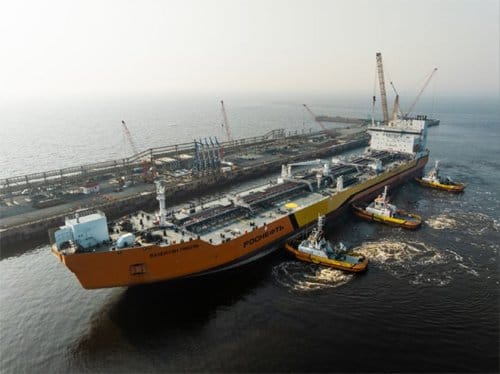
Russian shuttle tanker Akademik Gubnik arrived for the first cargo from Vostok (Rosneft)
Development of Vostok included the creation of the Sever Bay port located at the mouth of the Yenisei River. Putin and Rosneft boasted that the port is almost 500 km further north, making it the northernmost port in the world. Putin recognized that the construction work took place in severe frost and fierce wind conditions and included building a special dam to protect the bay and make year-round shipping possible.
The two oil fields are connected to the port by a newly created 790-kilometer (490-mile) pipeline, which is reported to have a capacity to move 100 million tons of oil per year. It includes a 6-kilometer (3.7-mile) section running below the Yenisei River.
At Putin’s direction, loading began for the shuttle tanker Valentin Pikul (69,323 dwt) built in 2024 for Rosnefteflot. Rosneft CEO Igor Sechin said that the company’s larger crude oil tanker, Akademi Gubkin (112,909 dwt), was already standing by to begin loading the second cargo from Vostok.
Sechin said, “As early as the second half of next year, Vostok Oil will ship 30 million tons of oil, increasing to 50 million tons by 2030, and eventually to 100 million tons per year.”

Putin attended the opening ceremony (Office of the President of Russia)
Putin added that the development of Vostok was just the first of many energy and other projects they envision for the Arctic. He said the agenda includes the integration of the Arctic sea terminals with railways and inland waterways to support the development.

that matters most
Get the latest maritime news delivered to your inbox daily.
“New icebreakers and ice-class vessels are being built for year-round navigation along the Trans-Arctic Transport Corridor,” announced Putin. He predicted that by 2030, “the domestic icebreaker fleet will be augmented by three serial universal nuclear-powered icebreakers of the Arktika project and the ultra-powerful nuclear icebreaker Rossiya of the Lider project. At the same time, we are developing the cargo and emergency rescue fleet, and the satellite constellation. The logistics infrastructure of the ports of the Baltic, Barents, and Kara seas, as well as in the Pacific Ocean, is being upgraded.”
Putin told the audience that the new oil pipeline and port terminal for Vostok will make it possible to increase shipments along the Northern Sea Route. He said that last year 37 million tonnes of cargo were transported along the route, while forecasting that by the end of the decade the annual cargo flow should reach 70 million tonnes.
