


Report: U.S. No Longer Has Enough Interceptors to Deter China
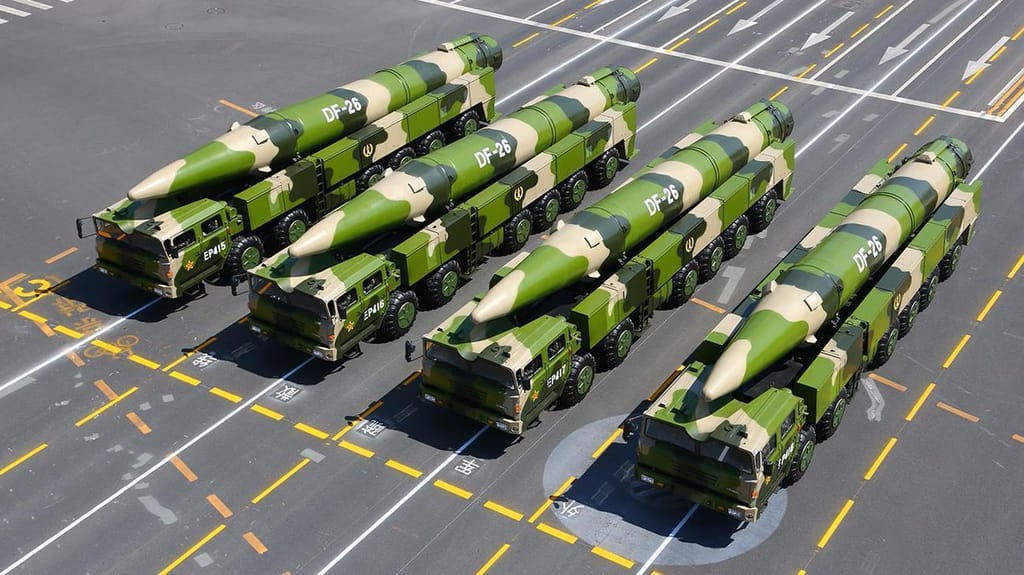
After six months of conflict with Iran, U.S. missile interceptor stockpiles have fallen so low that American forces do not have what they would need to successfully defend Taiwan against a Chinese invasion, according to a new review from the Heritage Foundation. The limited means to defend against China's abundant ballistic missiles - corroborated by multiple news outlets in recent reporting - raises questions about potential outcomes in the Western Pacific, and the viability of the Pentagon's plan to "pivot" to Asia.
A conflict in East Asia would center on naval capabilities, but those capabilities require basing for repair and replenishment. A significant part that activity would occur at forward locations - Guam, Okinawa, Yokosuka and Subic Bay, among other sites. To reach those locations, China has made deep investments in its ballistic missile inventory, and has about 2,700 available to launch at high-value targets around the region. Some models are designed and specifically tested for hitting American warships under way. China also has thousands of cruise missiles, likely in the range of 11,000 units, including supersonic models that require advanced interceptors to shoot down.
Each inbound threat requires the launch of three interceptors to assure it does not get through; one or two shots might work, but the odds of failure go up. An American response would prioritize whittling down China's ability to launch ballistic missiles on the ground, but that would itself take time, Heritage notes. "Interceptor inventory is not a supporting detail in a China contingency—it is what allows the Joint Force to survive long enough to win," wrote Heritage.
The U.S. interceptor inventory is classified, but multiple reports suggest it is getting low. New reporting by CNN suggests that the war with Iran has consumed the majority of available ground-based THAAD and Patriot interceptors, which have been used to protect Israeli territory, U.S. bases and the GCC countries' oil and gas infrastructure from Iranian counterattack. The current limitations of the U.S. precision-weapons stockpile were reportedly a factor in administration officials' reluctance to re-engage in major combat with Iran last weekend.
While the exact numbers are not public, both Heritage and CSIS have recently attempted to quantify the shortfall. Heritage's estimate portrays challenges ahead for deterrence in the Pacific: by its count, the U.S. has about 1,500 Patriot PAC-3 left, out of about 7,000 needed for a minimum "floor"; just 200 THAAD, out of 1,400 needed; 1,000 SM-6, out of 6,000 needed; and 400 SM-3, out of about 1,100 needed. Though far above current inventory, the "floor" numbers only reflect the study's most optimistic scenario: they assume that U.S. strikes could prevent the launch of half of China's ballistic missiles.

that matters most
Get the latest maritime news delivered to your inbox daily.
"In practical terms, the United States would run out of interceptors in the first few days of a conflict should China target U.S. bases with even a fraction of its missile inventory," Heritage concluded.
If onboard and shore-based missile defenses were exhausted, U.S. carrier strike groups would run high risks anywhere in the Western Pacific. China's DF-27 ballistic missile can reach all the way to Hawaii or the U.S. West Coast, and may have anti-ship capabilities. Smaller and more plentiful Chinese antiship missiles can reach the Philippine Sea, Japan, the Strait of Malacca and even Guam.
