
Op-Ed: Sanctions Drive Growth of a Parallel Shipping Economy
The Russia – Ukraine war started on 24 February 2022, when Moscow invaded its neighbor. The invasion triggered widespread condemnation, and a coalition of over 40 countries has imposed coordinated economic sanctions on Russia as a result. This international response consists primarily of the "G7+ coalition," which includes all major Western economies and several key Asian and Pacific nations.
Just last week, on July 23, the EU adopted its 21st (!) sanctions package since the invasion. The purpose of the sanctions is to restrict Russia's ability to finance and sustain the war in Ukraine. The main targets are Moscow's financial system, energy revenues, central bank reserves and military supply chains. The sanctions against Russia have been highly effective at causing long-term economic degradation and fiscal strain, but they have failed to stop the Kremlin's battlefield operations in Ukraine. However, the sanctions have had a major impact on the tanker industry.
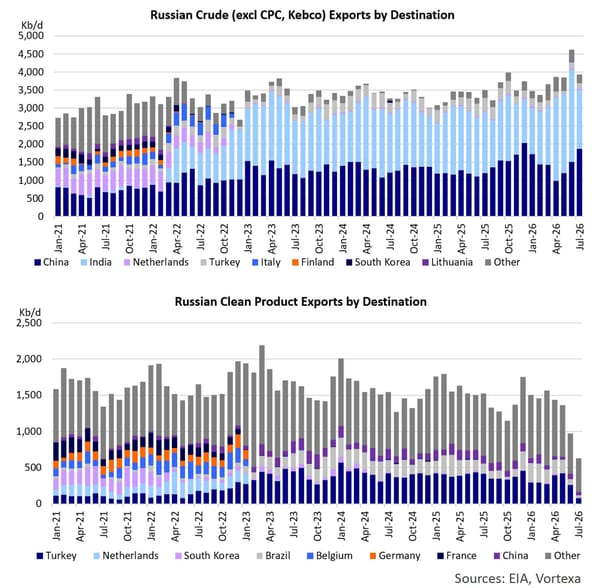
The sanctions on Russia have transformed crude oil and refined product flows. Before the war, the vast majority of Russian seaborne crude went directly to European Union ports. Today, that flow has essentially dropped to zero, rerouting heavily toward Asia. China and India, who are not sanctioning Russia, now consume more than 80% of Russia's seaborne crude oil exports. This has led to a massive boost in long-haul Suezmax and Aframax employment. One would typically use VLCCs for these long-haul trips to Asia, but Russia does not have access to VLCC-capable export terminals. This has transformed Russia's oil flows from using regional pipelines and short-haul voyages to long-haul trips on medium-sized, suboptimal tonnage.
The introduction and enforcement of price caps and trade bans has reshaped fleet ownership, vessel values, and maritime safety standards globally. The sanctions against Russia have also fractured the global oil tanker industry, splitting the maritime shipping world into two distinct, parallel markets: the regulated "mainstream" market and a booming, opaque "shadow" market.
The shadow fleet existed prior to the Russia-Ukraine war, when it was servicing sanctioned Iranian and Venezuelan barrels, but the size of the shadow fleet expanded rapidly since 2022. The size of the global shadow fleet is now estimated to number between 1,000 and 1,500 tankers. Depending on the segment, up to 20% of all oil tankers worldwide now operate entirely outside Western regulatory reach, creating a massive parallel shipping economy. Approximately 65% to 70% of Russia's seaborne oil exports are currently moved via these untraceable shadow vessels.
Surviving The Sanctions
Despite the sanctions, Russian crude oil exports have largely been maintained. As a matter of fact, they have been rising in 2026 to date. There are two main reasons for this.
First, the US-Iran war, which started at the end of February, closed the Strait of Hormuz and tightened the oil markets. To prevent oil prices from rising too much, the US government temporarily waived some of the sanctions on Russia, leading to an increase in shipments.
The second reason for higher Russian crude oil exports are the Ukrainian drone attacks on Russian refineries, dropping the Kremlin's domestic crude processing to a 21-year low. The Ukrainian attacks target critical components that are difficult to repair. This has created domestic fuel shortages in parts of Russia, putting pressure on the Putin regime. It also reduced Russia's refined product exports and forced more crude oil onto the export market.
What's next? As the scope of additional direct sanctions appears limited, countries are heavily leaning into secondary sanctions. The United States Senate is currently advancing a major Russia Sanctions Bill that would authorize up to 100% tariffs on third-party nations—such as India and China—that continue importing large amounts of Russian crude or facilitating evasion. It would also add more sanctions on Russia's leaders, its energy sector and Russia's shadow fleet, although President Trump will have broad waiver authority.

that matters most
Get the latest maritime news delivered to your inbox daily.
The geopolitical landscape is complex and increasingly interrelated. The war in Ukraine and the conflict in the Middle East both have a big impact on the oil and tanker markets and as a near term solution seems elusive in either conflict, the tanker market will have to continue to deal with high levels of uncertainty.
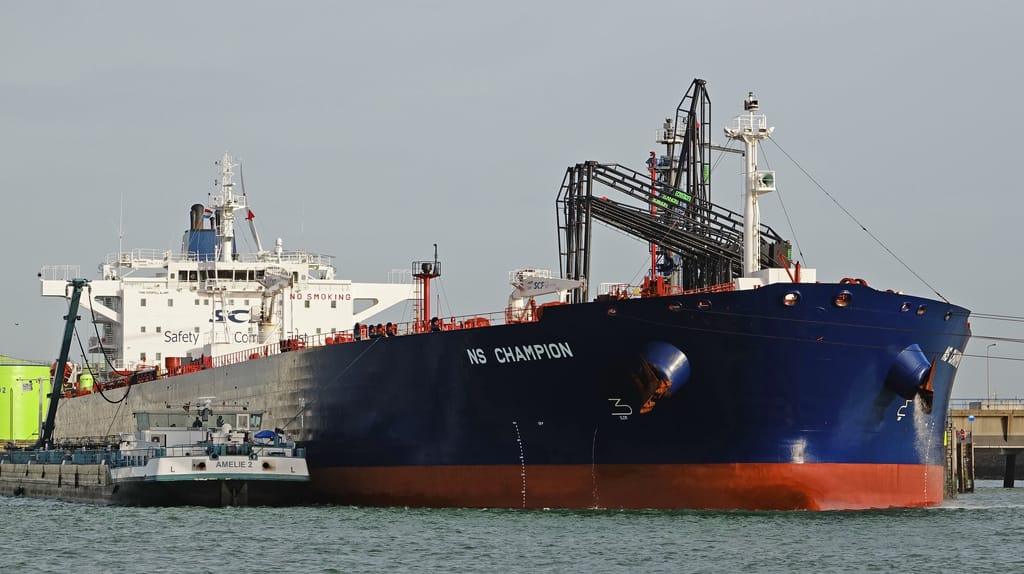
Top image: Sanctioned shadow fleet tanker NS Champion (Kees Torn / CC BY SA 2.0)
The opinions expressed herein are the author's and not necessarily those of The Maritime Executive.

.jpg)