


Oman Works to Clean Up Spill as Oil From Stricken Tanker Comes Ashore
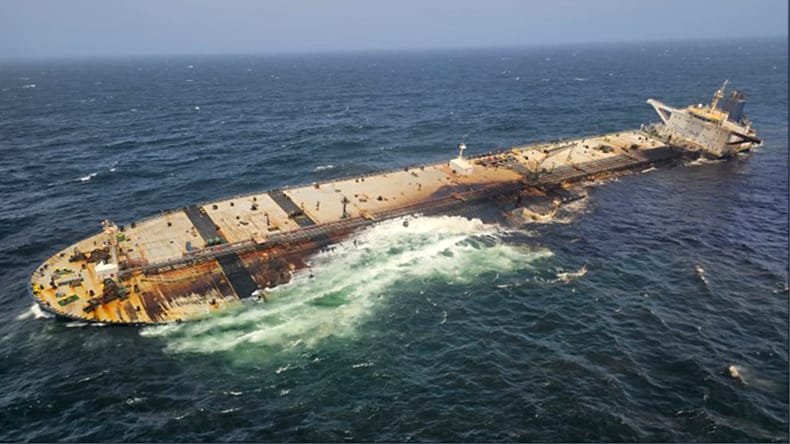
As oil spilled from the grounded tanker Caroline Bezengi begins to come ashore in mainland Oman, the nation's emergency-response agency is kicking into gear with a beach cleanup operation, the last resort of spill mitigation.
A stretch of coastline measuring about six to eight miles long has been fouled by the former cargo of the Russian shadow fleet tanker Caroline Bezengi, which was disabled by an explosion in June and drifted ashore on a remote island about 30 nm off the coast of southeastern Oman. The region is a protected marine area, home to sea turtles and humpback whales, and the spill is a significant environmental hazard for wildlife.
Workers with the National Committee for Emergency Management (NCEM) were working to clean up the spill by hand this week, according to local outlet GDN. Video from the scene showed heavy oil pollution on a stretch of sandy shoreline.
Oman’s National Committee for Emergency Management (NCEM) has spent days clearing crude oil from a 12km stretch of coastline, after the grounded Russian-linked tanker Caroline Bezengi leaked oil into a protected marine area off the sultanate's coast. #oman #oilspill #coastline… pic.twitter.com/UXPj767FIJ
— GDN Online (@GDNonline) August 18, 2026
????????? ?????? ????? Caroline Bezengi ????? ???? ??? ???? ????? ??????? ???? ????? ???? ??? ?????? ??? ???? ?????? ??? ????? ??? ?? ????? ???? ???? ???? ???? ????
— The Sea In Arabic ????? ??????? (@Theseainarabic) August 14, 2026
???? ??????? ????? ??????#ship #sea #port #oman #tanker #pollution #gulf pic.twitter.com/OJrwW9FaG1
Oman is working with the British maritime consultancy Ambrey to arrange for pollution abatement, and preparatory work is ongoing, according to Muscat Daily. Mohammed bin Abdullah Al Rawahi, Director General of Maritime Affairs, gave the outlet a thorough depiction of conditions on scene, and the situation is challenging.
The fully laden Suezmax tanker is aground on a rocky shoreline, exposed to 40 knot winds and waves of up to 12-15 feet. She has taken on a list of 17 degrees, her port side is awash, and her decks are slick with oil, making movement on board hazardous. An unspecified number and type of her tanks are punctured, and she is actively releasing oil. There is no reliable power aboard, so any pumping or ballasting operation will require generators. One possible objective, he said, would be to transfer oil from high-risk tanks over to other tanks that are less likely to suffer damage.

that matters most
Get the latest maritime news delivered to your inbox daily.
The characteristics of the bottom are rocky and unsurveyed, complicating approach by sea. Survey operations are under way as a priority measure in order to figure out how to bring larger salvage vessels alongside. There are no sheltered harbors in the immediate vicinity for staging maritime assets, and the only possible access for personnel is by helicopter.
For now, the intense winds and seas of the Khareef monsoon are hampering efforts. The season ends in September, at which point conditions should ease, enabling access, reducing safety risks, and slowing the gradual, inexorable effects of wave action on a grounded ship.
