
Launch Control
(Article originally published in Jan/Feb 2026 edition.)
A rocket launched from a barge in the middle of the ocean is the end of a long logistics chain involving cranes rated for explosive cargo, reinforced piers, cryogenic fuel storage and crews of workers and sailors willing to work the most isolated jobs on Earth.
All of that is very expensive. Still, mobile, sea-based launch platforms are worth it for a particular kind of customer. Specifically, for one trying to reach, and track, orbital paths that aren't accessible to fixed land-based facilities like Cape Canaveral in Florida or Kourou in French Guiana. In that case, using barges, support vessels and specialized shoreside infrastructure makes sense.
Also, you might not care about the equatorial band. You may be targeting a polar orbit, for which higher and lower latitudes work best. Then, the equatorial boost, which adds up to around 460 meters/second to your launch velocity, is irrelevant. When you launch from the ocean, you can maneuver your platform into the position best suited for its ballistic task.
The strategic value of a sea-based launch platform is, in any event, undeniable. And China, the biggest customer for sea-based orbital launches, isn't guided by financial considerations.
China leads
For China, progress is easy when you attach a military budget to a civilian operation that never needs to turn a quarterly profit.
Take Tai Rui, a semi-submersible barge rumored to be around 160 meters long: It can fire off Long March 11 rockets. These are derived from the DF-31, an intercontinental ballistic missile with an 8,100-mile range. The DF-31 missile can deliver a one-megaton warhead to targets in North America, Europe or Asia. Or, if launched from the ocean, its target range would be much more flexible.
Tai Rui had to have its ballistic cargo transshipped when on location. Then came De Bo 3, built in 2017. It can haul missiles directly from Haiyang City Space Port, a facility in which "the People's Liberation Army (PLA) remains centrally involved," according to the China Aerospace Studies Institute. And Haiyang City Space Port is building a specially designed rocket-launching vessel, according to Chinese news agency Xinhua, which will be "a moveable landing platform" that "can provide more orbital routes for rocket payloads."
To support these launches, the tracking vessels Yuanwang 3, 5, 6 and 7 are operated by the China Satellite Maritime Tracking and Control Department. Yuanwang 7 can operate for over 100 days at sea. These ships monitor orbital objects.
Liaowang-1 is the first in a line of new hulls scheduled to ultimately replace the Yuanwang-series of vessels. It's said to be able to track 1,200 targets simultaneously with 95 percent-accurate identification while simultaneously acting as a mobile command center for space and naval operations.
Such ships can close gaps in terrestrial tracking systems. During the Cold War, until 1983, the U.S. maintained the missile-and-capsule-tracking vessel USNS General Hoyt S. Vandenberg. Russia retired the 232-meter Kosmonavt Yuri Gagarin in 1996 due to funding constraints.
Russia and the U.S.
So, where does this leave the rest of the world? The U.S., specifically SpaceX, is the leader in using barges to recover booster stages that have landed at sea. And then, of course, Europe has its own program, as does Russia – at least, on paper.
Vladivostok, Russia's port at the Sea of Japan, is the first stop on our tour. There, resting in port (R.I.P.), you will find SP Odyssey and Sea Launch Commander, built in 1983 and 1997, respectively. Both once belonged to the multinational, Switzerland-based Sea Launch conglomerate, which combined American, Ukrainian, Russian and Norwegian expertise to cover everything from shipbuilding to rocket science.
After its 2009 bankruptcy, new owners stepped in, flying occasional missions. In 2018, Russia's S7 group bought the barge and command ship and moved them to where they are now laid up. With restoration costs estimated at over $470 million and no orderbook, future scrapping seems likely.
Moving to the U.S., SpaceX and its water-based operations have neatly solved for recovery, but not for launch. The reason: The Pacific and Atlantic Oceans are both already well reachable from Vandenberg and Cape Canaveral. Both allow debris to fall into the water. Vandenberg is far enough north that it's no trouble to attain a polar orbit from there.
In 2020, SpaceX bought two oil rigs with the intent to use them for Starship launches. But in 2023, Gwynne Shotwell, President of SpaceX, said, "they were not the right platform." Elon Musk believed that "[o]ver time I think there's going to be floating spaceports," but SpaceX sold the two mentioned oil rigs anyway.
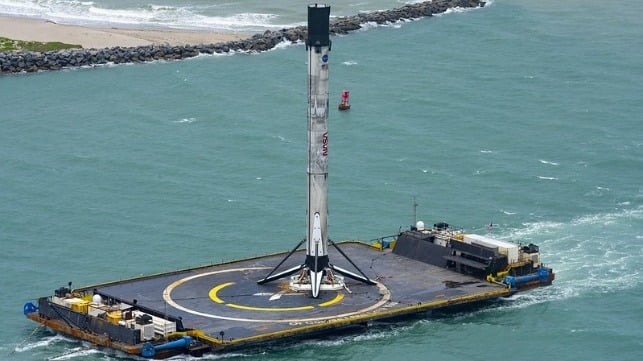
In the interim, the company invested in converted Marmac deck barges that are deployed as drone ships. They're used to recover the boosters for Falcon 9 and Falcon Heavy rockets, which cost double-digit millions each. By now, SpaceX has recovered hundreds of such boosters successfully.
One SpaceX barge, A Shortfall of Gravitas, is even able to sail autonomously and use its own positioning, so it doesn't need to rely on a tugboat for its mission – an engineering triumph.
China's military-backed, state-funded operations run free of commercial pressure. SpaceX is focused on the most pragmatic, economically viable options. Russia's two hand-me-down vessels are not operational and have no viable pathway. What about Europe?
Europe
In September 2023, the German government committed €2 million to the German Offshore Spaceport Alliance (GOSA).
Most of that funding went toward feasibility studies, paperwork and fitting out supporting ships, in particular, the Combi Dock I, a 170-meter semi-submersible, heavy-lift ship owned by Harren & Partner, a white shoe, family-owned shipping company. After announcing that the first orbital launch would happen in the spring of 2024, delay followed delay. In mid-2025, GOSA went silent. Its website no longer appears to be active. As of this reporting, contemplated German offshore spaceport orbital launch vessel Combi Dock I was carrying general cargo from Seville in Spain to Esbjerg in Denmark.
But that is not to suggest that Europe is presently entirely without options.
Copenhagen Suborbitals, the world's only crowdfunded space program, has a better record. Since 2011, the group has designed and successfully launched six missions from the Baltic Sea, including rockets and capsules. With roughly 50-60 volunteers including "blacksmiths, physicists, rocket scientists and software engineers, to name only a few," Copenhagen Suborbitals is preparing for its first manned missions using its Spica rocket and a floating launch platform called Sputnik.
Before a mission, accompanied by its support vessels, Sputnik is towed from Nexo harbor at Bornholm in Denmark to EDS139, a Danish navy shooting range in the nearby area. To date, the group has focused on suborbital spaceflight, which means it targets below the Karman line. At 100 kilometers above the surface of the Earth, the Karman line separates our planet from space.
If nothing else, the group has shown that a small budget is no obstacle. And as for the law? "There is no particular regulation with regards to putting people on board rockets and blasting them off into space," says Jacob Larsen, who moonlights for Copenhagen Suborbitals when he isn't working his day job in the satellite industry.
Whether that sentiment holds up against the E.U. Space Act, proposed on June 25, 2025, remains to be seen. "Collision avoidance" and "debris mitigation" regulations sound like trouble.

that matters most
Get the latest maritime news delivered to your inbox daily.
"We're flying an amateur astronaut into space on an home build [sic], crowdfunded rocket," Copenhagen Suborbitals declared on its (live!) website. "Want to see it happen?"
Yes, I do. And that mission sounds risky enough that ships will be involved, too.
The opinions expressed herein are the author's and not necessarily those of The Maritime Executive.