


Australian High Court Says Shipping Company Cannot Limit Liabilities
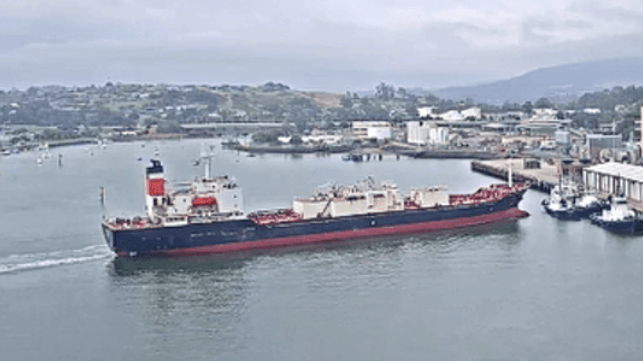
Four years after a docking accident caused the loss of two tugs and caused significant environmental damage, Australia’s High Court has ruled the shipping company CSL Australia cannot limit its liabilities resulting from the incident. The case has gone back and forth in the courts as TasPorts, operator of the Devonport harbor where the incident took place and owner of the tugs, sued to recover its losses.
The case stems from a January 2022 incident when the Australian-flagged cement carrier Goliath (15,539 dwt), operated by CSL Australia, was maneuvering into the dock at Devonport. The master of the vessel was conducting the maneuver. His practice was to maneuver using the main engine telegraph for power control; the bow thruster control; and the joystick for the specialized VecTwin rudder angle control, according to the Australian Transport Safety Bureau (ATSB).
In its report, ATSB found that the ship was not responding as the master expected, and then suddenly the vessel had picked up speed to four knots and was still accelerating. As the ship closed in on the wharf, the master looked at the rudder angle indicator and determined that both rudders were amidships, not the rudder angle set on the VecTwin joystick. ATSB found the incorrect settings caused the allision where the vessel struck the wharf as well as two docked tugs, York Cove and Campbell Cove, which were badly damaged and sank at the pier.
There was an estimated 69,000 liters of diesel and other fuel on the two tugs, which leaked into the river. TasPorts undertook the clean-up, and more than six months later, the salvage of the two tugs.
TasPort sued for approximately A$22 million (US$16 million). CSL Australia did not deny liabilities in for the incident but sought to invoke the convention for the Limitation of Liability for Maritime Claims. It is a long-standing principle of maritime law, with the most recent version of the IMO Convention drafted in 1976 and in force since 2004. While the limit of liability for claims covered was raised considerably, it still uses a formula based on tonnage to determine liabilities.
Under the formula, CSL asserting its liability should have been limited to no more than A$15 million (US$11 million).
A Federal Court judge initially found in favor of CSL, but TasPort won on appeal in front of the full court. Today (May 13), the High Court dismissed an appeal from the Full Court of the Federal Court of Australia. The case had come down to the fact that Australia, when it adopted the convention, had elected not to adopt certain provisions. The courts debated where CSL’s liability fell within the convention. The High Court finally ruled Australia had not adopted provisions that limit the liabilities for the raising, removal, and destruction of a sunk or wrecked ship.

that matters most
Get the latest maritime news delivered to your inbox daily.
Experts point out that this could have wider ramifications in Australia and future liability cases. Similar issues will also be debated elsewhere, including in a U.S. federal court in Baltimore in the coming weeks. Grace Ocea, the owner of the containership Dali, and Synery Marine Group, operators of the containership that destroyed the Francis Scott Key Bridge, have sought to invoke an 1850s law that would let them cap liabilities at the value of the vessel and its cargo. Plaintiffs ranging from the City of Baltimore to cargo owners, the families of six people killed when the bridge collapsed, and local businesses, are seeking to block the limitation of liability.
The problems for CSL Australia, however, are not over from the 2022 incident. The company has also been charged with causing serious environmental damage. A legal case is still pending on those charges.
