


OpEd: Russian Ceasefire Scam Hardens Ukrainian and Widens Maritime Risk
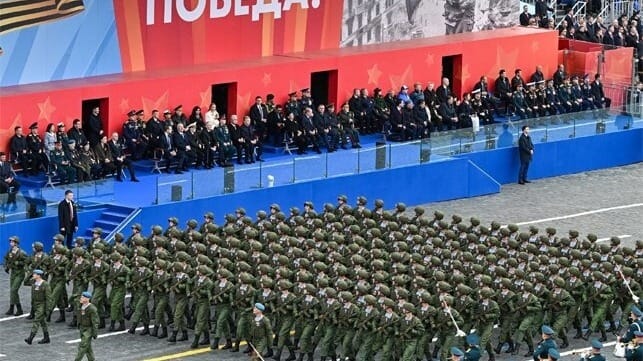
The Russian Victory Day Parade in Moscow on May 9 is normally a display of military might. This year, however, it was a greatly scaled-back affair without the display of equipment and lasting less than one hour.
With Ukrainian drones and missiles regularly penetrating Moscow’s air defenses, President Vladimir Putin had to call on President Trump to guarantee a ceasefire, to ensure that even the scaled-down parade, which was held, was not attacked.
In doing so, President Putin demonstrated two things. By failing afterwards to release 1,000 Ukrainian prisoners as fixed for May 9, the key incentive for the Ukrainians into the temporary ceasefire offer for which President Trump was the guarantor, Putin betrayed Trump, confirming once again his consistent untrustworthiness as a negotiating partner. It also demonstrated that Putin no longer has confidence in his own war machine and that the parade, as configured, was in effect a warning and indicator of Russian military weakness on the battlefield.
Even if he finally relents and bargains afresh to go forward with the prisoner exchange, President Putin’s blatantly humiliating behavior in regard to the United States should also persuade President Zelensky to be clear on who his allies are and who is offering comfort to Ukraine’s enemy. When US-brokered peace negotiations are so obviously skewed to favor the Russians, there is no longer any need for pretense or restraint on the Ukrainians’ part to keep the United States on side politically, especially as US arms transfers to Ukraine are largely paid for by Europe. American ‘private enterprise’ support is, however, still hugely important to the Ukrainians. Control of Starlink access and assistance with developing battle management systems are proving to be decisive factors in Ukraine’s increasing success on the battlefield.
Whereas the Ukrainian leader is now discounting diplomatic support from the United States, casting doubt on what role the United States might have in settling the war, support from Europe is now firmer – because only Ukraine sits between Europe and a revanchist Russia, and also because Ukraine is leading advances in military technology that are needed to counter the Russian threat.
Ukraine has also acquired more friends in the Middle East, where Ukraine has stepped forward to offer air defense assistance to Gulf countries under attack from Iran. These Gulf countries are aware that Russia has been providing assistance to Iran, and despite Gulf countries wooing Russia over the past decade, Russia has done nothing to help them, even vetoing the GCC-supported and watered-down resolution put forward by Bahrain to the UN Security Council. When the war in the Gulf ends, the Gulf oil producers will need to rebuild their markets. Whereas before some cooperation with Russia was necessary to balance supply and demand in the global oil market, now these Gulf countries will need to look after themselves and will see a recovering Russia rather more as a competitor than as an ally deserving some assistance. This gives Ukraine the opportunity to widen the scope of the war, and the possibility of additional support as well.

that matters most
Get the latest maritime news delivered to your inbox daily.
In practical terms, as far as this has an impact on the maritime community, this means that an intensification of Ukraine’s attacks on Russian shipping can be expected, attacks which will be less and less confined to home waters and will range the world. With oil export and refining infrastructure an acknowledged target, even non-sanctioned tankers loading non-Russian oil at Russian terminals, for example, Chevron’s Kazakh crude loaded at Novorossiysk from the CEPS pipeline, are now more likely to fall victim to Ukrainian attack if they are in the wrong place at the wrong time. Further attacks similar to that carried out on March 3 against the Russian-flagged LNG carrier Arctic Metagaz in the Mediterranean are likely. It seems an astute move on the part of Oman’s Asyad Shipping to have divested itself of the now Russian-flagged LNG tankers Kosmos (IMO 9300817), Luch (IMO 9317315), Orion (IMO 98899040 and Mercury (IMO 9262170), because the risk to these vessels in any port, not just in Murmansk, to where the Luch is heading, has increased significantly.
Key to the additional risk posed to Russia-related assets is the improvement in the quality and quantity of Ukraine’s offensive drones and missiles, far outpacing Russia’s own production. Aside from important tactical developments on the battlefield, Ukraine appears to have increased the range of its Firepoint FP-2 drone so that, with a video link and terminal guidance, it can hit targets in the Caspian Sea 1,000 miles away. Production of FP-5 missiles now appears to be reaching 50 per week, with reports that the Emirati parastatal Edge has made a substantial investment in increasing production and developing longer-range models. The existing FP-5 model already has a range exceeding that of the BMG-109 Tomahawk cruise missile. In an accelerated research and development pipeline are further models, reduced costs, increased range, and the introduction of genuinely hypersonic terminal guidance. Just as important, Ukraine has now developed its intelligence collection and its Delta battle management system to be able to take full advantage of these improvements in weaponry.
The opinions expressed herein are the author's and not necessarily those of The Maritime Executive.
