


Iranian Oil Afloat is Keeping China Well Buffered
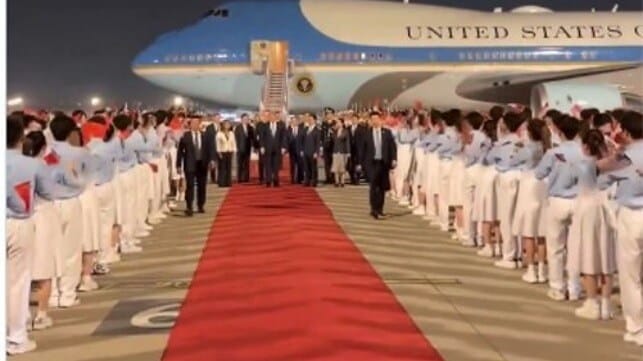
As President Trump lands in Beijing to discuss the 4 Ts (Tehran, Trade & Tariffs and Taiwan), a backdrop to the talks will be China’s dependence – or otherwise – on imports of Iranian oil.
An assumption generally made is that China, without supplies of its own, is critically dependent on oil imports, and of course, it is true that China does indeed have a large appetite for crude. But less well appreciated is that China generates 85 percent of its energy needs from its own internal resources, including from nuclear, coal, and wind power. So China has some flexibility to adjust its energy generation sources when its supply of crude from the Gulf is restricted, and it also maintains reserves equivalent to about 150 days of consumption. Hence, China has relatively robust strategic energy resourcing- unlike, for example, Japan, which also maintains a 150-day reserve but is 85 percent dependent on energy imports.
On this basis, President Trump will be able to exert relatively little leverage over China, if he seeks to persuade China to use its influence over Iran to soften its negotiating position so as to get Iranian oil exports flowing again. Iran might be feeling the pinch, given that between 80 and 90 percent of its oil exports are sold to China, and it is becoming increasingly difficult for Iran to find other markets, as sanctions on the Iranian dark fleet become more oppressive. But China will not be overly concerned about the predicament Iran finds itself in, and it has no need to expend political capital to resolve the crisis in the Gulf when its impact on the Chinese economy is as yet relatively limited. Indeed, China will be more worried about the impact of the crisis on its export markets in South East Asia and elsewhere than on the direct impact of shortages of crude needed to maintain economic activity and keep the lights switched on at home.
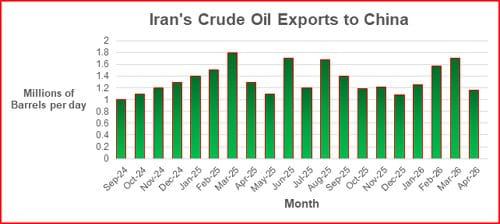
For many years China has bought between 80 and 90% of Iran’s total oil exports, with monthly volumes estimated on the basis of Kpler analysis (CJRC)
This general analysis of the situation has been given an interesting twist by research conducted by Muyu Xu, Senior Crude Oil Analyst at Kpler. Her research has found that oil exports to China from Iran have indeed dropped quite significantly in March, from 1.71mbd to 1.16mbd in April. But as yet the deficit is not being drawn instead from the 155mb of Iranian crude held afloat outside the Gulf, principally off China, in the South China Sea and in the Malacca/Singapore Strait, some of it quite vulnerable. Chinese importers are either needing less, or getting extra stock from Chinese reserves or from other global oil exporters. Hence, the 155mb of Iranian crude held afloat is still largely intact as a buffer. Indeed, the lack of Chinese demand for their stocks afloat may be tempting the Iranians to sell their crude elsewhere – at record prices. This suggests that strategic planners both in China and Iran have had a far-sighted contingency plan for trouble in the Gulf, foresight which is exposing the lack of a well thought-through strategic contingency plan coordinated in advance between Iran’s adversaries.

that matters most
Get the latest maritime news delivered to your inbox daily.
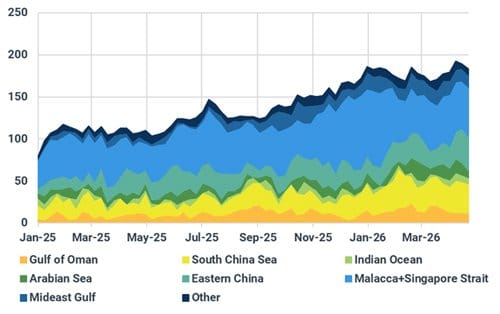
Iranian crude held afloat in millions of barrels, split between geographic areas (Source: Kpler)
The opinions expressed herein are the author's and not necessarily those of The Maritime Executive.
