

Hapag-Lloyd Calls Q1 "Unsatisfactory" While Warning of Uncertainty
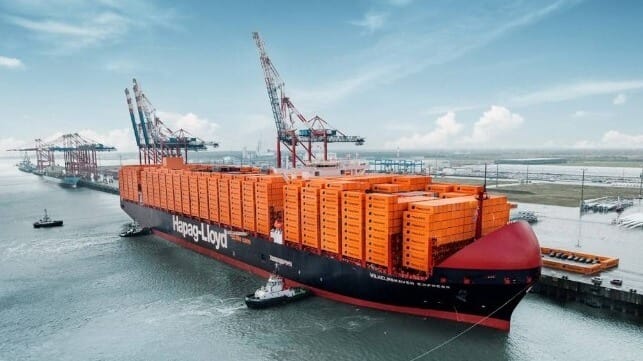
Hapag-Lloyd was the latest carrier to report dramatically lower first quarter financial results. Reporting that the company swung to a financial loss for the quarter, management called the quarter’s performance "unsatisfactory" but maintained its financial outlook for the full year.
The world’s fifth-largest container carrier, which is poised to leap forward with the pending acquisition of Zim, said the near-term outlook remains subject to “considerable uncertainty due to highly volatile development of freight rates and the conflict in the Middle East.” While sounding cautious over the challenging, volatile market environment, management told investors the second quarter of 2026 was seeing some improvements. It said the company was experiencing stronger cargo volumes and "healthy" forward booking trends.
“The first quarter of 2026 was unsatisfactory for us, with weather-related supply chain disruptions and pressure on freight rates leading to significantly lower results,” said Rolf Habben Jansen, CEO of Hapag-Lloyd. He cited a nearly one percent decline in volumes while reporting the average freight rate fell 9.5 percent on weaker demand.
The company also pointed to operational disruptions during the first quarter. It said bad weather conditions in Europe and North America had caused disruptions in terminal operations and supply chain issues. Like all of the carriers, it also experienced issues with geopolitical issues and specifically the blockade of the Strait of Hormuz. In late April, the company said it still had four vessels stuck in the Persian Gulf. One ship, however, was able to make the transit during one of the lulls in the fighting. One other ship had come off charter while waiting in the Persian Gulf.
Hapag reported an 18 percent decline in first quarter revenues to $4.8 billion for its shipping segment and $4.92 billion for the group. The company also swung to financial losses on both an EBITDA and group profit level, reporting that overall profit went from $469 million in Q1 last year to a loss of $256 million this year.
Volumes, however, remained stable during the quarter at approximately 3.2 million TEU, which the company noted was largely on par with the year ago. Further, Jansen said the Gemini network (partnership with Maersk) had proven its resilience even under difficult conditions, helping the company to maintain a reliable service offering. The financial results were also helped by the weaker U.S. dollar, which contributed to a reported six percent decline in costs. Costs would have increased 4.6 percent if adjusted for currency.
While a smaller portion of the overall group, Hapag’s terminal operations helped to offset the pressures in ocean shipping. Revenues from its terminals were up for the quarter, in part due to the first incorporation of its acquisition of India’s JM Baxi into the results. Hapag also said it had strong volumes in both Latin America and India.

that matters most
Get the latest maritime news delivered to your inbox daily.
While Jansen expects the markets will continue to be highly volatile, he said Hapag was moving forward on its strategy while also maintaining rigorous cost controls.
Hapag maintained its financial forecast, which projects group EBIT in the range of a loss of $1.5 billion to a profit of $500 million for the full year.