


Iran Piles on Pressure and Targets Tanker off Omani LNG Terminal
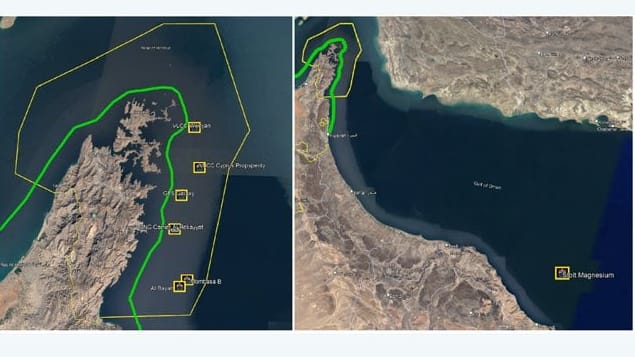
Oman has been sent a new signal by the IRGC, following drone attacks on ground targets in the Musandam, Batinah, and Al Wusta governorates on July 12. It followed the attacks on tankers in Omani territorial waters using the southern route through the Strait of Hormuz which began on July 6.
The new attack was carried out late on July 13 on the Liberian-flagged chemical product tanker Stolt Magnesium (27,600 dwt), 40 nautical miles northeast of Qalhat, the Omani LNG terminal near Sur. There were no injuries aboard the tanker, nor any rupture of tanks, but the crew subsequently was fighting an engine room fire.
The attack was far from the Omani Coastal route in the Strait of Hormuz, on which the IRGC has concentrated its attacks in recent days. Last night's other attacks, the Liberian-flagged crude oil tankers Al Bahyah (299,425 dwt) and Mombasa B (299,392 dwt), were near the Strait of Hormuz. The attack on the Stolt tanker is raising concerns, and perhaps threatening, that LNG tankers loading at the Qalhat terminal could be vulnerable to attack in the near future.
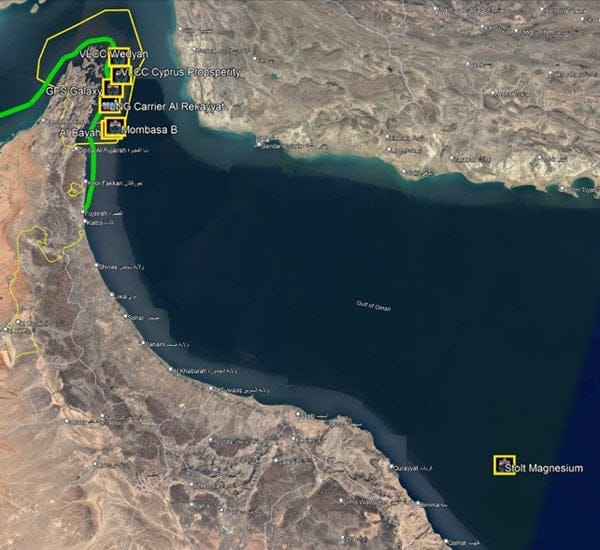
The pattern of IRGC attacks July 6-13 in the Strait (top left) and the attack late on July 13 (right)
(Google Earth/CJRC)
The Omani authorities have not announced what ground targets were attacked on July 12, but The Maritime Executive understands that the targets included coastal radar sites in Musandam covering the Strait of Hormuz, logistic stores at an airbase in central Oman, and bunkering facilities in Duqm. There have been no reported casualties, and Omani authorities appear keen to downplay the attacks, with no mention of the incidents either in newspapers or on social media. The pattern of events suggests that, notwithstanding the attacks, Oman is keen to continue its dialogue with Iran, with whom it believes it is making progress towards a long-term solution. In an interview with Le Monde on July 12, Sayyid Badr Al Busaidi, the Omani Foreign Minister, said that “complex talks have begun to shape a lasting framework guaranteeing freedom of navigation in the Strait of Hormuz.”

that matters most
Get the latest maritime news delivered to your inbox daily.
Nonetheless, it appears that Iran is upset and is attempting to pressure Oman into dropping its insistence that a final solution to the Hormuz transit issue should be compliant with international law and UNCLOS, and should not involve paying passage fees. Donald Trump’s announcement that he proposes to charge 20 percent of the value of cargoes transiting through the Strait has enabled Oman to restate its principles – a solution within UNCLOS and without passage fees – that applies equally to both Iranian and American attempts to disturb the status quo.
It is apparent that Trump’s 20 percent levy was announced without pre-consultation with Oman, through whose territorial waters ships transiting the Strait must pass. Moreover, the Musandam Peninsula is dependent in daily life on coastal traffic travelling through the Strait to reach settlements otherwise unreachable by road. The Trump pronouncement is evidently unworkable from a practical perspective, but its most long-lasting impact may be to upset countries whose sovereign rights are implicitly ignored by his proposal. While Iran is threatening logistic and bunkering facilities in Oman, which all nations make good use of now that such facilities within the Gulf are no longer available, President Trump’s proposal is also a good cause to withdraw those facilities.
