


Drawing on LASH Heritage, BlackSea Builds Carrier for Floating ISO Boxes
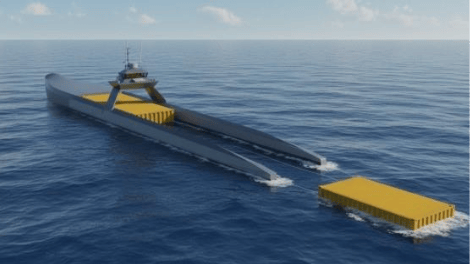
The American autonomous-boat builder Blacksea Technologies has reinvented the Cold War concept of the Lighter Aboard Ship (LASH) vessel, reduced its scale and applied it to contested logistics. Its new autonomous-vessel design, NightTrain, retains the core concept of a self-lightering vessel for shallow-water deliveries, but it is built to carry watertight, floating ISO containers in place of 40-tonne barges.
The LASH idea was developed in the 1960s as an alternative to containerized freight and breakbulk. A militarized variant, the Cape M-class "Sea Bee" barge carrier, served throughout the Cold War for shallow-water and beachhead logistics applications. The big barges used by LASH carriers could not compete commercially with ISO containers, and these specialized vessels were ultimately repurposed or retired.
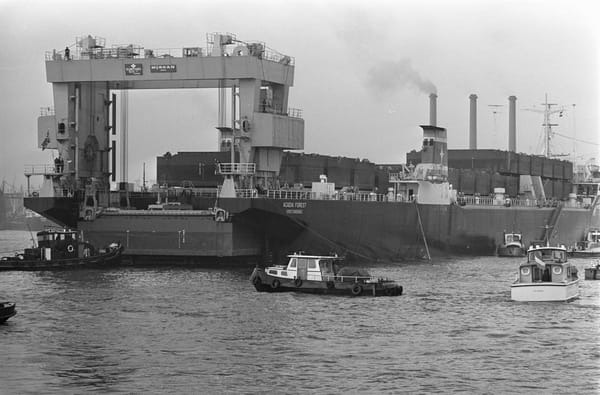
LASH carrier Acadia Forest loading a barge at her stern, 1969 (Herbert Behrens / Public domain)
The NightTrain concept marries the modularity and intermodal flexibility of the ISO container with the undeveloped-port capability of the LASH carrier, at far smaller scale. For this novel vessel, the ISO container itself is both the cargo and the floating lighter. Instead of the LASH carrier's heavy, mechanically complex hoist at the stern, the NightTrain has an open bay down the centerline so that all the cargo can be floated aboard, like a semisubmersible heavy-lift ship. The payload capacity of the 85-foot vessel is about 70 tonnes overall, with a speed of 11 knots and a range of about 2,700 nautical miles. It can fit a handful of boxes stowed end-to-end, up to a total combined length of 53 feet (the maximum single container size found in North America).
From the Navy's perspective, its biggest advantage may be its low profile. Illustrations provided by the manufacturer suggest that it is designed to ride low in the water with its bow intermittently awash, like a drug-smuggling semisubmersible. The small radar cross-section of a semisub allows it to minimize the odds of detection and intercept - ideal for a vessel designed for autonomous resupply voyages through contested waters. The mission set for NightTrain is to "keep sustainment moving when ports, airfields, predictable routes and assured communications are no longer guaranteed" and to create a "distributed alternative to traditional logistics."
A little NightTrain progress.
— BlackSea Technologies (@BlackSea_Tech) August 18, 2026
Our 85-foot semi-submersible logistics vessel is taking shape, with fabrication well underway.
NightTrain is designed to keep sustainment moving when ports, airfields, predictable routes, and assured communications are no longer guaranteed. The… pic.twitter.com/xIkhAxYzv8

that matters most
Get the latest maritime news delivered to your inbox daily.
BlackSea is building a prototype in aluminum, and has completed most of the hull, a video released by the firm shows. The company has a long pedigree in autonomous navigation as the developer of the Global Autonomous Reconnaissance Craft (GARC), the most widely used U.S. Navy autonomous boat solution, and delivers 32 of these small vessels every month.
Last week, BlackSea was acquired by aerial drone maker Aevex for as much as $650 million.
