


Maersk Completes First Ethanol Bunkering in US Testing Bioethanol
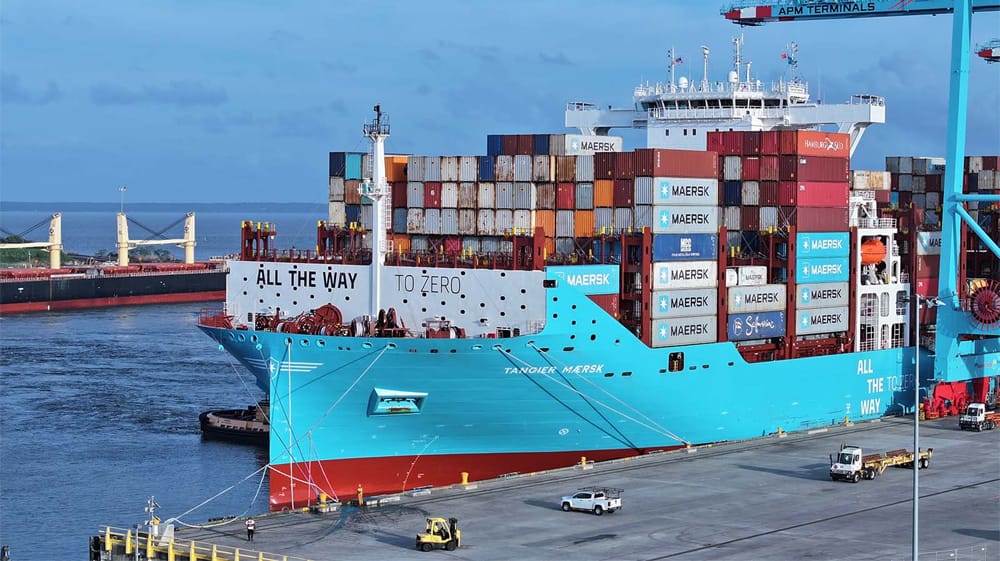
Maersk reports it recently completed the first ship-to-ship commercial ethanol bunkering of a container vessel in the United States. It was a 100 percent bioethanol blend from U.S. producer Poet as part of an ongoing trial by Maersk of ethanol and alternative fuels.
The bunkering took place aboard the Tangier Maersk, a recently delivered mid-size vessel built in China and delivered in February this year. The ship, which is 270 meters (900 feet) in length, has a capacity of 9,000 TEU and is equipped with a dual-fuel engine able to operate on methanol. Maersk previously explained that, because ethanol and methanol are both alcohols, they share similar properties, and it was testing interoperability, or swapping ethanol onto its dual-fuel vessels.
POET, which is headquartered in South Dakota and bills itself as the world’s largest bioethanol producer, supplied plant-based bioethanol for the first 100 percent bioethanol bunkering operation in the United States. The company points out that it was a cooperation that also involved Kirby Corporation, which supported the marine bunkering operation and transportation of the fuel. Port of Houston provided critical port coordination and infrastructure, while the U.S. Coast Guard supported the regulatory requirements necessary to conduct the bunkering operation.
Maersk reported that the operation was providing valuable real-world experience. It said it would provide valuable insight into the operational, infrastructure, sourcing, and supply chain considerations for using ethanol as a marine fuel. While ethanol benefits from an established production base, Maersk said that existing infrastructure and compatibility with alcohol-enabled vessel technology, scalable future fuel pathways would also depend on fuel availability, regulation, and operational readiness across the maritime value chain.
The operation builds on previous ethanol trials aboard Laura Maersk and Antonia Maersk and reflects Maersk’s continued commitment to exploring and advancing credible pathways to drive progress within the shipping industry’s energy transition.
The company announced in December 2025 that it had conducted the initial test using E10 (10 percent ethanol) in an ethanol-methanol blend to confirm safe integration and performance. They reported they would be looking at issues including ignition quality, how the fuel burned, potential corrosion issues, and testing the emissions to see if there were differences. Building on a successful initial trial, the company planned to blend 50 percent ethanol with 50 percent methanol in a test onboard the vessel Laura Maersk. It said it was also aiming for a 100 percent ethanol test.

that matters most
Get the latest maritime news delivered to your inbox daily.
The U.S. is the largest ethanol producer in the world, followed by Brazil, and combined they comprise approximately 80 percent of the world market. Poet says that American-made bioethanol is already produced at a commercial scale, with the company reporting that it produces more than three billion gallons annually across its network of 35 bioprocessing facilities.
Maersk says that it will continue to explore alternative fuels and the different availabilities as it works to decarbonize its operations. It believes, as do many sources, that the future will consist of a range of different fuels to achieve the goals for shipping.
