


Container Shipping: The Third Phase
Op-Ed by David Rosen
.jpg) It is apparent that the container shipping industry is going through a fundamental stage in its modus operandi. This stage is the harbinger of the final phase of the container revolution. To understand the nature of this phase we need to analyze the preceding phases.
It is apparent that the container shipping industry is going through a fundamental stage in its modus operandi. This stage is the harbinger of the final phase of the container revolution. To understand the nature of this phase we need to analyze the preceding phases.
The initial phase was technological – conversion of piecemeal cargo movements to intermodal transport in standard boxes carried by the new class of container vessels. This required the development of design and engineering for new vessels, port terminals, hinterland facilities and land transport platforms. The phase began in the late 60s, and continued through the 90s of the last century.
The second phase was operational. The implementation of liner routes based on weekly schedules, hub and spoke networks. The CSI moved from liner routes to global service networks. This phase lasted from 90's of the last century to recent days.
The first two phases were affected by the accelerated and continued growth of demand for containers transport due to the following factors:
1. Economic growth, primarily In the USA and Europe, and the increase in demand for consumer goods.
2. Switching loose freight transport in conventional ships to containerized cargo in container vessels.
3. The global sourcing, particularly from China, due to lower production costs.
4. Globally distributed manufacturing sources, for parts and components coupled to globally distributed assembly facilities.
5. Fuel costs, reasonable for most of the period.
6. Accessibility to credit, for the purchase of vessels, containers and construction of ports and terminals.
As a result, the growth in demand for container transport grew at a CAGR of between 10 and 15 percent powering the first two phases. The during this period, there was a synergistic relationship between the global economy and the CSI as a demand accelerator contributing to the substantial decrease in the unit cost of global supply chains.
However current factors are moving in the opposite direction. Economic stagnation in the United and Europe, coupled to demographic trends that reduce the rate of demand growth particularly in the retail sector, which accounts for 70 percent of GDP in the United States, with global spillover to other global economies. Most of the potential for the transition from conventional to container transport has been realized. Conversion of refrigerated transport in reefer vessels to refrigerated containers is a good example of massive conversion from dedicated vessels to containers. Currently refrigerated transport demand in containers is increasing according to normal sector demand trends.
Production and Logistics costs in China are increasing. Improvement in local living standards (30 million Chinese are joining the middle class every year), increase in local demand, inflation, a shortage of workers, an aging population and further afield industrial centers, are more expensive in terms of China total source cost. Sourcing moving away from China to other Far-East countries reduce the transport distance to Europe – the main global container trade artery. Given that on this route, the largest capacity of container vessels fleets are employed, any reduction in origin to destination distances will immediately reduce fleet capacity demand. Fleet capacity required for a given volume demand, is a function of distance.
In addition to these factors, remote sourcing cost considerations are considered in terms of total costs - availability, reliability, risk, supply and supplier management, inventory costs. Also, local USA energy input costs are currently decreasing due to new energy production technologies giving the USA an advantage in terms of energy input costs.
The Chasm Theory (published in 1991, in a marketing book by Geoffrey A. Moore) describes the behavior of the high tech market, when there is a chasm between initial adoptions of technologies by consumer innovators to the major market of pragmatists which are late to embrace the benefits of the new technology.
The container shipping industry, a traditional industry, has evolved in a similar manner, by undergoing a high tech revolution. Initial adapters of containers transport technology were companies (like Zim, Sea-Land and others). Initially this technology was not adopted by consumers. In the early years, most of the containers were (LCL), which meant that loose cargo was delivered to the port of departure, where it was consolidated into ocean containers transported to ports of destination and then deconsolidated into the warehouses at the port of destination.
Bridging the divide was an operational revolution that enabled the house to house logistics revolution. Concurrently shipping lines developed new liner routes, hub and spoke networks and cooperative agreements that enabled economies of scale benefits with larger vessels. This revolution was achieved in a global economy that was developing at a high rate, with container transport demand increasing with a multiplier of three times the rate of economic growth, powered by the container growth factors described above.
Companies that did not evolve operationally, fell into the operations chasm, and did not survive as global operators.
The diagram below describes the steps and the chasms between the development phases:
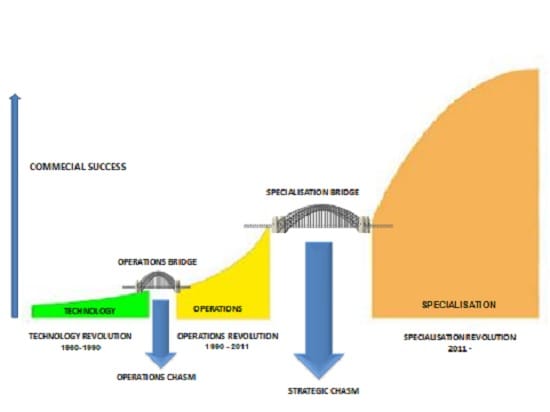
Currently the challenge is to cross the strategic chasm by developing a strategy of specialization, as the key to long term survival. This is particularly essential in an industry with a commoditized product where a participant needs to be differentiated and adaptive in order to survive in a brutal "Darwinian sense."
The survival of the container shipping industry species depends on the following strategies:
1. In a competitive market companies will survive by applying specific operating and asset deployment strategies adapted to specific niche markets.
2. Successful coexistence can be realized with the unique specific ecology of each partner.
3. Due to external and internal factors the CSI has reached the Production-Possibility Curve. Previously, it was possible to apply in parallel expansion, economic growth and operational efficiency. With the exhaustion of these concurrent marginal contributions, strategy can only be applied on the curve.
Therefore survival requires a lateral niche strategy.
The evolution will not be voluntary, because the container shipping industry does not have any aggregate rational behavior. Most shipping companies act as if the market is in a constant increase on all fronts, as it has been for the past 20 years.
Analysis of current industry data indicates that demand for container transport is in a state of stagnation due to the slow growth in throughput demand In terms of distance. X volume. Major players will not change significantly in terms of rank in the foreseeable future, although there may be changes in collaborations such as M2, O3 alliances under various names and acronyms.
There is no connection between the size of the company and its success. Also, there is no connection between fleet vessel sizes and business results. The basic premise is to achieve lower costs with large vessels providing lower slot costs. However this is coupled to the need to fill the ships, financial risk, loss of control and independence due the need to cooperate resulting in a loss of competitive differentiation.
In conclusion some thoughts on possible niche strategies:
1. Mega Feeders: ULCV will function not only as inter area liners but operate as inter area feeders for smaller companies scattered in different areas.
2. Activities focus in a particular area, and short sea lines.
3. Convert from liner to feeder services.
4. Split large companies to smaller area / trade focused services.
5. Symbiotic activity such as NVOCC' - getting rid of vessel operations.
6. Cooperation in containers stock between companies with centralized inventory management.
7. Niche services such as focused express services between port pairs.
8. Vertical cooperation between shipping companies and forwarders as exclusive sales channels.
9. Reducing the size of company to achieve profitability and long-term survival.

that matters most
Get the latest maritime news delivered to your inbox daily.
Obviously there are other potential strategies which can be applied based on specific company parameters. The main point of this article is to emphasize that business as usual is not an option for survival.
About the author: David Rosen has been in the container industry since the 1970’s as a member of the set up team of Zim Container Service where he has held IT and commercial responsibilities in Japan and Israel. He then moved to London as Digital Equipment Corporation, Europe Transport Industry Marketing Manager. Co-Founder and Operations Manager for Maersk Israel. Currently CEO of IDILITI maritime consulting practice. He is a team member of Hackett Associates and widely participates and lectures on Liner Shipping, in corporate and academic programs.
