


The Future of Fleet Efficiency is Stacked Optimization

Implementing stackable energy-saving technology provides shipowners and operators with a class-certified, engine-safe pathway to maximize fuel efficiency and achieve emissions compliance, all without sacrificing vessel availability
The maritime sector operates under tightening regulations. Owners and operators of container and roll-on/roll-off (ro-ro) vessels on fixed routes face rising and unstable fuel costs that directly erode profitability, along with tightening environmental standards that impose strict limits on operational emissions. To remain competitive, fleet operators cannot rely solely on traditional maritime intuition because the margins are simply too thin and the regulatory stakes are too high.
Achieving cost-efficiency and regulatory compliance has traditionally required large capital expenditures and extended dry dock stays to perform hull modifications and complex mechanical overhauls. However, to remain competitive and compliant, container and ro-ro vessel owners and operators are looking for additional ways to improve operational efficiency. Propulsion optimization provides a proven solution that easily stacks on top of other efficiency approaches.
Proactive fleet operators recognize the importance of determining overall propulsion efficiency — not just fuel oil totals — so they can act on it safely, continuously, and without downtime. Shipowners need new technologies that can help them achieve maximum value from their assets, while avoiding risk. One option is Emerson's Aperio™ SmartPropulsion, an easily adopted and proven solution that adds propulsion efficiency and real-time data insights to any ship. The solution helps owners reduce fuel consumption, lower emissions, improve operational performance and maximize profitability.
Seamanship and stacked efficiency
Container and ro-ro vessel management presents a dynamic challenge. Propulsion efficiency is constantly affected by variables like ship draft, trim, hull fouling, and changing weather and sea conditions. Experienced crews do their best to maintain schedule and safety, but statistics show that human personnel cannot continuously determine the optimal vessel propulsion with changing internal and external factors. Finding the best intersection of minimal fuel consumption and optimal engine performance in real time requires more automated functionality.
Many operators view fleet efficiency and energy-saving technologies (ESTs) as either/or solutions. True operational excellence comes from stacking efficiencies. Every conventional EST contributes measurable gains, whether it is routine hull cleaning, applying anti-fouling paint, or propeller upgrades. The Aperio SmartPropulsion optimization solution complements other ESTs, stacking directly on top of them and increasing the cumulative benefits.
How Aperio™ SmartPropulsion works
The solution continuously optimizes vessel propulsion by adjusting to changing internal and external conditions in real time. Software-driven dynamic optimization extracts the maximum possible performance from every underlying asset by continuously factoring in actual feedback conditions and propulsion capabilities.
It uses self-learning optimization algorithms that analyze and act on data such as speed over ground (SOG), speed through water (STW), draft, trim, weather conditions, and engine performance, to identify the most efficient operating points.
Hardware and software operate as an "add-on" solution, designed to integrate seamlessly with existing systems, sensors, and equipment, without altering underlying safety controls. The solution can be used for all propulsion types, engine types, fuel types and propulsion control systems. Technicians can install the compact electronics in just a few days while the ship is under way, with just one day alongside, avoiding dry dock, downtime and in most cases no operational revenue loss.
This advanced technology is readily adopted by shipboard personnel, delivering a new level of clarity via an intuitive human-machine interface (HMI) installed on the bridge.
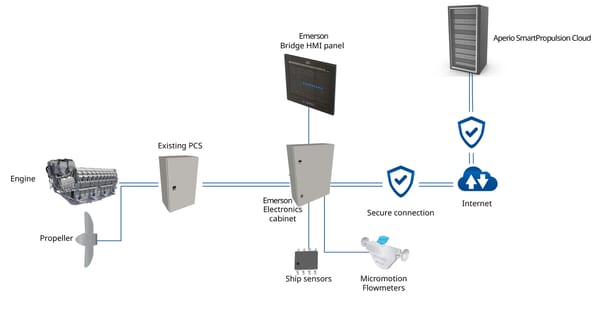
The solution integrates seamlessly as an "add-on" without overpowering the existing propulsion control system (PCS)
Aperio SmartPropulsion operates as an additional engine telegraph, integrating with the existing PCS. The crew monitors operating status via the HMI and based on the selected mode they may choose to control the power handle, or they can control the power handle normally if necessary.
Crucially, the solution is architected with careful handshakes to ensure engine safety under all conditions. While providing oversight, efficiency, and compliance, the PCS interface precludes overriding of engine load limits, protecting the propulsion elements under all operating conditions.
Beyond immediate fuel use reduction, it serves as a vital framework for predictive maintenance and regulatory reporting. Instead of performing maintenance and overhaul activities on a calendar-based schedule, fleet managers can forecast and schedule the work when it is most cost-effective. Furthermore, the platform is fully class-certified and complies with IACS UR E27 cybersecurity standards, so maritime leadership can deploy the solution with confidence in its security, safety, and class-approved operation.
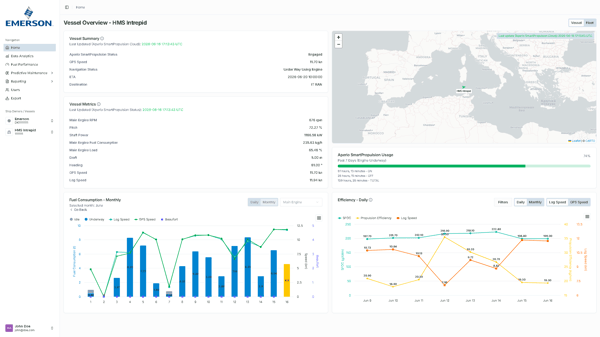
Aperio SmartPropulsion's fleet management platform shows extensive vessel data and actionable KPIs to support stringent reporting requirements
Clear oversight and compliance
In today's volatile operating environment, reducing fuel consumption, maintaining compliance, and maximizing profitability requires a smarter approach than traditional manual control.
By implementing a dynamic, and proven automated propulsion optimization solution like Aperio SmartPropulsion, shipowners can successfully balance engine safety and commercial goals. The Aperio SmartPropulsion technology has been deployed and improved since 2017, with a substantial install base operating different engines and vessel types worldwide. It is a patented technology approved by leading marine classification societies. Users are realizing an overall saving of up to 15% and a return on investment in as little as nine months.
The solution installs quickly on top of any existing systems, is easy to use, and delivers benefits that combine seamlessly with other conventional efficiency-enhancing technologies as part of a multi-layer optimization approach. Emerson's propulsion optimization solution delivers an engine-safe, stackable approach for countering rising expenses and meeting environmental legislation.
Visit Emerson.com/marine to learn more about Aperio™ SmartPropulsion.
About the Author
Magnus Mikkelsen is an Area Sales Manager at Emerson. Magnus has a strong maritime background as a dual-purpose officer and has extensive seagoing experience across a wide range of vessel types. Previously, he has worked as a project manager and superintendent, combining hands-on operational insight with technical and commercial expertise.
This article is sponsored by Emerson.
The opinions expressed herein are the author's and not necessarily those of The Maritime Executive.
