


Germany Receives Next FSRU as It Adds LNG Import Capacity
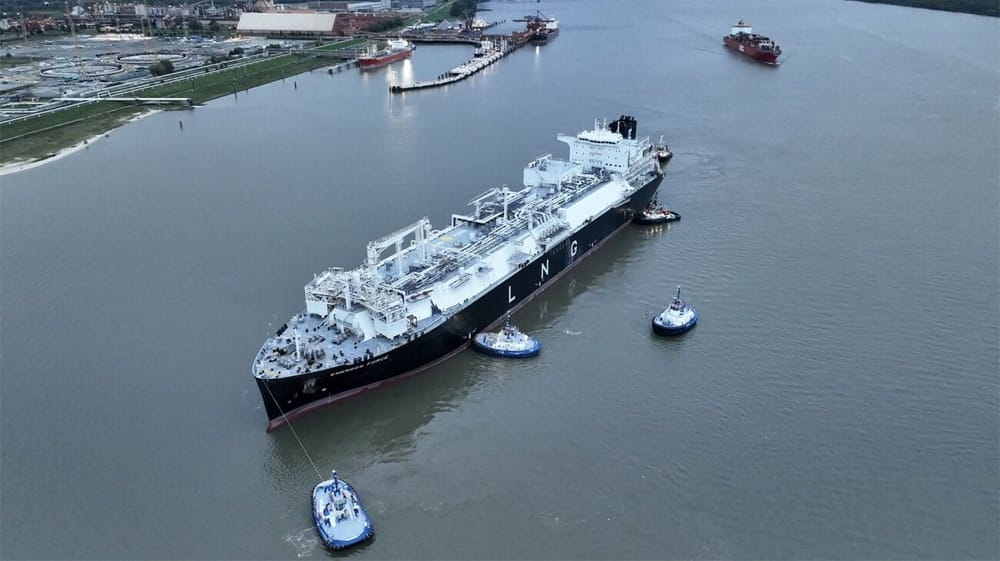
The state-owned Deutsche Energy Terminal GmbH (DET) highlighted the return of its fourth FSRU (Floating Storage and Regasification Unit) as it gears up for increased LNG import capacity. Germany launched the FSRU program in 2022 after the Russian invasion of Ukraine to replace supplies of Russian gas, and now as the EU moves to a total ban on the importation of Russian gas.
The Energos Force (94,361 dwt) docked at the end LNG terminal in the Stade-Bützfleth industrial port, near Hamburg on the Elbe River. The FSRU will have an injection capacity of up to 3.2 billion cubic meters of natural gas per year by 2027, making Stade, they said, an important component of Germany’s security of supply. It is expected to complete commissioning and begin operations by November.
“As promised, the return of the regasification vessel to the Stade jetty marks the start of preparations for the terminal’s commissioning," said Dr. Peter Röttgen, CEO of DET. “The road to this point has not always been easy. Shortly after assuming responsibility for completion, we brought all necessary partners on board, who are working together with full commitment toward this common goal.”
DET highlights that extensive technical and safety-related assessments, along with preparatory measures, were carried out, as well as the construction of the jetty and onshore terminal. The terminal is still being completed. While the new facility was being developed, the state-owned company sub-chartered the FSRU Energos Force—the regasification vessel designated for operation in Stade—and deployed it in Jordan.
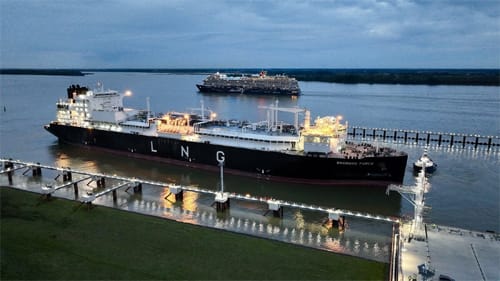
Energos Force is on the Elbe near Hamburg as the fourth FSRU managed by the state-owned company (DET)
The FSRU Energos Force was built in 2021 and will operate under a long-term charter to DET. The vessel can regasify up to 500 million standard cubic feet of gas per day (MMSCFD) using steam boilers in a closed-loop system. In summer, it can ideally regasify up to 750 million standard cubic feet per day using Elbe River water in an open-loop system.
For 2027, DET expects the Stade terminal to feed up to 3.2 billion cubic meters of natural gas into the grid. This volume would be sufficient to supply approximately 2.6 million four-person households with heating energy for a full year.
It becomes the fourth FSRU DET is managing. The program began in December 2022 with the FSRU Höegh Esperanza, which became the first German LNG terminal to commence operations. It is located in Wilhelmshaven, close to the Jade Weser port, where an existing berth was expanded. It is under a ten-year charter from Höegh Evi and has a capacity of 170,000 cubic meters and a regasification capacity of up to 750 MMSCFD.
The Excelsior was added in Wilhelmshaven in April 2025 and began commercial operations in August. Its pier is located as an island jetty around 1.5 kilometers from the shore in the Jade stream, just 2 km (just a little over 1 mile) south of the Wilhelmshaven 1 terminal. The vessel, which has a storage capacity of 138,000 cubic meters and a regasification capacity of up to 500 MMSCFD, is on a five-year charter.

that matters most
Get the latest maritime news delivered to your inbox daily.
The Höegh Gannet is moored at the existing dock in the port of Brunsbüttel on the river Elbe. The plan was for the vessel to move to a new berth as soon as the purpose-built new jetty is completed. It has a capacity of 170,000 cubic meters and a regasification capacity of 750 MMSCFD.
German officials highlight the success of the FSRU program, especially considering the speed at which it was developed. It is ensuring a steady supply of gas replacing the pipelines from Russia.
