


Hot Weather and Politics Bring Yemen Back to the Brink in the Bab el Mandeb

Weather rarely has a direct impact on political tensions, but the ultra-extreme heat of the summer in Yemen is an exception to the rule, fraying tempers and testing patience at a time when Iran is urging its Houthi allies to cause trouble and help deflect pressure from the U.S. military operation in the Strait of Hormuz.
At risk is freedom of navigation in the southern Red Sea and Gulf of Aden. Safety of navigation is even more important this summer than when the Houthis were routinely attacking shipping between 2023 and 2025. This is because Gulf countries are using Red Sea ports as a substitute for those ports within the Gulf that used to handle their trade. In particular, Saudi crude exports which used to leave via Ras Tanura are now leaving, topped up from the East West pipeline from Yanbu on the Red Sea – and a substantial percentage of ships are heading eastwards to Asia through the Bab el Mandeb, where tranquility is now threatened.
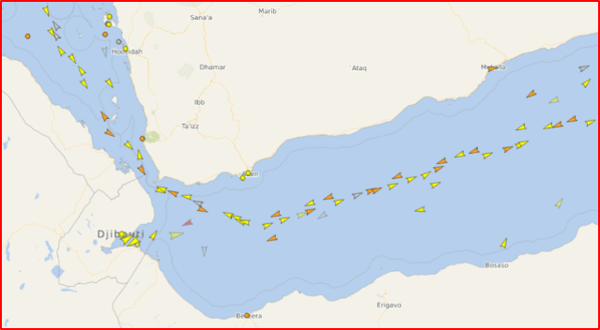
Marine traffic in the Red Sea and Gulf of Aden, July 16 (VesselFinder)
Much too many people’s surprise, the Houthis have not so far this year bowed to IRGC pressure and re-started their war on shipping. This would have redoubled pressure on world markets and global economic stability, given the cut in flows through the Strait of Hormuz. By not doing so, the Houthis have in fact saved the global economy from the meltdown that was expected. The Houthis held off for good reason, never quite as subservient to the IRGC as the IRGC might have hoped, given their investment in the Houthi war machine. This was because the Houthis were making progress in their Omani-mediated negotiations with the Saudis for a full and final settlement to the Yemen civil war, which has been rumbling on since 2014.
The Houthis were holding out for a recognition of their political autonomy, a lifting of the economic blockade which has isolated them from global trading, and last but very much not least, a huge financial subsidy which would have enabled them to consolidate their influence over the areas they control. The Houthis have been pitching for the $13 billion unpaid salary roll of their rebel movement for the last decade - payment for the very people who have been waging war on the Saudis and the forces of the Internationally Recognized Government (IRG) since 2014.
The face of the Houthi leadership, AbdulMalik al Houthi, has appeared frequently on Yemeni television in recent months, a calm voice expressing determination but reserving for himself the moment when Houthi forces might be unleashed on the battlefield, to take on all-comers including the Israelis, Saudis and the IRG. But in his most recent appearance, he seems to have lost his cool, brought on to a degree no doubt by the oven-like temperatures but also the lack of progress in negotiations with the Houthis.
The Saudis have not been brow-beaten by the Houthis, nor overly alarmed by the situation in the Hormuz. Since the Emiratis have scaled back their support for the Southern Transition Council separatists in the south, the IRG is coming together, developing a more effective military chain of command and enjoying a boost in their confidence that they can finally push the Houthis back on the battlefield.

that matters most
Get the latest maritime news delivered to your inbox daily.
AbdulMalik al Houthi‘s outbreak of temper on television – tellingly, directed at the Saudis rather than the IRG – plus tribal gatherings in both Houthi and IRG areas, have contributed to the sense that a return to warfare both on land and either side of the Bab el Mandeb is imminent. That point is still probably some way off. The testing ground is the resumption of flights into Sana’a, part of the ongoing coalition blockade of the North but broken by flights for a Houthi delegation to attend the funeral of the late Supreme Leader Ali Khamenei in Iran. For the moment, the risk is that a mishandling of volatile events will accidentally spark off a breach of the ceasefire, rather than a deliberate abandonment of the negotiating process, from which the Houthis still probably think they can win additional concessions.
If attacks at sea are to be resumed, and the Bab el Mandeb blocked, it will be a major test for the West. The US Navy is somewhat pre-occupied with enforcing the blockade on Iranian ports and ships. It will fall to the Europeans to reinforce Operations Atalanta and Aspides. Luckily, the under-utilized European naval task force, led by the FNS Charles de Gaulle carrier strike group, is already in the Arabian Sea - and might be available to take on the role.
The opinions expressed herein are the author's and not necessarily those of The Maritime Executive.
