


Report: Trump Wants to Move Ford-Class Carrier's Island for Appearance
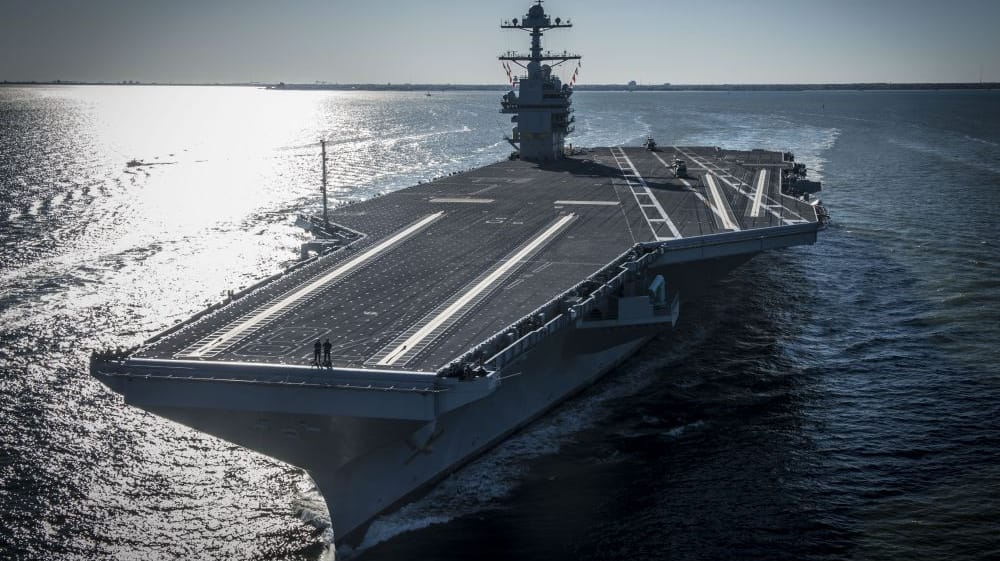
In addition to the remarkable decision to remove the electromagnetic launch system and weapons elevators from future ships in the Ford-class carrier program, the White House has reportedly asked the Navy to relocate the entire superstructure to place it amidships.
The Ford-class gave the Navy the opportunity to rethink its carrier concept, and it has fundamental differences from previous generation designs. The island - the combination navigation bridge, air traffic control tower and mast system - is located more than 100 feet aft of its previous location aboard the Nimitz-class carrier series. The Navy's reasoning came from operational lessons-learned, adapting design to the fundamental purpose of a carrier - launching and recovering aircraft.
The previous Nimitz-class design has four aircraft elevators, two to a side. The starboard quarter elevator is located aft of the island, next to the landing zone and arresting gear, and is not normally used because it can't be reached without interrupting flight operations. Likewise, parking area aft of the island on a Nimitz is inaccessible during landings. For Ford, the Navy removed that disused elevator and parking, and shifted the entire island aft, saving the weight and space of the fourth elevator and creating a larger unobstructed area forward of the island. Combined with the smaller footprint of the reworked island, the Ford-class gained about half an acre of deck space.
The intended practical advantages to this layout notwithstanding, the Navy is now studying a revamp of the design to put the island amidships, the way it was on older generations of pre-nuclear, conventionally-powered hulls. The motive is in part to make the ships more aesthetically pleasing for the president, according to new reporting by The Hill and the Washington Post. The Navy's engineers have "begun moving out on options to meet the President's intent," a spokesperson confirmed to The Hill.
The Washington Post reports that the cost of the redesign would be in the range of several billion dollars, on top of the $13 billion base price per unit. This extra cost would add to previously-announced multi-billion dollar change orders to remove the ships' electromagnetic catapults and weapons elevators, two systems that the Navy has had significant difficulty in bringing to maturity. Weapons elevator problems delayed the first deployment of first-in-class USS Gerald R. Ford for years, and have set back the delivery of USS John F. Kennedy as well, with cascading effects for future ships in the class.

that matters most
Get the latest maritime news delivered to your inbox daily.
The White House's elevator and launch system changes have been proposed for future hulls from USS Doris Miller onwards. Steel cutting for Miller began five years ago, and long-lead-time component orders have been in the works for years. It is unclear how many of the proposed design revisions would require physical rework of components already prepared or assembled. General Atomics, maker of the Ford-class electromagnetic launch system, said that "nearly 50 percent of production" is complete, and that any changes to Miller at this point would create significant risks to cost and schedule on the already-delayed program.
There is an additional concern in the opportunity cost - not just the money, but all the time that these changes will consume, former CNO Adm. Gary Roughead (ret'd) told The Hill. "The engineering effort and design effort obviously will detract from other shipbuilding design initiatives that are in play and engineering issues that are in play," Roughead said.
