


Oman’s Turtle Coast Hit by Oil Leaking From the Tanker Caroline Bezengi
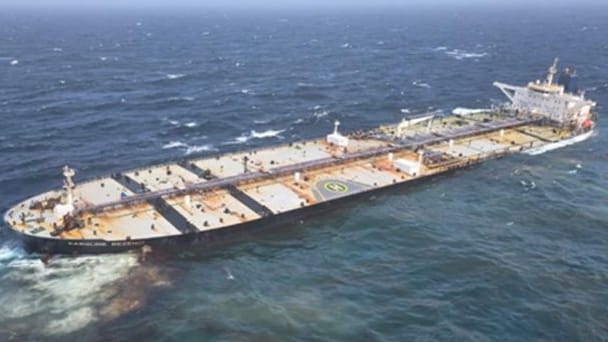
The environmental catastrophe predicted when salvage surveyors inspected the Russian dark fleet Supermax, the Cameroon-flagged Caroline Bezengi (159,168 dwt), beached on rocks off an Omani island, is beginning to unfold.
The Caroline Bezengi was hit by an explosion on June 8 while off the coast of Oman. The tanker had completed a transit of the Suez Canal on May 30 and left the Maritime Security Transit Corridor when the explosion occurred. The crew was taken off without injury some four days later, and the tanker subsequently was driven onto the rocks on the southwest tip of Jazirat Al Qibliyyah, one of the Hallaniyat Islands off the coast of Dhofar in the southwest of Oman. The tanker was laden with oil taken on board at Novorossiysk and was destined for Gujarat. The tanker has a past association with Russian state ship-owner Sovcomflot, and had been sanctioned by the EU, UK, and US (OFAC).
The position of the ship is particularly difficult, and is exposed to heavy seas normal in this Khareef monsoon season. While the ship appears to be grounded on rocks forward, there are outcrops off the port side that could also catch the ship if it shifted. There are also exposed rocks 500 yards off the stern of the ship.
The Omani maritime authorities conducted an onboard survey of the ship on July 12, and noted considerable deterioration in comparison with an aerial survey conducted the prior week, with the ship lower in the water, with a more pronounced list, and liable to break up in heavy weather. The tanker was fully laden except for one tank – this empty tank being the only one apparently not breached, with the remaining tanks all full, showing signs of seawater contamination. Crude leakage into ballast was noted during the on-board inspection, and also into the double hull spacing, the fumes from which were identified as potentially explosive. The survey also identified a feasible plan for off-loading the Caroline Bezengi’s cargo, worth probably over $100 million, via a 1000-yard pipeline to a receiving tanker anchored in safer waters in the lee of the island. The tanker potentially could be refloated as it was lightened, but with all the risks of on-board explosions and the ship breaking up further as the operation progresses.
Local newspapers reported on July 23 that the Omani Ministry of Transport, Communications and Information Technology has issued an urgent 24-hour directive for the owners to remove the vessel. It is not clear if the Ministry received a response from the Chinese registered owners, Rentoor Ship Management, based in Huangpu Qu, Shanghai. But it appears unlikely, as the address appears to be a dead-letter box in a residential block of flats in downtown Shanghai, a typical set-up in the registration particulars of Russian dark fleet tankers.
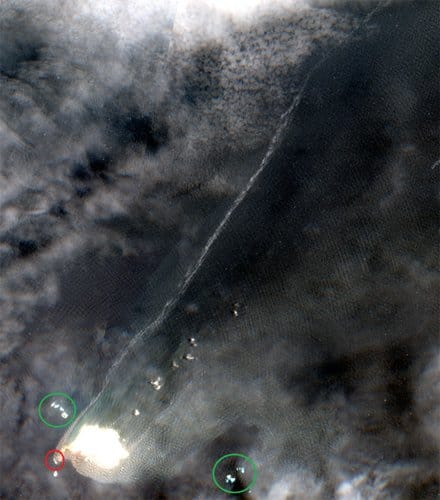
Jazirat Al Qibliyyah and the Caroline Bezengi (red) on August 2 with possible salvor vessels (green) (Sentinel-2/CJRC)
From satellite imagery of Jazirat Al Qibliyyah on August 2, there are indications of several small vessels standing off the wreck in two groups, 1nm to the north and 5nm to the east of the wreck of the Caroline Bezengi. But no unloading operation appears to be underway, and a strong plume of oil can be seen drifting around the island from the wreck and way off towards the north-east. This plume continues in a consistent direction and broadens, such that it would hit the Omani coast between Sharbithat and Ras Madrakah. This is a particularly isolated area, the sea fringed by cliffs and small widths of inaccessible beach, which makes it a perfect coastline for turtles to come ashore and lay eggs without human interference. The sea area offshore is a marine reserve for a number of endangered species, including petrels and the rare Arabian Sea humpback whale. It is not clear if the Omani authorities have yet got a salvage operation underway, and neither the ministry nor the marine salvage firm best equipped to take on the task have responded to enquiries.
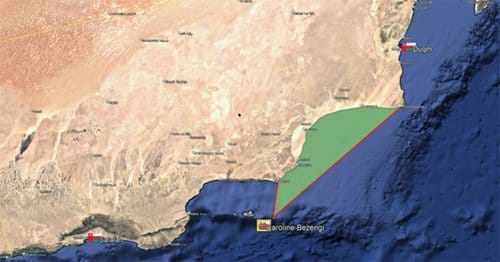
The spread of the oil plume from the Caroline Bezengi, affecting a protected marine reserve and landing on the Omani coast between Sharbithal and Ras Madrakah (Google Earth/CJRC)

that matters most
Get the latest maritime news delivered to your inbox daily.
The Caroline Bezengi appears to have been a victim of a limpet mine attack, likely orchestrated by Ukraine. Unless the Ukrainians have acquired a long-range naval capability, a limpet mine would most likely have been placed on the ship since leaving Novorossiysk, and when it was at anchor. Ships customarily anchor while waiting to enter the Suez Canal, but also often do so in the As Suways Anchorage on exit as well, to complete procedures. The timing of the explosion, on a predictable course, may have been a warning not to register Russian-owned dark fleet tankers; 39 such vessels currently fly the Omani flag, out of a total ship registry of 43 vessels.
