


South Korean Containership Completes NSR Passage Arriving in UK in 21 Days
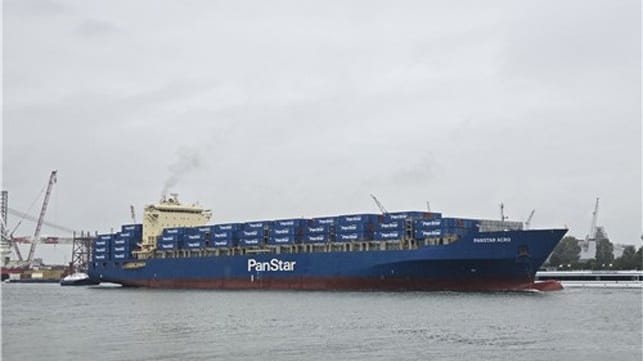
South Korea’s Ministry of Oceans and Fisheries and the Panstar Group reported that the containership Panstar Arco has completed the first leg of its demonstration voyage on the Northern Sea Route, reaching the UK and Rotterdam. The vessel is now in Rotterdam, preparing for its return on a trip designed to demonstrate the opportunities and to collect critical data about the challenges of the passage through the Arctic.
The passage took 21 days from Busan, South Korea, to Felixstowe in the UK and 22 days to Rotterdam. The ship is slightly behind the anticipated schedule, but reports are that it had no major problems in making the transit. After departing Busan on August 22, the vessel entered the Arctic on August 31 and cleared the western side of the passage on September 9. The total distance sailed from Busan to Rotterdam is approximately 13,000 km (nearly 8,100 miles) compared to a normal distance of 20,000 km (12,500 miles) on the route through the Suez Canal to Europe.
The 45,500 dwt containership was carrying 737 TEUs of cargo, including chemical products, used cars, and auto parts. Reports vary, saying there are between 100 and 200 empty TEUs also loaded. The ship has a capacity of 2,758 TEU, and the target had been for at least 1,300 TEU. Government officials are saying the shortfall was due to a short booking window and uncertainty surrounding the first voyage.
The company said there were 20 crewmembers, including a Korean captain, chief engineer, and other key engineering officers, making the voyage. The first officer is the navigation officer from the South Korean government icebreaker Araon, who is also an experienced polar navigator. Also making the transit was Jae-Geun Kwon, the head of shipbuilding and the offshore business division of Panstar. An engineer who was previously with the Korean Register, he was aboard to secure technical data on polar navigation, including engine operation in the low-temperature environment, hull behavior, and fuel consumption.
The vessel was forced to stop overnight, according to the Korean media outlet AJP, near Wrangel Island in the Chukchi Sea because it encountered drifting ice that was blocking its path. Strong winds and currents pushed the vessel. The containership reported wind speeds of 40 knots in the Laptev Sea, which forced the vessel to reduce speed, and it was also required to carry out evasive maneuvers to avoid harder chunks of ice near the Vikitsky Strait, AJP reports.
The Panstar Arco reached Felixstowe on September 12 and Rotterdam on September 13. It will be handling cargo before sailing to Gdynia, Poland, where it is due on September 16. It is expected to load additional cargo before beginning the return trip. The vessel is currently scheduled to return to Busan on October 12.

that matters most
Get the latest maritime news delivered to your inbox daily.
It is closely following the first Chinese ship to make the passage in 2026, the Dubai Tower, operated by Sea Legend. After making a stop in Teesport in the north of the UK on September 9, the ship arrived in Felixstowe on September 13. It is currently in Hamburg before starting its return voyage across the NSR.
South Korea had tested the Arctic in 2013, 2015, and 2016, but it now envisions laying the groundwork for regular service through the Arctic to Europe. It is anticipated that the government may encourage a second demonstration voyage as part of its goal to launch commercial service by 2030.
