


As Gulf Crisis Continues, Biofouling Risks Multiply for Ships at Anchor
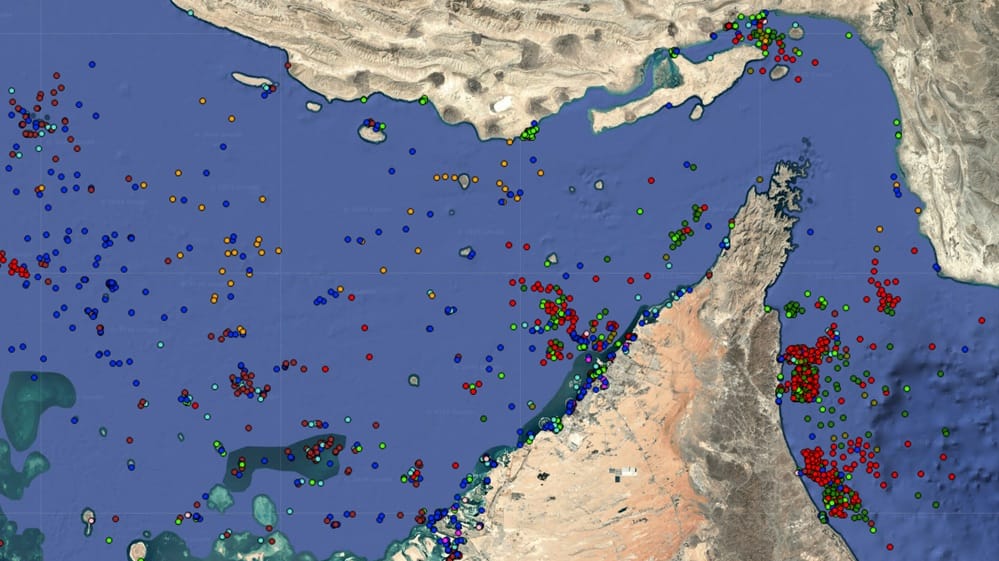
Maritime operators are navigating an unusually volatile Gulf shipping market, with months of disruption and uncertainty leaving large numbers of vessels anchored for extended periods across the Arabian Gulf. AIS data gathered by MarineTraffic and reported by Weathernews put the number of stranded vessels at 958 as of mid-June 2026, with 63% idle for 100 days or more – a glimpse into a crisis that has continued to evolve since.
Whatever happens next in the Gulf, months of inactivity have already left their mark below the waterline. Prolonged idling changes hull conditions in ways that carry operational, environmental, and biosecurity consequences long after a vessel resumes trading.
What starts growing the moment a vessel idles
Marine growth starts within minutes of a hull meeting seawater as a conditioning film of organic molecules and microorganisms form on the surface. A slime layer of bacteria, algae and diatoms follows. Over the following weeks or months, larger organisms such as barnacles, mussels, tubeworms, sea squirts and seaweed can begin to colonize the surface. When left unchecked, these organisms multiply quickly, adding roughness and drag to a hull built to move through water.
These changes matter to a vessel’s bottom line – slower speeds, heavier engine loads, and higher fuel bills, along with the emissions that come with burning more fuel for the same performance. Jotun’s 2025 survey of 1,000 shipowners and operators found 50.4% of respondents had already experienced higher fuel consumption and lower operational efficiency as a result of poor biofouling management. This reflects ordinary trading patterns, and not the extended idling many vessels in the Gulf have now endured.
An ideal breeding ground
Several conditions in the Arabian Gulf make it an ideal breeding ground for biofouling. Warm water year-round speeds up the growth cycle for algae, barnacles and other fouling organisms. Busy ports, heavy industry, and coastal runoff boost nutrients in the water, giving marine growth plenty to feed on. Vessels unable to depart, waiting for cargo, instructions, security or berth space have sat still for prolonged periods, giving these organisms ample opportunity to settle on hulls. Prolonged inactivity can also reduce the effectiveness of some antifouling systems, particularly where a vessel is operating well outside the profile for which its coating was selected. Even the Gulf’s high salinity, which inhibits some species, does little to slow down the organisms that cause the most damage.
When fouling becomes a compliance issue
Fouled hulls can carry invasive species across borders, introducing non-native organisms into vulnerable ecosystems. As a result, a growing number of countries have responded by writing biofouling controls into law. Jotun's 2025 survey found that 41% of respondents faced regulatory penalties linked to biofouling, and 38% had been denied port access because of non-compliance. Forty-nine per cent reported they now bypass ports with stringent biofouling requirements altogether, an increasingly unsustainable strategy as more jurisdictions tighten their rules.
Under Australia’s Biosecurity Act 2015 and its biofouling management requirements, vessel operators can demonstrate proactive management in one of three ways: cleaning all biofouling within 30 days prior to arrival; implementing an effective Biofouling Management Plan and Record Book; or using an alternative biofouling management method pre-approved by the Department of Agriculture, Fisheries and Forestry. New Zealand works similarly, requiring arriving vessels to provide evidence that biofouling has been appropriately managed under its Craft Risk Management Standard, assessing vessels against risk-based clean hull thresholds and requiring a Biosecurity Pre-Arrival Report – non-compliance can mean a Notice of Direction, mandatory cleaning, or being turned away.
The rules extend beyond the Asia Pacific. The California Code of Regulations requires vessels of 300 GT or larger to keep a Biofouling Management Plan and Record Book and file an Annual Vessel Reporting Form – vessels idle for more than 45 days are flagged for extra scrutiny. Brazil’s NORMAM-401, introduced in 2025 and with enforcement of the new biofouling provisions beginning in June 2026, is a hybrid of Australian, New Zealand and Californian approaches that permits only microfouling or slime under an IMO Level 1 standard.
An overlooked security risk
Extended anchorage carries another risk – the possibility that a vessel, without its crew’s knowledge, is being used to move contraband. Vessels sitting at anchor for extended periods are easy to locate on public monitoring platforms, giving traffickers clear targets to plan around. As the underwater areas would require cleaning, divers carrying out cush work can attach waterproofed, illegal packages to a vessel’s underwater cavities, such as sea chests and rudder trunks, while it sits in port at the point of departure. Because these compartments are beyond the areas vessel crew would routinely check, the cargo can travel undetected. A second team of divers will then retrieve the contraband once the vessel reaches its destination, bypassing security and border checkpoints entirely.
This technique has been used to move illicit cargo through ports on multiple continents. Law enforcement agencies across several countries have documented similar cases, pointing to how organized crime groups have routinely relied on vessels for this sort of smuggling.
What operators should check before returning to service
For vessels held up for months, hull fouling deserves an early look whenever speed declines, fuel use or engine loading rises, or voyage efficiency deteriorates. Diver surveys and ROV inspections are the most reliable ways to evaluate how much growth has accumulated and whether cleaning or other remedial work is needed before a vessel resumes service.
Regular underwater inspections and tighter security procedures before a vessel resumes trading address these concerns, since the same survey that checks for fouling can just as easily verify that nothing else has been attached.
What comes next
The prolonged delays experienced by vessels in the Arabian Gulf may have consequences that extend well beyond schedule disruption. Months at anchor in a fouling-prone environment lead to higher fuel costs, added maintenance, and compliance exposure in ports that now scrutinize hull conditions more closely, alongside biosecurity and security risks already mentioned.
Ship managers, owners, operators, and charterers with vessels that have sat idle for extended periods should treat a hull inspection as a condition of returning to service and confirm biosecurity requirements at the next port of call well before arrival. Taking these steps can minimize operational disruptions, protect marine ecosystems, and safeguard commercial performance.
Appropriate security measures must be enforced while the underwater cleaning for compliance is being carried out to ensure no contraband is attached to the vessel.

that matters most
Get the latest maritime news delivered to your inbox daily.
Capt. Harshvardhan Kumar is Director of Marine Technical Services at Charles Taylor.
Top image courtesy Pole Star Global.
