


NTSB: Houston Pilot's Cell Phone Call Contributed to Fatal Collision
The National Transportation Safety Board has released its report on the collision of the Chinese bulker Yangze 7 and the towboat Miss Peggy, which capsized the smaller vessel and killed one of its crewmembers. The casualty's root cause was a comprehensive failure to maintain proper lookout by both vessels' bridge teams, NTSB found, exacerbated by the Yangze 7 pilot's "nonoperational cell phone use." The safety agency called out a pattern of "normalization" of personal cell phone use by pilots on the Houston Ship Channel, normalized and allowed by the local association.
At about 1000 hours on July 19. 2024, the bulker Yangze 7 got under way from the Galveston offshore anchorage, bound for the Kinder Morgan coal terminal on the Houston Ship Channel. She was in ballast and drawing about 23 feet. The pilot boarded at the Galveston Bay entrance channel for the inbound transit. For the five-hour transit for a vessel of this size, the pilotage fee would come to (very roughly) $15,000 at 2026 tariff rates, roughly equivalent to several thousand dollars per hour.
The pilot set up on the bridge with his PPU at a forward station, and was joined by the master, the watch officer and a helmsman. The bosun was stationed on the bow.
Sometime after noon, the officer of the watch observed "the Houston pilot watching a video not related to operations on his cell phone." At 1322 hours, the ship's VDR recording captured the pilot taking a phone conversation with a second Houston pilot who (at the time) had the conn of the laden tanker Petrel, outbound in the channel. Petrel was already past and clear Yangze 7, having passed her half an hour previously.
At 1332, still talking to the pilot on the Petrel and using a Bluetooth earpiece, the pilot continued to issue rudder commands in between snippets of conversation. The VDR picked up clear audio details of his call from 1335 onwards, "and the subject was not related to operations," NTSB found. The call continued on as the vessel progressed up the channel and neared her destination.
At 1349, Yangze 7 approached the inbound towboat Miss Peggy from astern. The pilot - still on the phone - ordered half ahead, then full ahead. He paused briefly to make a VHF call to a third pilot and to check in with Houston VTS, then returned to the phone call. The watch officer told investigators that he was growing very concerned that the pilot would issue a wrong helm or propulsion order while having a conversation that was "not about the vessel, not about safety, not about navigation."
By 1358, Miss Peggy was less than four ship lengths away and the two vessels were closing quickly. The pilot ordered rudder commands to bring the ship to the center of the channel, lining up to overtake Miss Peggy on the towboat's port side. The LPG carrier Silvio was outbound on the other side of the channel and also closing fast, lined up for a port to port passing.
Miss Peggy's skipper was not aware of the bulker's approach, but an off-duty deckhand stepped out onto the upper deck and spotted Yangze 7, and he realized that a collision was imminent. Meanwhile, the bosun on the bow of Yangze 7 - who had been watching Silvio, like the rest of the crew - noticed Miss Peggy at about the same time, and called in "one tugboat very near . . . about 20-30 meters" just before 1403.
At 1403, the pilot on Yangze 7 ordered starboard 20 degrees rudder and then back to midship in order to clear Silvio. 30 seconds later, the crew of a nearby harbor tug called Yangze 7 to warn the crew to "watch out for that tow right in front of you." The pilot ordered starboard 10 and 15 degrees rudder - towards Miss Peggy - and the helmsman executed the orders.
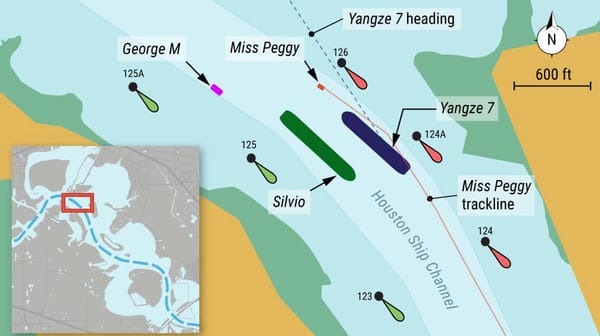
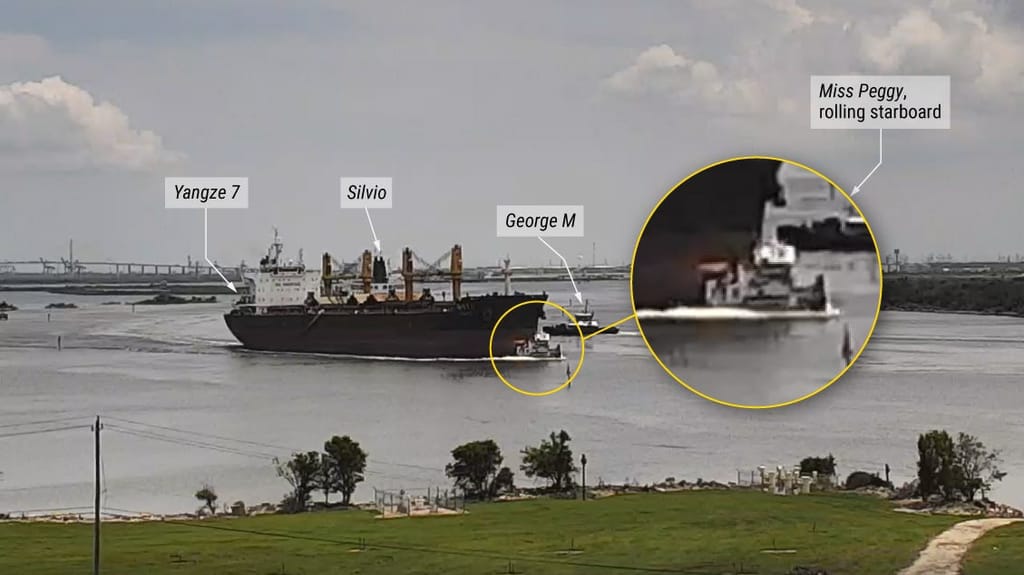
At about 1403:35, Yangze 7's bulbous bow hit the stern of Miss Peggy, which rapidly turned and rolled over on its starboard side. It happened so quickly that the towboat's master did not have time to sound the general alarm before water began flooding the pilothouse. One deckhand did not manage to escape the galley as the tug rolled onto its side; he did not survive. Two other sustained injuries, including one who needed intensive care treatment.
The George M - the good Samaritan tug that had tried to warn Yangze 7 - responded first to the scene of the casualty, and it used a rescue cradle to save the four survivors from Miss Peggy.
"Because the pilot on the Yangze 7 failed to maintain a proper lookout by all available means, his situation awareness while directing the movement of the bulk carrier in the Houston Ship Channel was degraded, resulting in him not detecting the Miss Peggy," said the NTSB.
NTSB also faulted the crew of the Yangze 7 for failing to maintain situational awareness and communicate their safety concerns to the pilot, as required by best-practice bridge resource management standards; the captain of Miss Peggy for failing to use all available means to detect the oncoming threat; and the pilot's association for not prohibiting personal cell phone use on watch. The agency did not fault the pilot conning Petrel, who had allegedly been on the other side of the "nonoperational" call while navigating a tanker.

that matters most
Get the latest maritime news delivered to your inbox daily.
Since the casualty, the Houston Pilots have added a rule that pilots should only use theuir personal phones to make calls related to “vessel safety, essential communications with other pilots, pilot transfers, Coast Guard, national security, law enforcement, or other professional purposes." The rule requires avoiding nonoperational uses of phones.
While the Coast Guard has issued repeated recommendations against cell phone use on watch, and many companies have policies prohibiting it, there is no federal regulation covering the practice.
