

Houthis Recapture Positions Overlooking the Bab el Mandeb
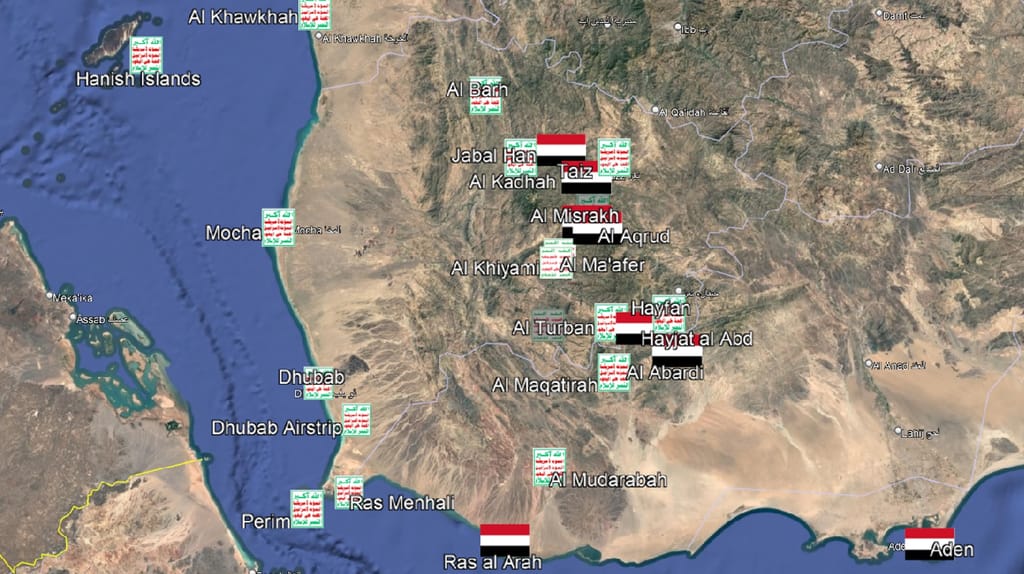
Fighting between the Houthis and forces of the Internationally Recognized Government (IRG) has continued without major advances or retreats on the Yemeni battlefield in recent weeks – until the IRG announced on November 15 that it was withdrawing from the Dhubab Airfield and the Bab el Mandeb area, leaving the Houthis free to once again occupy the Ras Menhali peninsula and Perim Island, dominating the southern entrance to the Red Sea.
The IRG explained that its withdrawal was prompted by the need to redeploy forces to defend Aden, giving a clear indication not only that the Houthis have made progress towards Aden from the northwest, but also that they may be tightening their siege of Taiz to the north. For several weeks now, the vital resupply route from Aden to Taiz has been threatened at its southern end, with access to Taiz only possible by using mountain tracks.
The surrender of the Bab el Mandeb back to the Houthis is a major reverse, and for the moment it appears that the IRG does not have the forces necessary to contest the recapture and mount a counter-attack. Possession of Perim Island in particular enables the Houthis to use a wider variety of means to control traffic in the Bab el Mandeb, the narrowest part of the Red Sea, and also traffic using the Maritime Security Transit Corridor (MSTC).
Rather than merely firing drones and missiles at passing ships from afar, the Houthis will now be able to use armed speedboats to attack and board ships, making it a much more practical operation to close down traffic. This they may wish to do at the prompting of the IRGC, which still maintains a mentoring on-the-ground presence alongside its Houthi allies, and at a time when the naval blockade of Iranian ships and ports is creating major internal pressures within Iran.

that matters most
Get the latest maritime news delivered to your inbox daily.
In recent weeks, the Houthis have not sought to exploit their tactical successes by shutting down general traffic in the Red Sea, instead proclaiming their intent only to target Saudi and Israeli-associated shipping. This has persuaded the United States, the European Union and major shipping lines to accept that the Houthis have no desire to disrupt shipping in the long term, and container lines have once again resumed using the Red Sea route.
However, the Houthis are desperately short of finance, and they see the potential to use the Bab el Mandeb to raise revenue, often quoting as a precedent the fees charged by Egypt on ships using the Suez Canal. The nations dependent on the use of the Red Sea as a major shipping route appear not to have considered that the Houthis may not be acting in good faith, and are merely waiting to act until they have consolidated their positions elsewhere in Yemen. Hence the EUNAVFOR Operation Aspides remains a force able only to mount occasional merchant ship escorts, and is not configured for more than limited defensive operations should the Houthis choose to tighten their control of the Red Sea.