


Galveston Continues Its Growth as a Cruise Homeport
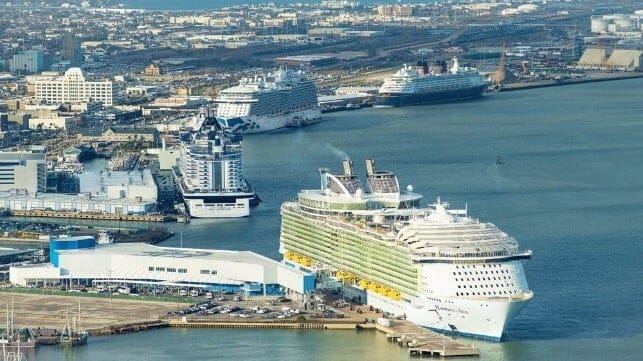
The Port of Galveston, Texas, continues to be one of the fastest-growing cruise homeports. Taking advantage of its geographic location and strong population growth in the Central United States, port officials highlight a steady growth trajectory over the past 25 years, while forecasting that cruising will continue to play a key role in the future development of Galveston.
“It seems like rapid growth, but it’s been measured and steady,” says Rodger Rees, Galveston Wharves port director and CEO. “In the last 10 years, we’ve doubled the number of passenger movements (embarkations and debarkations) from 1.9 million in 2017 to the 3.9 million forecast for 2026.”
Rees highlights that Galveston has been in the cruise business since 1990, when the port transformed a 1927 shipping terminal and warehouse into a cruise terminal. While the port continued to attract some cruise ships, it was really in the early 2000s that the business began to grow. Carnival Cruise Line homeported the original Celebration (built in 1987 and 47,000 gross tons) in the port in 2000, and the following year, Royal Caribbean International homeported its first ship (Rhapsody of the Seas with accommodations for 2,400 passengers) in Galveston.
The port took off as a homeport with more cruise lines deploying larger ships. Today, it is a year-round homeport to lines including Carnival, MSC Cruises, and Royal Caribbean. Others, including Disney Cruise Line and Norwegian Cruise Line, have seasonal deployments from Galveston.
Driving much of the growth is its unique geographic position, which gives Galveston easy access to the Central United States and a large drive market. Rees points out that the population in the drive-to-market has grown from 40 million just eight years ago to 46 million people and continues to expand.
The port has easy access to the ocean, can accommodate the largest cruise ships, and is also convenient to Houston’s airports. It is also unique among Texas ports in that it has a commercial area on the waterfront with a hotel, restaurants, and tourist attractions adjacent to its historic downtown, all of which add to the attraction for cruise passengers.
Recognizing both the opportunities and challenges of managing the growing cruise business alongside the commercial port, which is located on one of the nation’s top 40 cargo waterways, Galveston Wharves adopted a 20-Year Strategic Master Plan in 2019 to guide the overall development of the port.
Capital investments totaling $334 million have been made for the cruise industry, which include a doubling of the number of cruise terminals since 2022 to the current four dedicated, modern facilities. The Royal Caribbean International terminal opened in 2022, followed in 2023 by an expanded and improved terminal at Pier 25, which is the base for the Carnival Jubilee. A former cargo warehouse at Pier 16 was converted and opened in 2025 as a state-of-the-art terminal that serves both MSC Cruises and Norwegian Cruise Line. Galveston Wharves also invested $106 million in cargo expansion in the last two years.
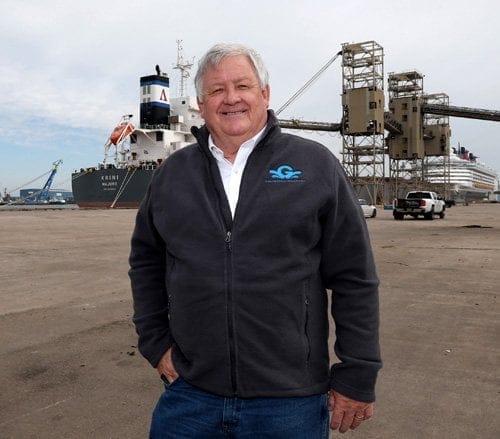
Rodger Rees, Galveston Wharves
“We’re the Port of Everything because we have grown cruise, cargo, and commercial segments,” says Rees. “By following our master plan, we consolidated our cargo activities on the west end of the port, which gives us greater efficiencies and expansion opportunities for all business sectors.”
Just last week, Galveston Wharves proposed a plan to develop 100 acres of land on Pelican Island for a new berth. It would become a multi-use berth that would support shipbuilding in Galveston, the port’s ro-ro cargo, and a much-needed LNG marine fuel bunkering operation that, in part, would support the cruise industry. Galveston is already homeport for the LNG-fueled Carnival Jubilee, and in 2027, Royal Caribbean will homeport in Galveston one of the world’s largest cruise ships, Icon of the Seas, which is also LNG-fueled.
“We’re working with cruise lines, energy companies, LNG bunkering developers, and others, to develop shore power and LNG bunkering services for the ships that call here,” says Rees.
As the rapid growth in cruise operations continues, Galveston Wharves has updated its master plan. Rees points to the recent announcement that Carnival Cruise Line will homeport a second, brand new 180,000 gross ton cruise ship, Carnival Tropicale, in Galveston starting in 2028.
Research indicates that the port could roughly double its passenger movements in the next decade to between 7 and 8 million in 2036.

that matters most
Get the latest maritime news delivered to your inbox daily.
“We’re in talks with a major cruise line interested in the port building a fifth cruise terminal,” says Rees. “We’ve also been approached by cruise lines that want to come into our market or want to expand their seasonal sailings. We continue to grow year-over-year because we can accommodate larger ships with unrestricted access to the Gulf.”
Galveston’s Master Plan forecasts that the port is on track to reach more than 10 million passenger movements annually by 2045. Rees notes that to realize this growth, the port will need two or possibly three more terminals.
