
"Energy Dominance" In Action
Middle East crisis has made the U.S. the marginal supplier
The crisis in the Middle East and in particular the effective closure of the Strait of Hormuz has upended global oil markets. Both crude oil and refined products are now in short supply. Refiners around the world are desperate to get their hands on alternative sources of crude oil, almost at any price. However, the options are limited and dwindling. The volume of Russian and Iranian oil in floating storage is shrinking fast since the U.S. has lifted some of its restrictions, allowing countries to buy these previously sanctioned barrels. Several countries have tapped into their strategic petroleum reserves, but most of this oil is being allocated to domestic refiners and not traded internationally. So, the focus has shifted to the Atlantic Basin, where several producers (Venezuela, Canada, Brazil) have some capability to ramp up production and exports. However, in this Weekly Tanker Opinion we want to highlight the United States.
The United States is by far the largest oil producer in the world. In 2018 it surpassed Russia and Saudi Arabia due to advancements in hydraulic fracturing (fracking) and horizontal drilling. U.S. crude oil exports, which (re)started in earnest after the crude export ban was lifted about 10 years ago, quickly ramped up from 500,000 barrels per day in early 2016 to average more than 4.0 Mb/d in 2023 and 2024. According to data released by the U.S. Energy Information Administration (EIA) on Wednesday, exports climbed to 5.2 million bpd, the highest in seven months. This was due to record demand from Asian and European buyers, who are scrambling to replace barrels from the Middle East that are trapped inside the Persian Gulf because of the war.
U.S. crude oil exporters are expanding their reach. Greece has bought U.S. crude for the first time ever, while Turkey bought a cargo for the first time in a year. The one limitation that could cap the U.S. export potential is the specifications of the U.S. crude. West Texas Intermediate (WTI), the main U.S. export, is a light sweet crude, while the refiners are trying to replace medium sour barrels from the Middle East. Mars crude is a medium sour grade produced in the U.S. Gulf of Mexico, but its production volumes are limited.
At the same time as exports surged, U.S. crude imports took a dive. Imports from Canada were at their lowest level for this year. Flows from Saudi Arabia and Iraq were down significantly as well, for obvious reasons. As a result, net imports of crude oil (the difference between imports and exports), narrowed to 66,000 barrels per day last week, the lowest on record in weekly data that goes back to 2001. This means that the U.S. nearly turned into a net crude exporter last week for the first time since World War II. Exports are expected to increase significantly in the coming weeks and this switch to a net exporter could become reality.
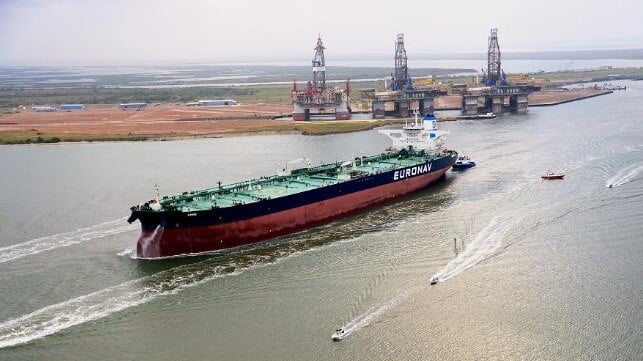
However, as a result of this ramp up in flows, the U.S. is approaching its export capacity. The U.S. is capable to export up to 6.0 Mb/d, according to estimates from industry experts. Pipeline capacity and export infrastructure are the limiting factors. U.S. exporters have become very adept at maximizing exports with a combination of direct loadings in U.S. Gulf ports and reverse lightering in designated areas offshore. However, outside of Corpus Christi, which can partially load a VLCC (only one reverse lightering needed), the Louisiana Offshore Oil Port (LOOP) is the only U.S. facility in the U.S. Gulf that can fully load a VLCC. More deepwater terminals are being planned, but none are available during this crisis.
U.S. refiners have also ramped up production and exports, motivated by strong refining margins and high crack spreads. In recent weeks, we have seen seaborne clean product exports (excluding LPG, lubes and chemicals) exceed 3.5 Mb/d driven by increased flows to Asia. These volumes represent record-highs.

that matters most
Get the latest maritime news delivered to your inbox daily.
The booming crude oil and refined product exports from the U.S. have benefited all tanker segments. The desire to get access to barrels (and get them quickly) has motivated certain Asian charterers to import crude from the U.S. Gulf on Aframaxes, routing it via the Panama Canal. These are not trades you would expect to see in normal circumstances, but these are not normal circumstances. When the conflict ends, vessels will reposition and eventually normal trade patterns will resume. Until that time, we do expect increased volatility and higher freight rates for most tanker segments to continue.
This research note appears courtesy of Poten & Partners.
The opinions expressed herein are the author's and not necessarily those of The Maritime Executive.