

Achieving Criticality
Nuclear power for ships reaches a tipping point.
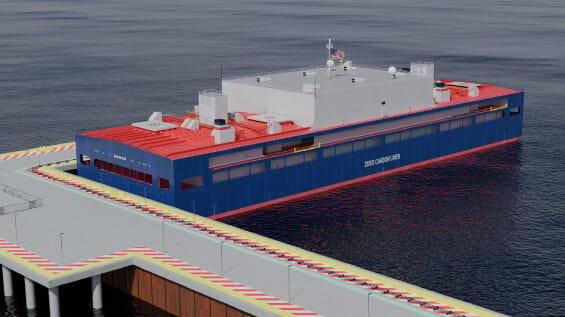
(Article originally published in Sept/Oct 2026 edition.)
NS Savannah was the world’s first nuclear-powered merchant ship.
Launched in 1959 under President Eisenhower’s Atoms for Peace program, she demonstrated how nuclear energy could power peaceful trade across the world’s oceans. But her bulky reactor installation, extensive shielding, and high construction and operating costs made her commercially uncompetitive.
Seventy-seven years later, the business case for nuclear is changing rapidly.
SMRS
Portable nuclear power has the potential to transform commercial shipping by cutting emissions, increasing cargo capacity and changing the economics of vessel speed. The technology is closer than many assume, but insurance, liability, port access and public perception remain bigger obstacles than reactor design.
The truth is that the design of modern SMRs – or Small Modular Reactors – don’t carry the same level of risk as the large nuclear power plants of yesterday. The technology is right-sized, and the fuel used is far less hazardous.
Yet a small amount of this fuel can deliver tens of thousands of times more energy than traditional marine diesel, gram for gram.
The business case is compelling, and the sector is poised to make the biggest advance towards widespread adoption in a generation – thanks largely to a pro-energy administration in Washington and a group of forward-thinking technology companies aggressively advancing the agenda.
The maritime sector is about to achieve criticality.
NUCLEAR IN A NUTSHELL
In a traditional diesel engine, power is generated when fuel, air and heat are combined. The resulting explosion is harnessed and turned into motion by the pistons, which turn the crankshaft. That final rotation can then be used to turn propellors or spin a generator to produce electricity.
A nuclear reactor is also a power-generating device.
The fuel in this case is uranium, which is formed into pellets and sealed inside fuel rods that are immersed in a cooling fluid. The nuclear reaction starts when a neutron source is introduced to the uranium and strikes a fissile atom, causing the atom to split. This releases heat and more neutrons, which begin striking the available atoms and begin the cycle.
Criticality is achieved when each round of fission produces enough neutrons to drive the next round and the process becomes self-sustaining. It’s like a flywheel that starts slowly but eventually begins to spin smoothly.
This nuclear reaction generates an immense amount of heat using small amounts of fuel that can be used to drive a turbine and generate electricity or propel a ship.
REGULATORY SUPPORT
In May of 2025, President Trump issued an Executive Order titled, “Reforming Nuclear Reactor Testing at the Department of Energy.” In it, he laid out a challenge: Achieve criticality by July 4, 2026, in time for America’s 250th anniversary.
“The renewed momentum behind maritime nuclear comes from the convergence of technology, economics and political appetite,” says Virginia Crosby, CEO of the Nuclear Energy Maritime Organization (NEMO). “Advanced reactors are becoming smaller, safer and more suitable for maritime use. The cost and practical limitations of alternative fuels are becoming clearer, and governments increasingly recognize that maritime decarbonization must also deliver energy security and economic growth. For the first time, these three forces are moving in the same direction.”
Houston-based startup Deployable Energy (“Deployable”) answered the call, achieving criticality in just 155 days. It accomplished this by rethinking system constraints and using readily available supplies in a new and innovative fashion.
HACKING THE SUPPLY CHAIN
There are many ways to split an atom, but most aren’t accessible in the marine space due to fuel availability, size constraints and the economics of building large offshore reactors.
This is where Deployable CEO Bobby Gallagher focused his energy and developed an elegant solution.
A fourth-generation veteran, Gallagher began his adult life in the Australian military at the height of the War on Terror, employing IED countermeasures on the ground to keep the troops safe. Later, he transitioned to the oilfield, building drillships in major yards across Asia and developing a kinetic blowout stopper (K-BOS), which was adopted across five continents in as many years.
He then turned his attention to nuclear power generation, which he saw as the only solution to the increasing power demands offshore. He identified the nuclear supply chain as the existing constraint.
Enriched uranium is incredibly powerful but is intensely controlled and not readily available and requires large freshwater reactors to be forged to contain it. So he looked for inspiration at earlier designs that didn’t require enrichment.
The resulting 1MWe system is similar to a small CANDU (Canada Deuterium Uranium) reactor: a Canadian-designed, pressurized heavy-water reactor that generates electricity using natural, unenriched uranium fuel and heavy water as a coolant and moderator. It’s easily constructed by the existing American workforce using non-exotic materials and leverages the existing light water reactor supply chain to obtain readily available enriched uranium as fuel.
Known as the “Unity Nuclear Battery,” the 1MWe system and its auxiliary systems fit inside a 20-foot container that can be easily fitted to a variety of vessels, making installation, operation and maintenance a relatively simple task.
PARTNERING UP
With the technology firmly in place, the next step was to set sail under nuclear power. For this, Deployable needed a reliable partner.
In August 2026, Hornbeck Offshore Services, Inc. (“Hornbeck”), a leading offshore marine services company, partnered with Deployable to test and use nuclear microreactors for maritime and offshore power. The two companies signed a memorandum of understanding with the goal of lowering operating costs by using clean, reliable nuclear power options.
While on the surface Hornbeck is a vessel operating company, it considers itself a technology company and has a long history of innovation.
“We’ve always been a technology company,” says Jacob Hornbeck, Business Development Manager, “and have led the way in this space. Our engineering teams provide solutions to the most complex marine problems in the world.”
Hornbeck’s September 2026 all-stock merger with Helix Energy Solutions Group expands this technical expertise into the subsea well-intervention and robotics market, supported by Hornbeck’s fleet of high-specification specialty vessels.
Immediately following the merger, Hornbeck returned to the New York Stock Exchange under its former ticker, HOS, unlocking access to capital markets and enabling it to rapidly advance its push into this new, nuclear-powered frontier.
PREPARING FOR SEA TRIALS
The National Reactor Innovation Center (NRIC) is the oversight body that will bridge the gap between nuclear concepts and commercial deployment. It’s selected Deployable and Hornbeck to conduct a Nuclear Energy Launch Pad USA maritime demonstration.
For the first time in over 50 years, a nuclear reactor will set sail on a commercial vessel.
While the exact vessel is not yet identified, Hornbeck and Deployable have targeted five sectors in their MOU: inland waterways, offshore, power barges, floating datacenters and national security logistics/automation.
Watch this space for developments on this historic testing program!
INTO THE FUTURE
The nuclear technology underpinning this accelerated development cycle is well-proven – from the first commercial nuclear-powered ship in the 1960s to the present day. While questions remain around topics like licensing, jurisdiction, classification, crew training, security and safeguards, the time has never been better to bring the international community together and advance the nuclear option. The existing maritime framework, such as SOLAS and MARPOL, provides a firm foundation upon which to build, yet more specific guidance and agreement will be required.

that matters most
Get the latest maritime news delivered to your inbox daily.
Collaboration between organizations such as NEMO, vessel operators like Hornbeck and mold-breaking technology companies like Deployable will ensure that safe, reliable and efficient nuclear power becomes an integral part of the modern energy mix.
Sean Hogue is Executive Vice President at Baker Marine Solutions.
The opinions expressed herein are the author's and not necessarily those of The Maritime Executive.