


Maritime Renaissance
Governments around the world are investing billions in future maritime capabilities. But fleets of ships only imply maritime power. Education and training will determine whether a nation possesses the workforce necessary to transform ambition into reality
(Article originally published in July/Aug 2026 edition.)
Amid volatile geopolitics and fast-paced innovation, maritime education has evolved as part of a much larger strategic challenge.
Governments around the world are dedicating significant resources to shipbuilding, domestic manufacturing, resilient supply chains, clean energy and autonomous technologies. In the U.S., recent federal initiatives directed toward revitalizing the nation's maritime industrial base have renewed focus on commercial and naval shipbuilding, port modernization, offshore energy and strategic sealift.
The renewed emphasis on the maritime industry has fundamentally changed the workforce conversation.
Success is increasingly dependent on personnel with diverse skills capable of designing, building, operating and maintaining increasingly sophisticated vessels and the related maritime infrastructure. With demand growing, the challenge is not simply finding enough people but finding people with the right combination of technical skills and digital literacy.
Maritime education has historically been measured by a single, clear metric: Produce enough licensed mariners to crew the world's merchant fleets. That mission, although still critical, is no longer sufficient. Ships are evolving into floating data centers where automation, artificial intelligence (AI), predictive maintenance and cybersecurity are becoming critical elements of a new version of seamanship.
The challenge comprises more than the shipboard mariners. While shipyards still require welders, pipefitters and electricians, these skills must now be integrated with expertise in automation and digital manufacturing. And, of course, ports themselves are becoming technology platforms.
BEYOND THE LICENSE PATH
To align with developing industry needs, maritime academies and institutes are educating not only ship operators but also the technology professionals, logisticians and emergency managers required to support the wider maritime enterprise.
In the U.S. and globally, the wide variety of maritime training centers are diversifying their approach, supporting and developing different components of the industry's workforce ecosystem. Collectively, they're redefining what a maritime education looks like.
At Massachusetts Maritime Academy, this paradigm shift is apparent. Roughly half of the academy's undergraduate students pursue licensed programs. The remainder study facilities engineering, international maritime business, emergency management and environmental protection, among other tracks.
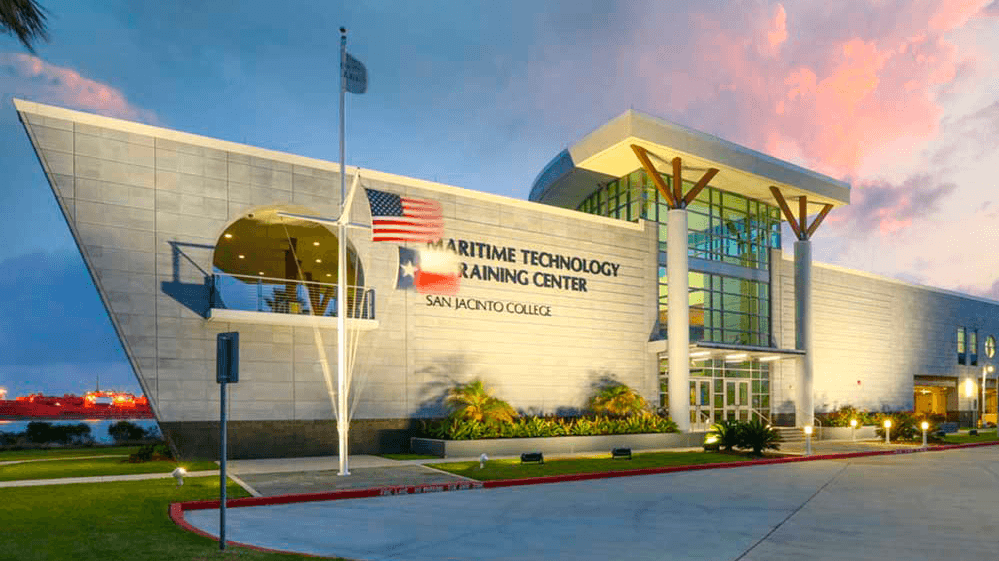
"The maritime workforce challenge extends far beyond licensed mariners," says John Stauffer, Associate Vice Chancellor of Maritime at San Jacinto College. "Across the Gulf Coast and throughout the nation, employers need workers who understand automation and digital systems."
Workforce development has become both an economic development priority and a national security imperative. As Congress debates measures to expand domestic shipbuilding capacity and strengthen the U.S. Merchant Marine, education providers are increasingly viewed as strategic partners rather than simply academic institutions. Their role is multidimensional: Identify workforce shortages and potential gaps in curricula; create pathways that allow students to enter modern, high-demand careers, and continue to build workers' core skills throughout their professional lives.
"We see this as a natural extension of our mission," states Capt. Elizabeth Simmons, Vice President, External Affairs at Mass Maritime. "We embrace the opportunity to work alongside shipyards, maritime companies, governments, technical and trade schools, community colleges, workforce development organizations and other educational groups to develop the workforce America will need to strengthen its maritime industrial base for generations to come."
THE DIGITAL MARINER
Technology is driving perhaps the most dramatic transformation in maritime education.
AI, integrated bridge systems, remote diagnostics, digital twins and advanced automation are among the innovations becoming ubiquitous aboard modern vessels. At the same time, training itself is becoming increasingly digital through sophisticated simulation, virtual reality and cloud-based learning environments.
While many in the industry fear that these innovations may overshadow traditional seamanship, educators argue these technologies demand even greater critical thinking to complement existing skills.
Mass Maritime rejects the notion that institutions must choose between traditional seamanship skills and AI. Rather, graduates must master both.
"Ignoring this technology," notes Jim McKenna, Dean of Undergraduate Studies, "is a disservice to our students. We've been preparing students for careers supporting sealift capability, commercial shipping, offshore energy, logistics and maritime business for many years. Our mission isn't changing, but the demand for our graduates and the investment required to prepare even more of them is."
Adds San Jacinto's Stauffer: "Maritime education must evolve from teaching only procedures toward teaching systems thinking, problem-solving, data interpretation, leadership and continuous learning. Technology will change throughout a professional's career. The ability to adapt will become as important as technical proficiency itself."
SHARED RESPONSIBILITY
Much of the attention surrounding America's maritime revival focuses on the ships themselves. Yet vessels cannot be designed, built or operated without people.
That philosophy reflects a growing consensus. Workforce development is becoming a shared responsibility across educators at every level – from maritime schools and academies to labor organizations, shipbuilders, ports and private industry.
"Community colleges must serve as the workforce engine supporting America's maritime industrial base," says Stauffer. "We're uniquely positioned to provide accessible, affordable, employer-responsive education."
Industry partnerships are essential. Located within the Houston maritime complex, San Jacinto works directly with vessel operators, shipyards, engineering firms and manufacturers, whose feedback influences training and education at the school.
"Industry engagement is central to everything we do," Stauffer notes. "Employers participate in advisory committees supporting internships, donating equipment and providing insight on workforce needs and curricula."
Recent disruptions across the supply chain due to regional conflicts and growing geopolitical competition have reminded policymakers that commercial shipping remains fundamental to national security. These events highlight the importance of maintaining a highly skilled domestic maritime workforce as part of a larger strategic role.
Mass Maritime and other maritime academies maintain close partnerships with MARAD, the Military Sealift Command and the U.S. Navy, reinforcing the inextricable relationship between commercial maritime and national defense. "Maintaining a strong pipeline of well-trained, licensed mariners – not just ships – is crucial regarding both geopolitical tensions as well as disaster relief across the globe," states Capt. Simmons.
GLOBAL PERSPECTIVE
These underlying trends are global. Training institutions around the world are making similar investments in innovation while strengthening relationships with industry to ensure graduates remain relevant in rapidly changing operating environments.
Perhaps the biggest lesson from all of this is that maritime education is no longer a one-time event capped with a diploma or license – and no longer limited to one part of the industry. "The skills are highly transferable across sectors," adds Capt. Simmons. "We need to do a better job of demonstrating that maritime isn't a single career path. It's opening the door to an entire ecosystem of career opportunities."
Commercial and military fleets only symbolize maritime power. Ships alone do not move commerce, respond to disasters or strengthen national resilience. These responsibilities still ultimately belong to the indispensable human element.
As governments around the world invest in industrial capacity, they're inevitably returning to the knowledge that the most important investment is not steel but talent. And much of that investment must focus on training and skills development for an evolving industry.

that matters most
Get the latest maritime news delivered to your inbox daily.
Education is no longer simply preparing students for careers. It's building the workforce that will determine whether the next maritime renaissance succeeds.
Chad Fuhrmann is Vice President at Core Group Consulting.
The opinions expressed herein are the author's and not necessarily those of The Maritime Executive.
